Current reading edition
English translation
Square brackets mark uncertain words or editorial explanations. Songs are translated for meaning; their speakers are not necessarily the writer.
Download the English text ↓Page 1 — Contact restored
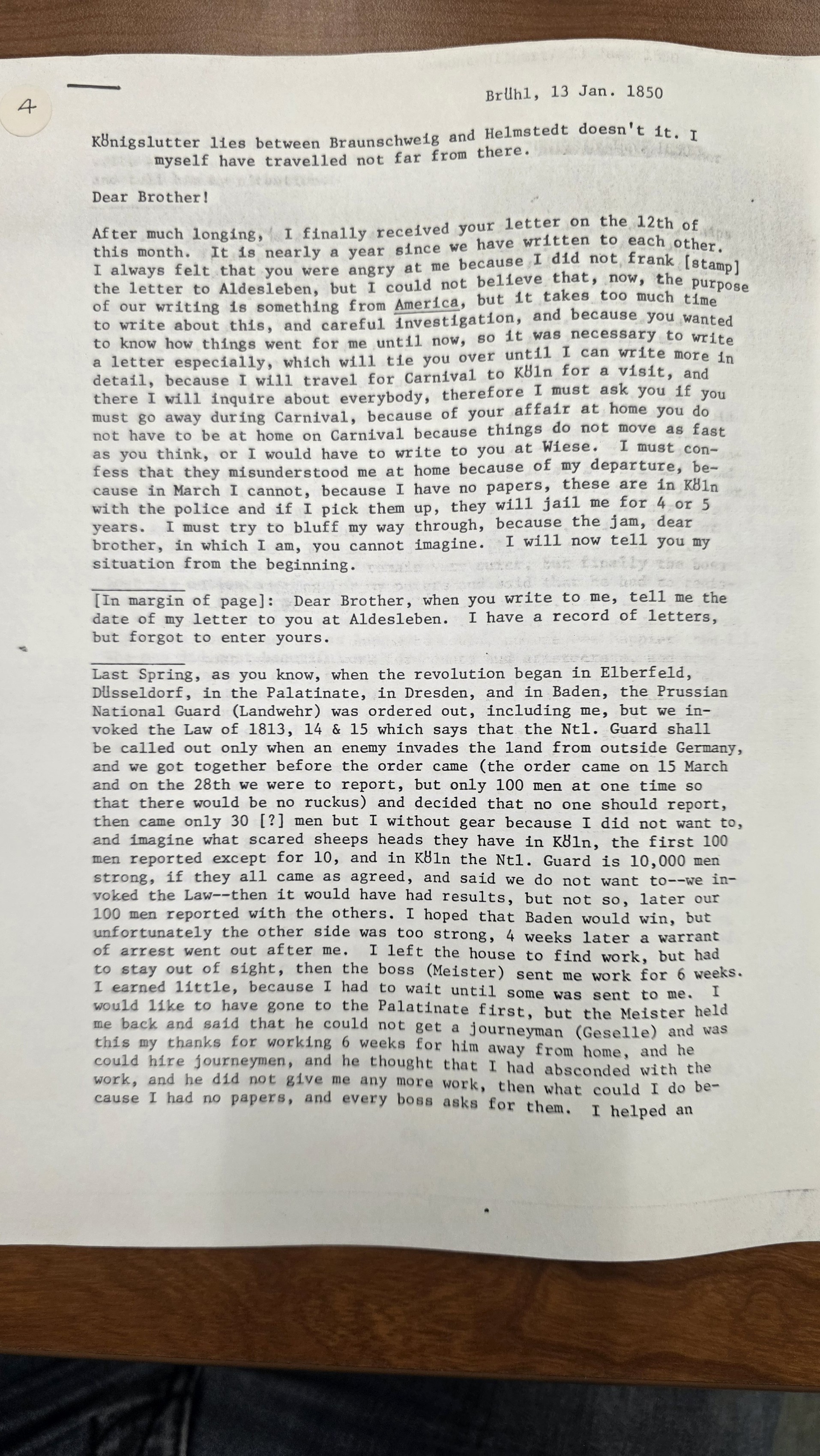
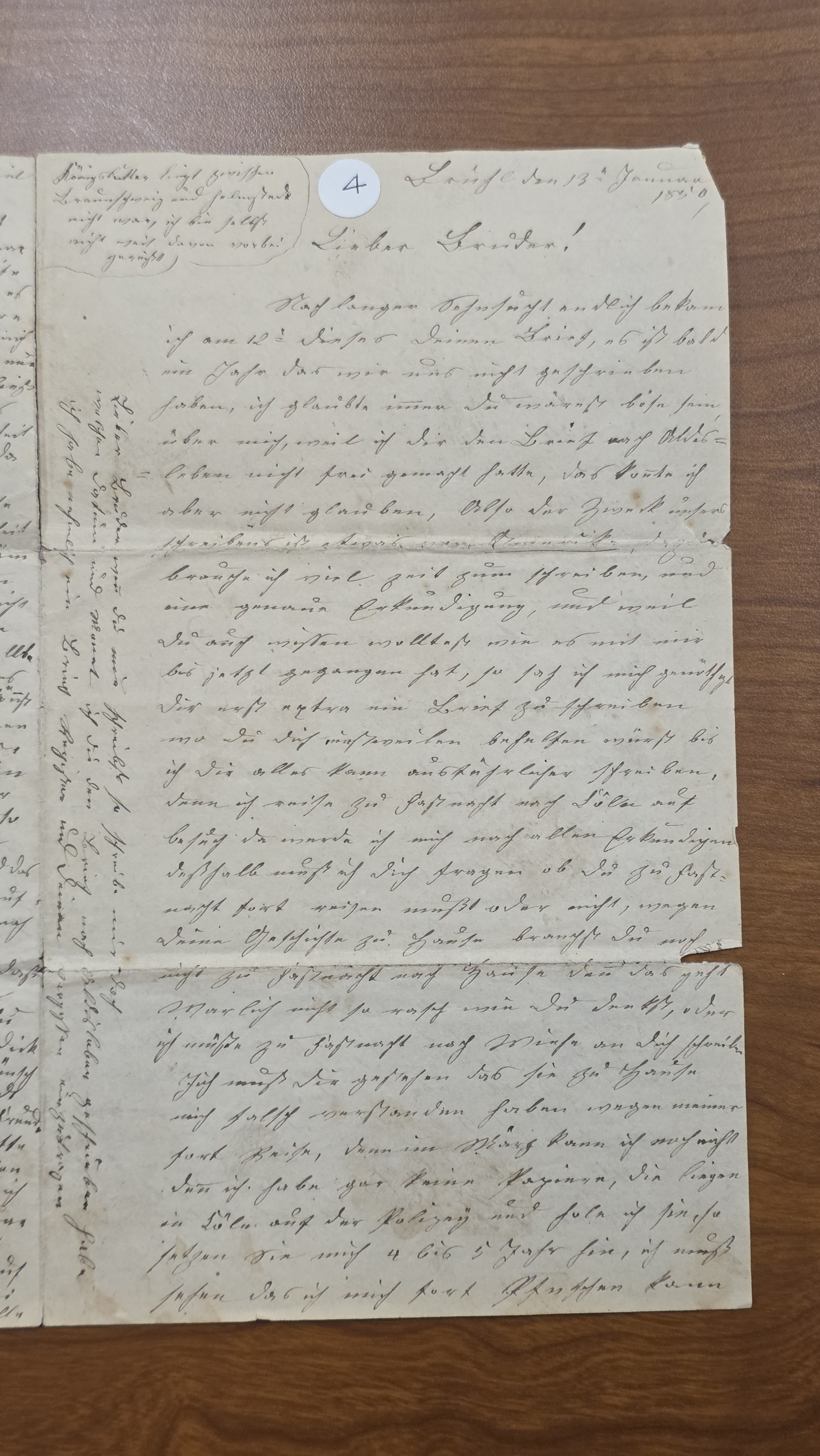
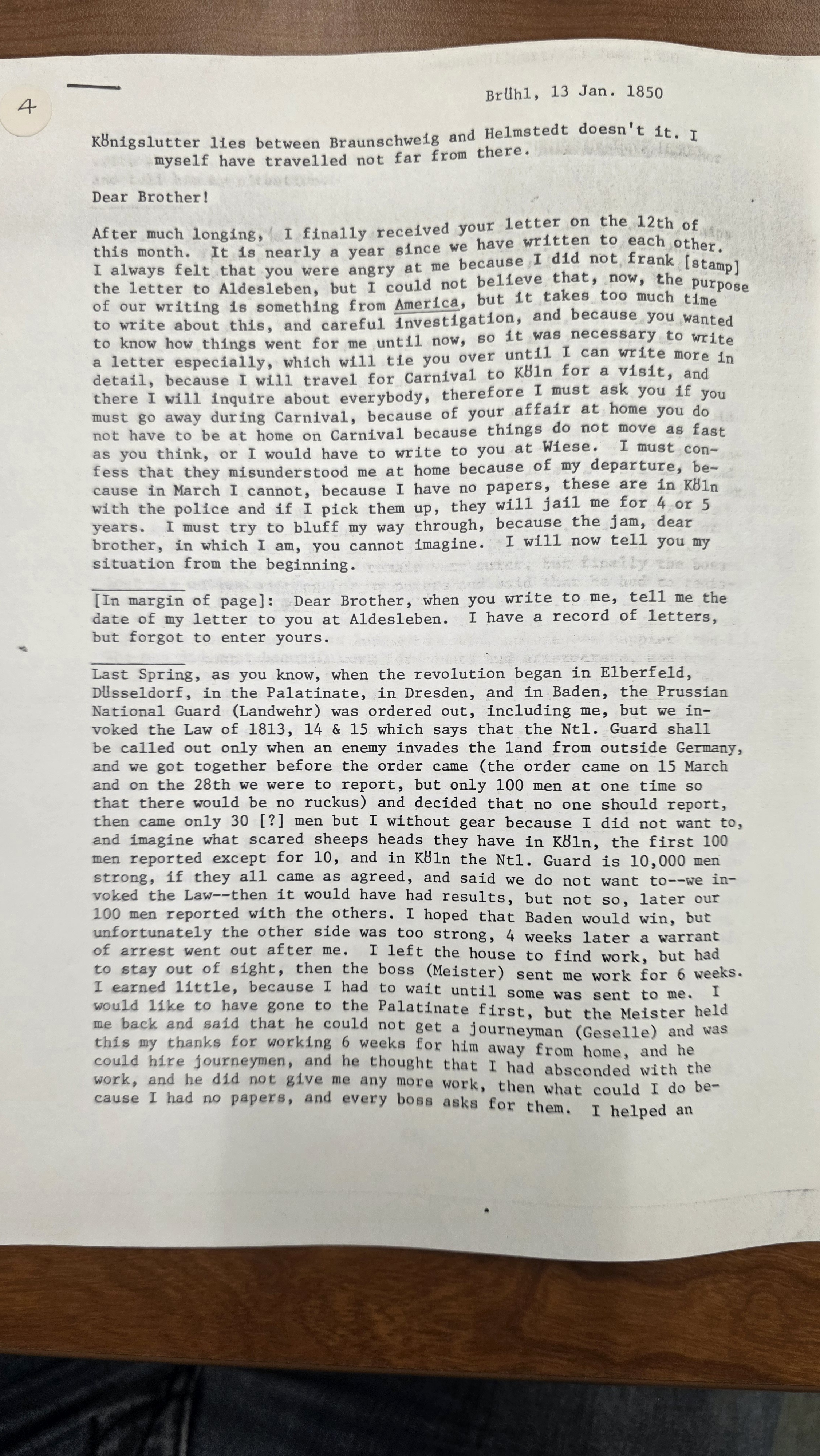
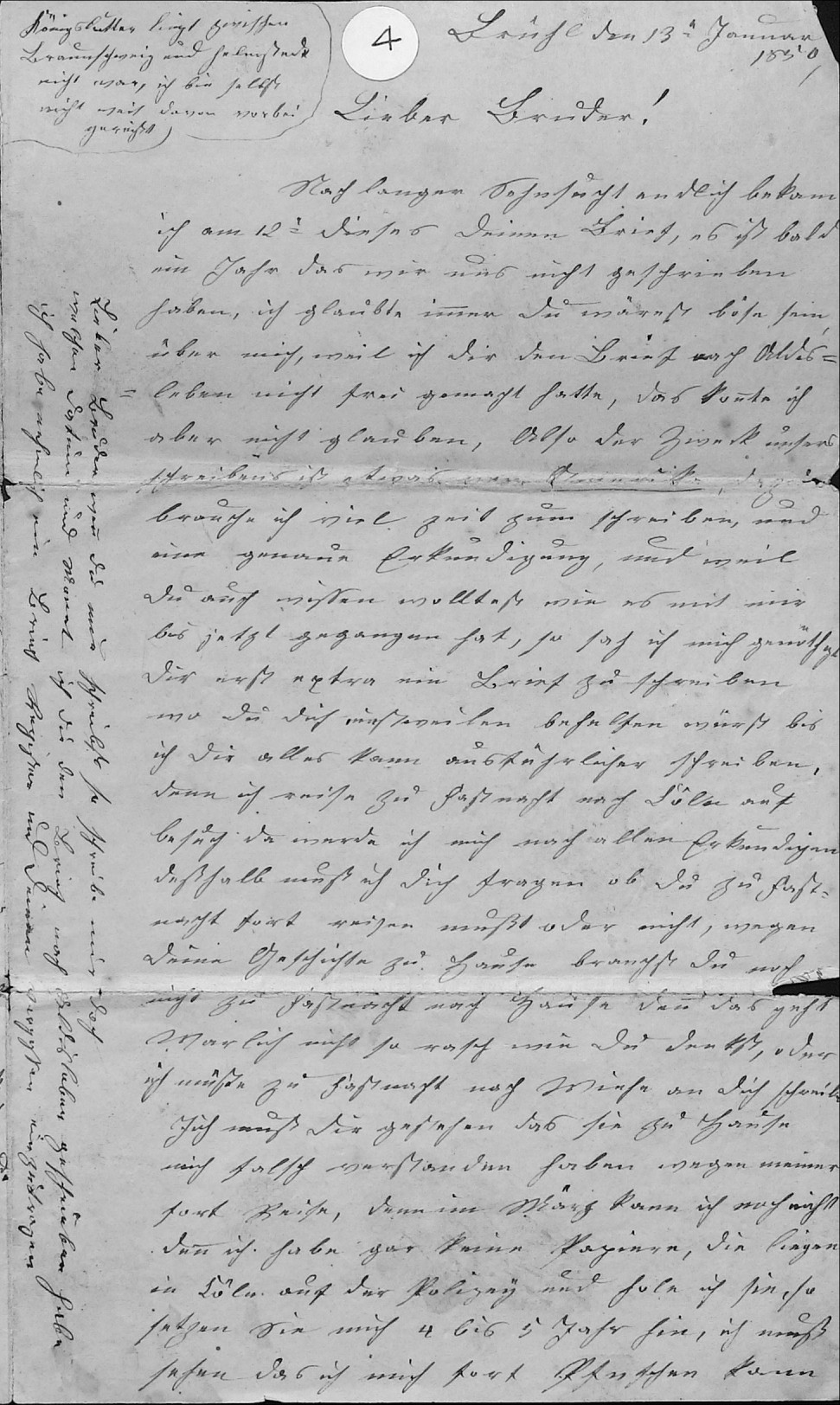
Brühl, January 13, 1850
Dear Brother,
After longing for it for so long, I finally received your letter on the 12th of this month. It is almost a year since we have written to each other. I kept thinking you might be angry with me because I had not prepaid the postage on the letter I sent you in Oldisleben, but I could not really believe that.
Now, the purpose of our correspondence is [words obscured at the fold]. I need a good deal of time to write, and to make careful inquiries. Since you also wanted to know how things have gone with me up to now, I felt obliged to write you a letter first that you must make do with for the time being, until I can write everything more fully.
I am going to Cologne for a visit at Carnival [Fastnacht], and there I shall inquire about everything. Therefore I must ask whether you have to leave at Carnival or not. As far as your affairs at home are concerned, you do not yet need to go home at Carnival, because things certainly do not proceed as quickly as you think. Otherwise I would have to write to you in Wiehe at Carnival.
I must tell you that they have misunderstood me at home about my departure. I cannot leave in March yet, because I have no papers at all. They are with the police in Cologne, and if I collect them they will lock me up for four or five years. I must see how I can get away.
Page 2 — Why he refused the military call-up
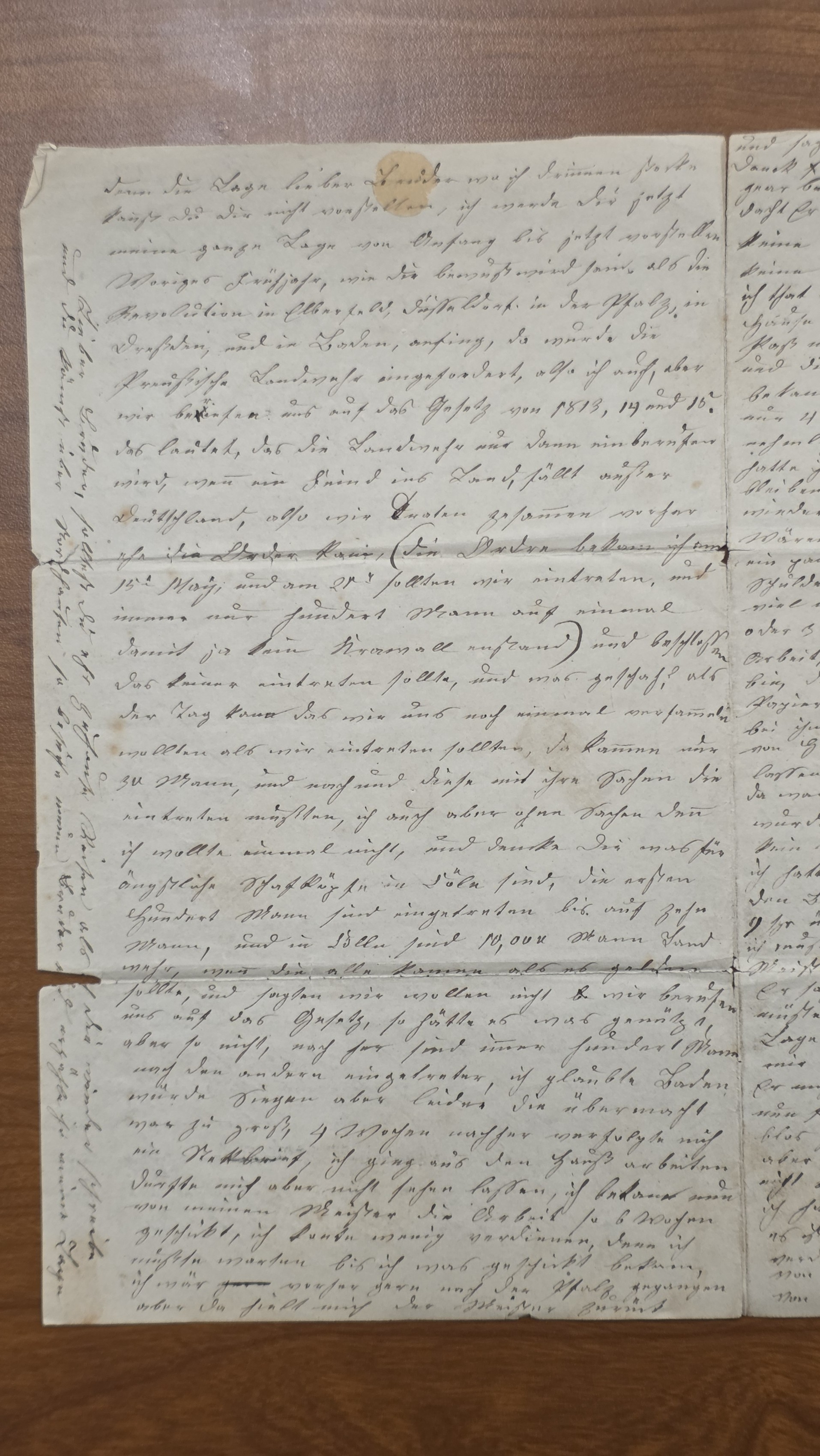
For you cannot imagine, dear brother, the situation I am in. I shall now describe my whole situation from the beginning up to the present.
Last spring, as you will probably know, when the revolution began in Elberfeld, Düsseldorf, the Palatinate, Dresden and Baden, the Prussian Landwehr was called up, and so was I. But we appealed to the law of 1813, 1814 and [final year uncertain], which says that the Landwehr is to be called up only when an enemy from outside Germany invades the country.
So we met together before the order came. I received the order on [the 15th; month disputed], and we were to report on [the 27th or 28th], always only one hundred men at a time, so that no disturbance could arise. We resolved that none of us should report.
And what happened? When the day came for us to assemble once more, when we were supposed to report, only thirty men came—and these even brought their belongings, intending to enter service. I came too, but without my belongings, because I was determined not to go.
Just imagine what frightened [scoundrels—insulting word not entirely certain] there are in Cologne! Of the first hundred men, all but ten reported. There are ten thousand Landwehr men in Cologne. If they had all come, as they were supposed to do, and said, “We will not go; we appeal to the law,” it would have done some good. But not like this. Afterwards they kept reporting, one hundred after another. I believed Baden would win, but unfortunately the opposing force was too great.
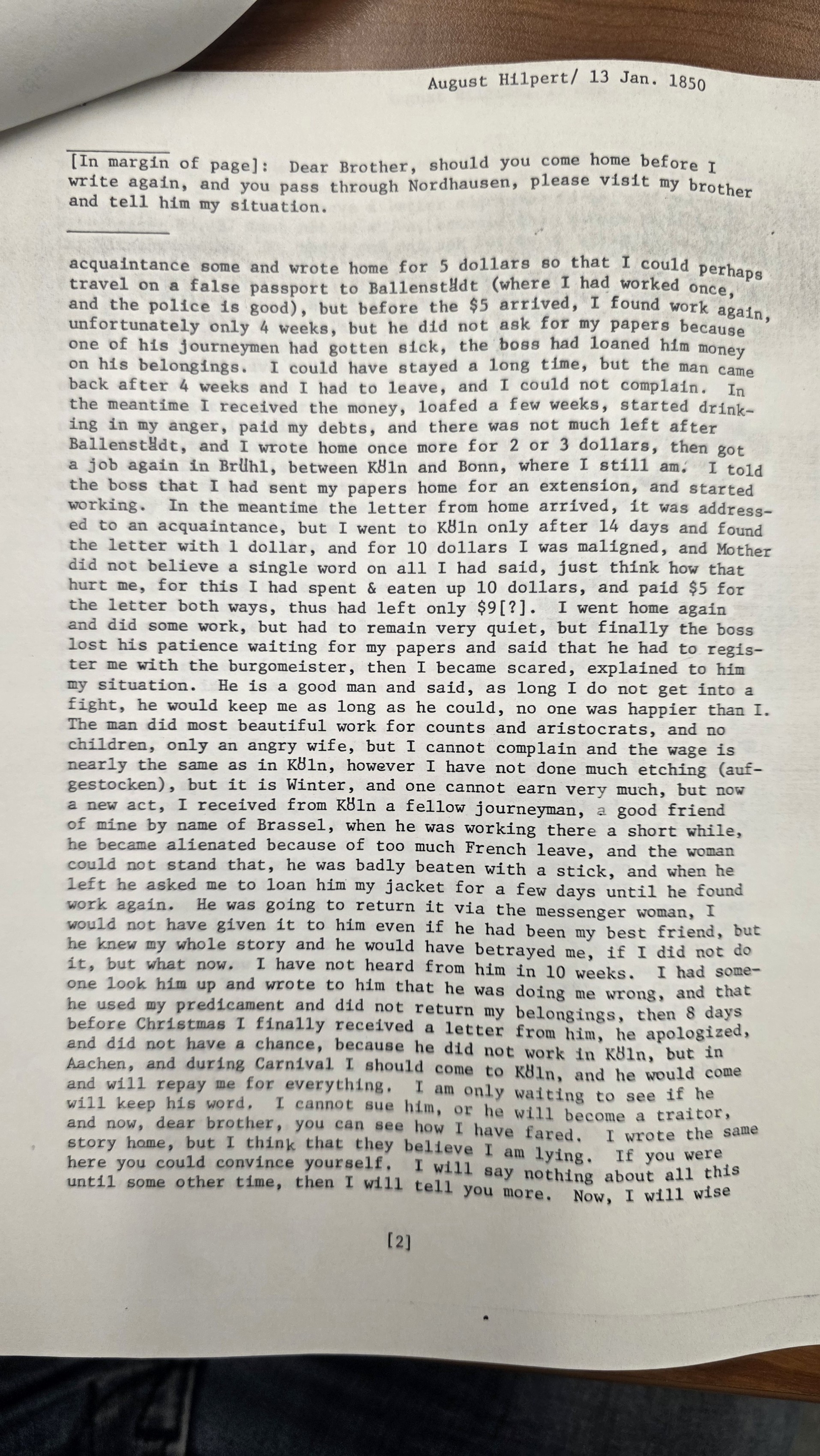
Four weeks later I was being pursued [the word naming the pursuer is overwritten/uncertain]. I went out to work away from the house, but could not let myself be seen. For about six weeks I had work sent to me by my master. I could earn little, because I had to wait until something was sent. I would have liked to go to the Palatinate, but the master held me back—
Page 3 — Uncertain work and a sympathetic employer
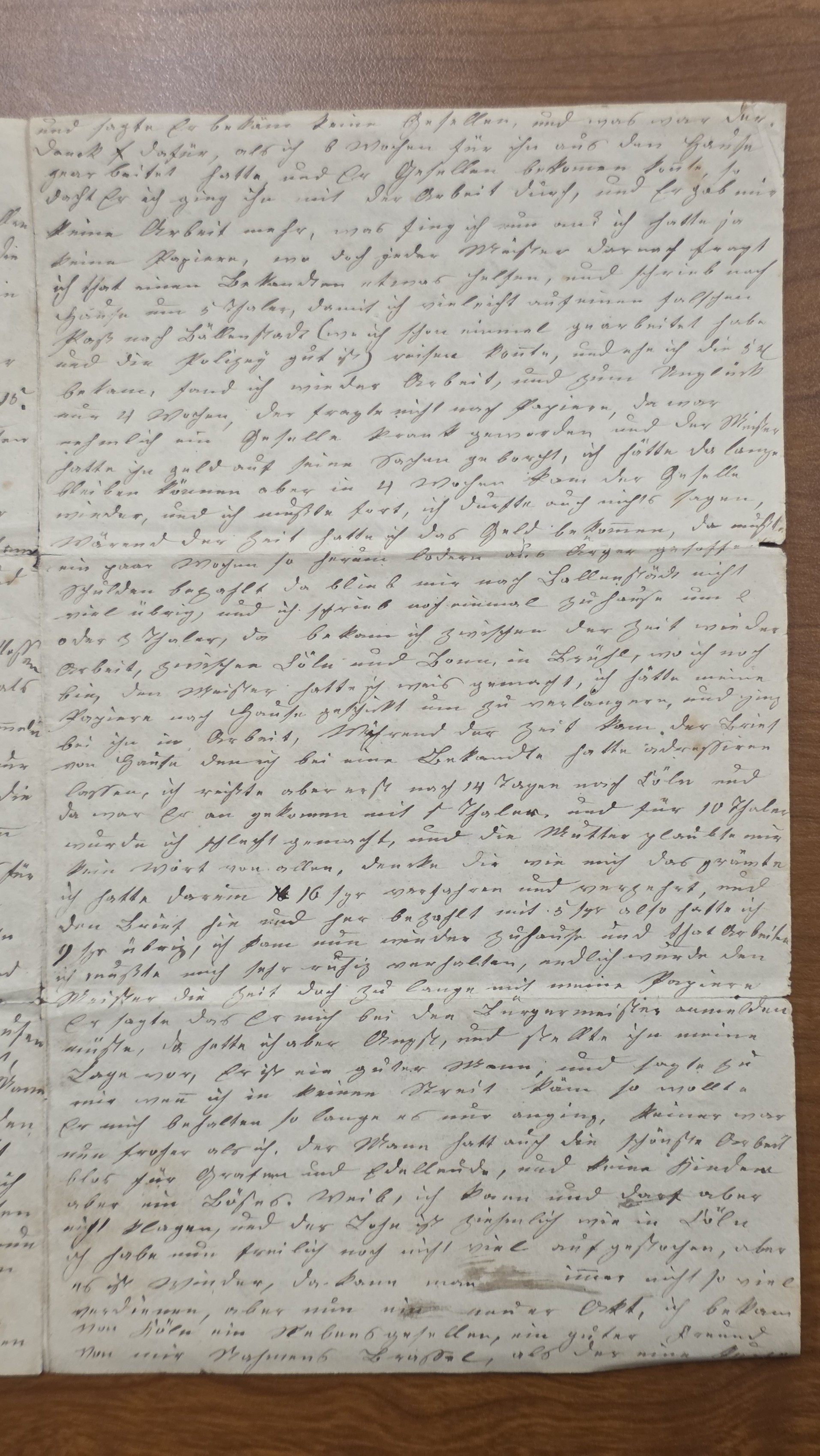
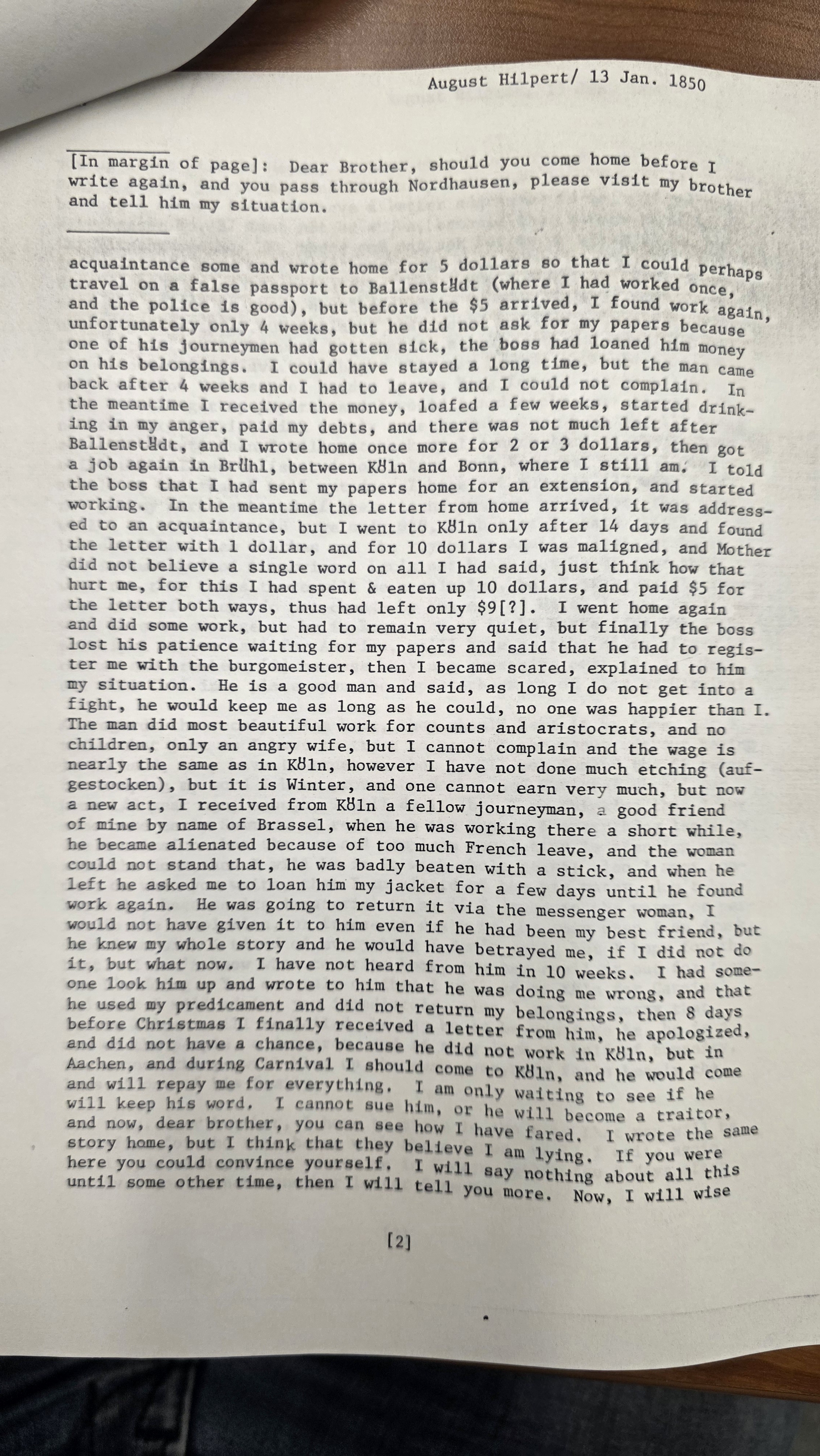
—and said he could not get any journeymen. And what thanks did I receive? After I had worked for him away from the house for six weeks, and he had obtained journeymen, he thought I might run off with the work, and gave me no more work.
What was I to do now? I had no papers, which every master asks for. I helped an acquaintance a little and wrote home for five thalers, so that perhaps I could travel on a false passport to Ballenstedt, where I had worked before and where the police are good [apparently meaning accommodating].
Before I received the five thalers, I found work again—and, to my great delight, only for four weeks! That master did not ask for papers. A journeyman had fallen ill, and the master had lent him money against his belongings. I might have stayed there a long time, but after four weeks the journeyman returned, and I had to leave. I could not object.
Meanwhile I had received the money. I had to live on it for a couple of weeks, [crossed-out/damaged words], and pay debts. There was little left for Ballenstedt. I wrote home once more for two or three thalers. In the meantime I again found work, between Cologne and Bonn, in Brühl, where I still am. I led the master to believe that I had sent my papers home to be extended, and began working for him.
During this time the letter from home arrived. I had arranged for it to be addressed to an acquaintance, but only after fourteen days did I travel to Cologne. There it was, with one thaler—and I received ten thalers' worth of abuse! Mother did not believe a word of it all. Imagine how that upset me.
I had [16?] silver groschen advanced to me and spent them, and paid three silver groschen for the letter there and back, so I had [9?] silver groschen left. [The figures and currency calculation need confirmation; the remaining amount must not be treated as exact.] I returned to Brühl and worked here, having to keep myself very quiet.
At last the master grew impatient about my papers. He said he had to register me with the mayor. That frightened me, and I explained my situation to him. He is a good man, and told me that if I could do fine work, he would keep me as long as it was possible. No one was happier than I was.
The man has the finest work, all for counts and noblemen. He has no children. [A clause about his wife or household remains uncertain.] I cannot and must not complain here, and the wages are about the same as in Cologne. Admittedly I have not yet saved much, but it is winter, when one cannot earn as much. [A few words are damaged/uncertain.] I acquired a fellow journeyman from Cologne, a good friend of mine named Brassel, a few weeks ago. When he had been here a short—
Page 4 — The missing coat, concealed letters and hopes of freedom
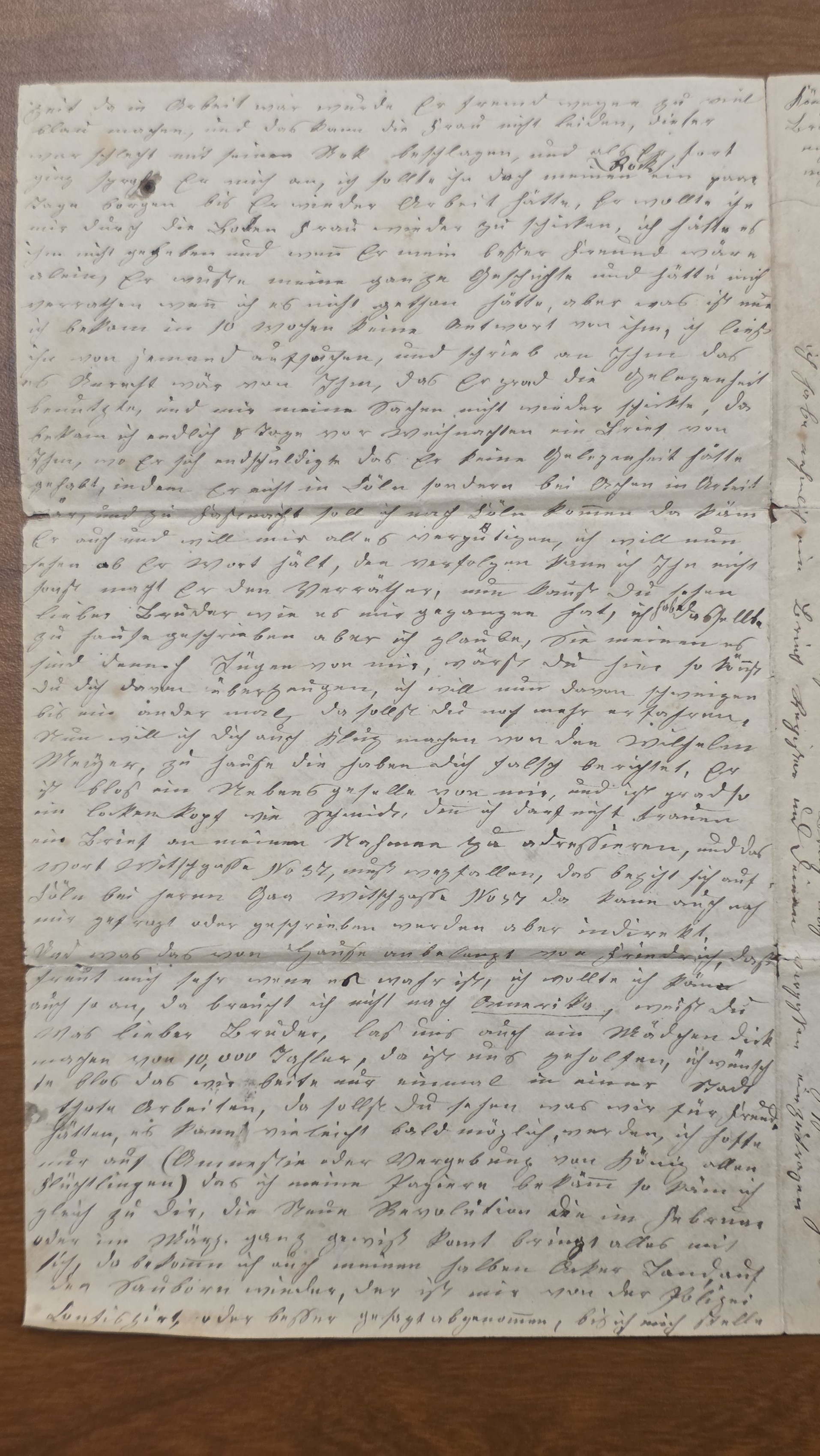
—time at work, he was sent away for taking too much time off, which the mistress cannot tolerate. He was badly off for a coat. When he left, he asked me to lend him my coat for a few days until he had work again. He would send it back to me through the post, postage paid.
I would not have given it to him even if he were my best friend, except that he knew my whole story and would have betrayed me if I had not done so. But what happened? I received no answer from him for ten weeks. I had someone look for him and wrote to tell him it was wrong to take advantage of the opportunity and not return my belongings.
At last, eight days before Christmas, I received a letter from him. He excused himself by saying he had had no opportunity, since he was working near Aachen, not in Cologne. I am to come to Cologne at Carnival; he will come too and return everything [or make everything good]. I shall see whether he keeps his word, for I cannot forgive him: now he is making a mockery of me.
Now, dear brother, you see how things have gone with me. I wrote the same thing home, but I believe they still think I am lying. If you were here, you could convince yourself. I will say no more about it until another time; you shall hear more yet.
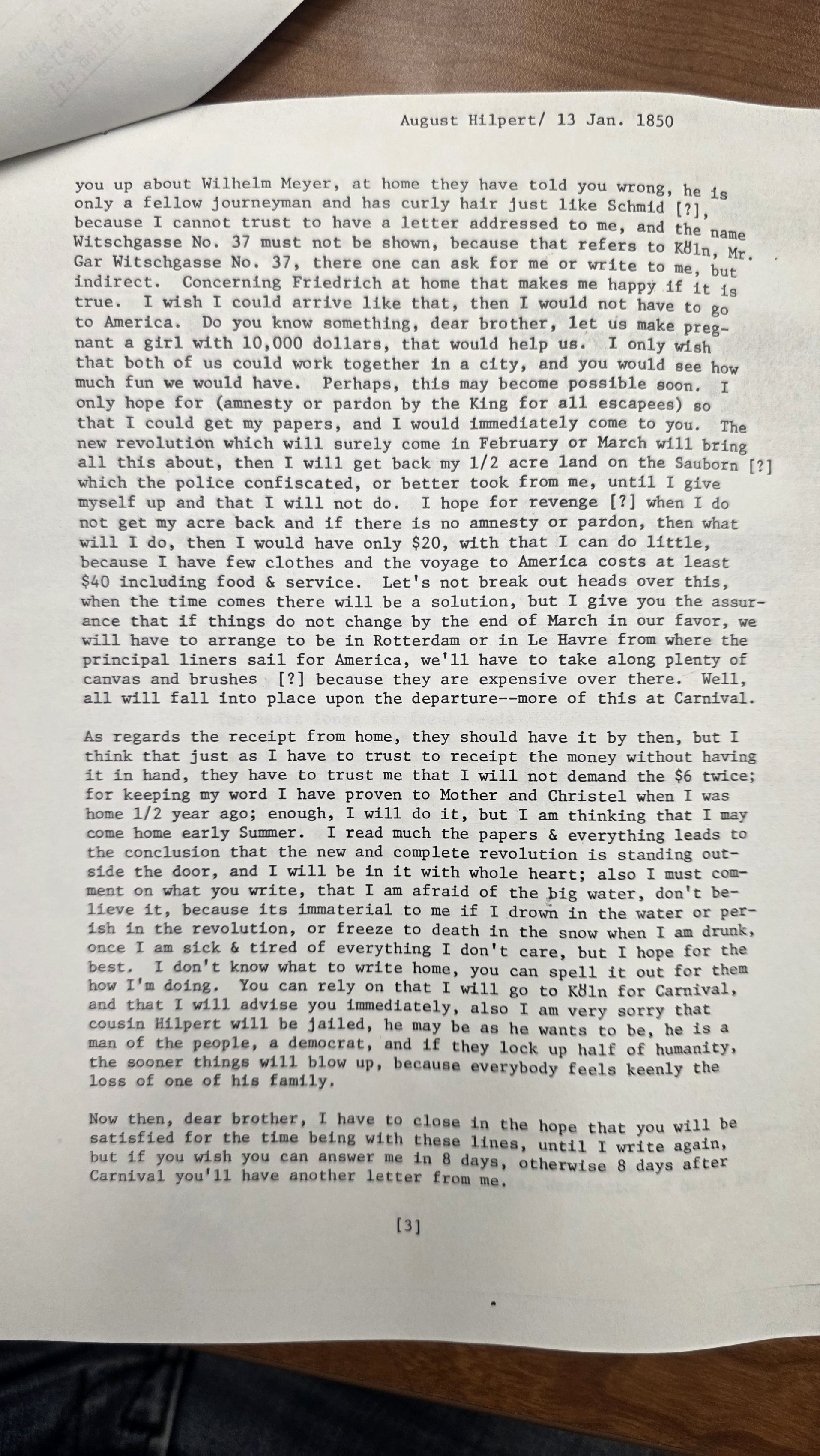
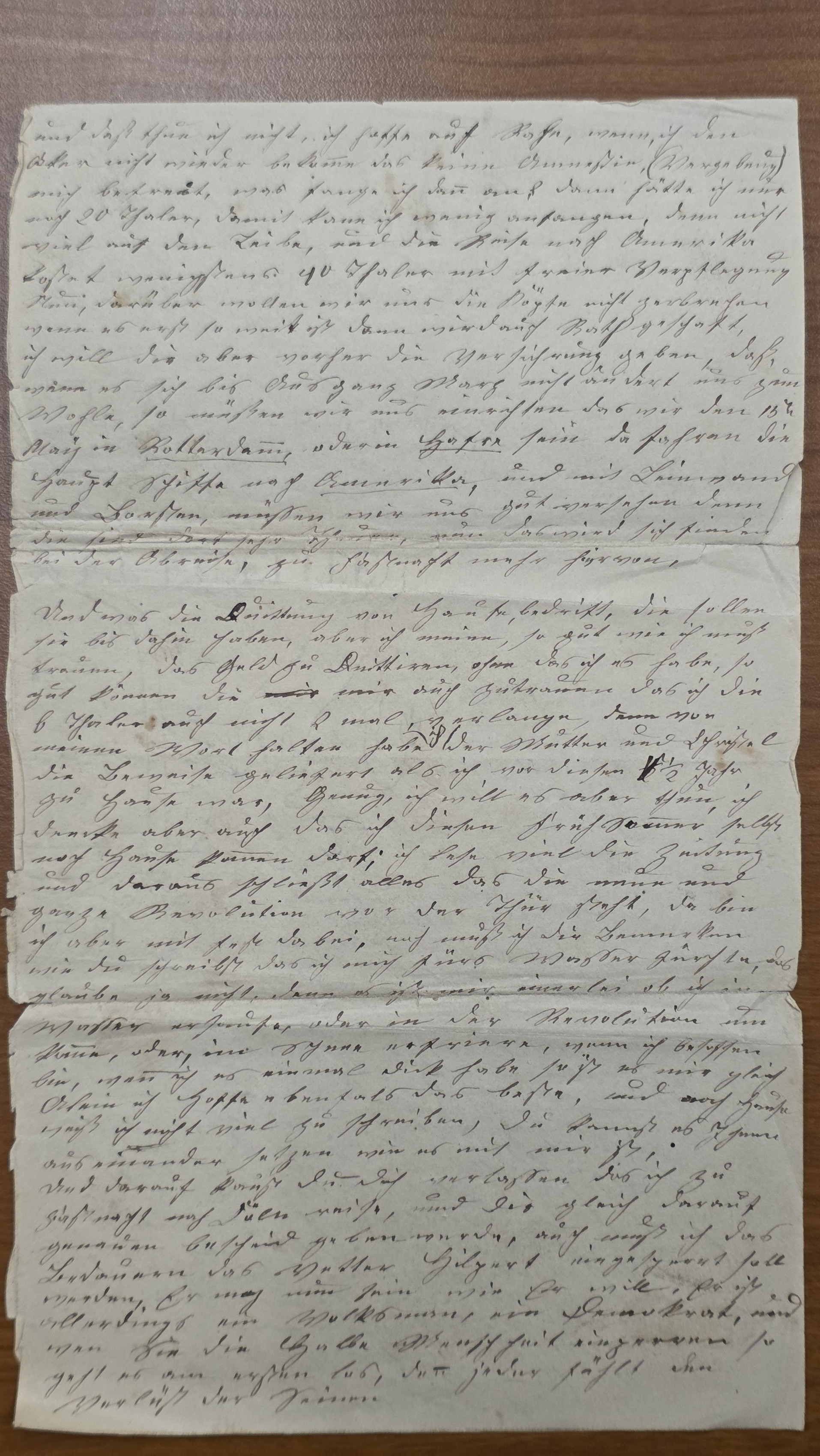
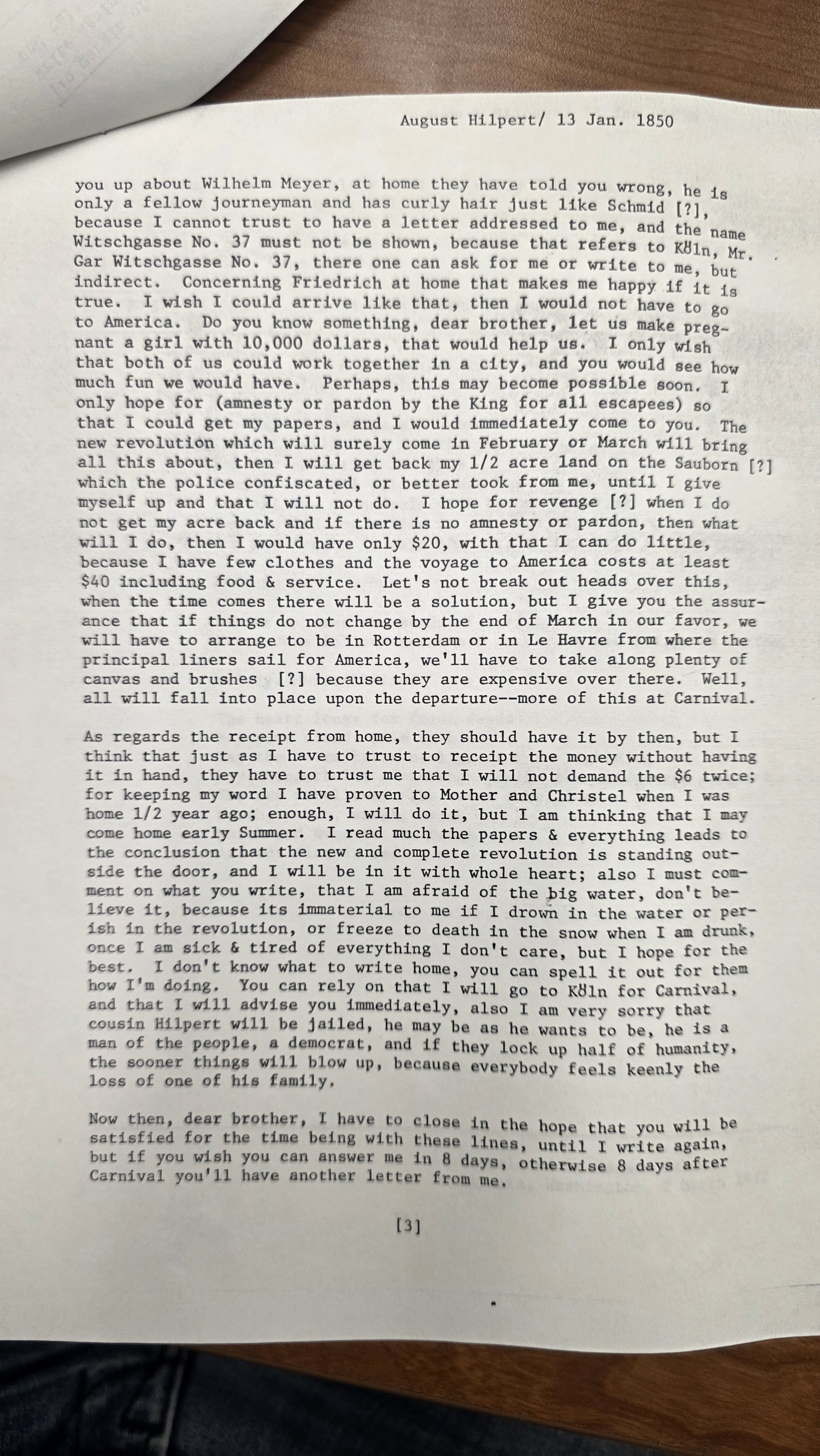
Now I also want to explain about Wilhelm Meyer. They have given you wrong information at home. He is simply a fellow journeyman of mine, and just as much a flighty fellow as [Schmidt?] in [Lauterberg?]. You must not dare address a letter to me in my own name. The words “[street uncertain] No. 37” must also be omitted. That refers to Mr. [Gaar?] in Cologne, [same street], No. 37. Inquiries can still be made there, or letters sent, but indirectly.
As for what you write about home, I am very glad if it is true. I wish I could do the same; then I would not have to go to America. You know, dear brother, let a girl with [ten or fourteen thousand thalers; figure uncertain] come my way too—that would help us!
I only wish the two of us could work in the same town for once. Then you would see what a fine time we would have. Perhaps it may soon become possible. I am only hoping for an amnesty—that is, a pardon from the king for all fugitives—so that I can get my papers; then I would come straight to you.
The new revolution, which will certainly come in February or March, will put everything right. Then I shall receive [the half parcel of land]. The police have placed it under attachment on my account until I report myself—
Page 5 — America as a possible last resort
—and that I will not do. Suppose that I do not get the land back, and that no amnesty, or pardon, applies to me: what am I to do then? I would have only twenty thalers left. I can do little with that, for I do not have much clothing, and the journey to America costs at least forty thalers with [free/included provisions; “freier Verpflegung” is the likely reading].
Well, let us not rack our brains over that. If things have come to that, God will provide. But I want to assure you beforehand that if matters do not change for our benefit by the end of March, we would have to arrange to be in Rotterdam or Havre on March 15 [date as read; this conflicts with waiting until the end of March]. The principal ships for America sail from there.
We would need to supply ourselves well with linen and other things. [Words obscured at the fold.] As I have said, I shall find out about the [costs/details] at Carnival.
As for the receipt requested from home, they shall have it by then. But I think that, just as I can trust them enough to acknowledge receipt of the money before I have it, they can trust me not to ask for the six thalers twice. For [word uncertain: money/share] I previously received, Mother and Christel signed the receipts themselves when I was at home a year and a half ago.
Enough; I will do it. But I also think I shall be able to come home myself this spring or summer. I read the newspaper a great deal, and everything points to a new and complete revolution being at the door. I shall certainly take part.
I must also remark on your writing that I am afraid of the great water: do not believe it! [He compares drowning, death in a revolution, and freezing in the snow when drunk; the complete sentence remains uncertain.] Once I am thoroughly fed up, it is all the same to me.
But I hope for the best in any event. I do not need to write much home; you can explain to them how things stand with me.
You may rely on my going to Cologne at Carnival, and I shall give you accurate information immediately afterwards. I also hear that [cousin Hilpert?] is to be imprisoned. Whatever else he may be, he is certainly a thorough democrat. [He says that imprisoning half of humanity would only hasten the outbreak; the precise final wording remains uncertain.]
Page 6 — Closing and address
Now, dear brother, I must finish, hoping that you will be content with these lines for the time being, until I write again. If you wish, you may answer me in eight days. Otherwise, eight days after Carnival you will have another letter from me.
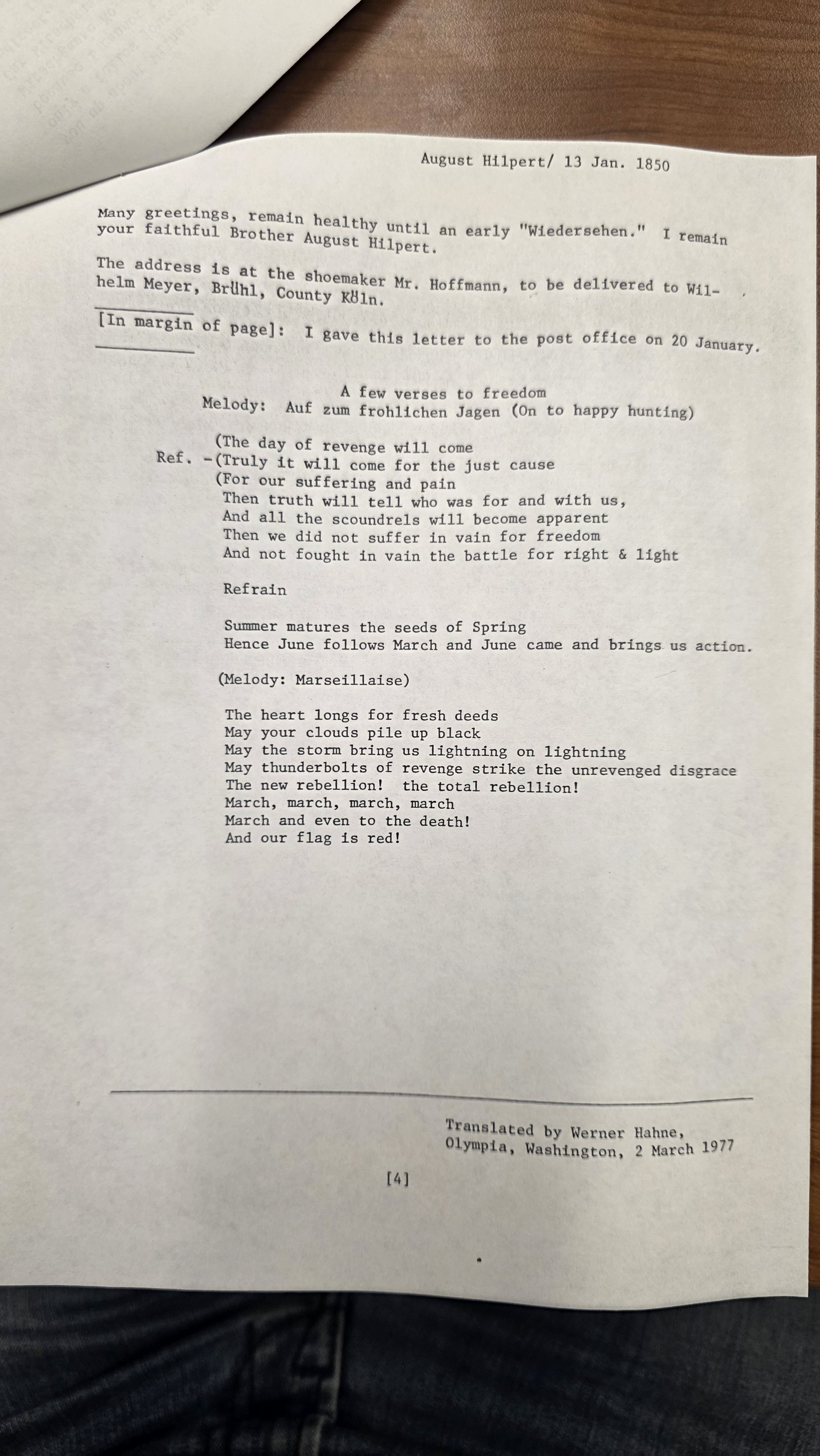
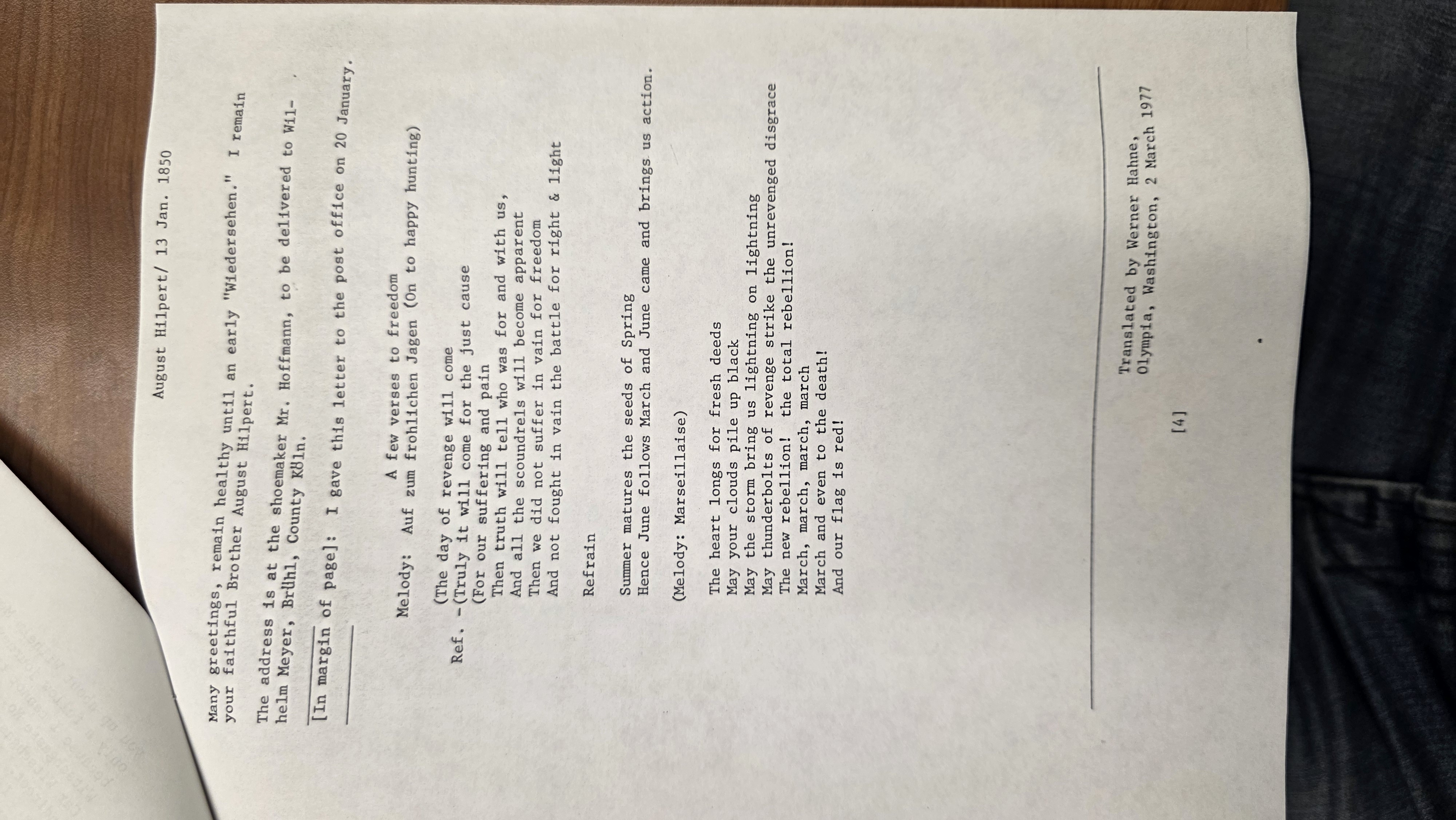
I send you many greetings. Stay healthy until we see each other again very soon.
I remain your faithful brother,
August Hilpert
Address: At master shoemaker Mr. Hoffmann's, to be delivered to Wilhelm Meyer, in Brühl, district of Cologne.
Posting note: “I put the letter in the post on January 20.”
Marginal additions
- Opening, circled: “Königslutter lies between Braunschweig and Helmstedt, does it not? I myself have travelled not far past it.”
- Opening, long margin: “Dear brother, when you write to me, please tell me on what date and in what month I wrote you the letter to Oldisleben. I have neglected to enter it in my letter register and [the remaining wording about yours is uncertain].” This is a record-keeping note, not a New Year's greeting.
- Page 2 margin: “Dear brother, should you be at home before I write to you again, and should you come through Nordhausen, visit my brother and tell him about my situation.” The brother is unnamed here; do not assign him to Ernst or Friedrich.
Appended political verses
“A few more verses of freedom.”
Tune: “Auf zum fröhlichen Jagen” [“Off to the merry hunt”].
The day of vengeance is coming;
Truly, it will come one day,
For the righteous cause,
For our hardship and suffering.
Then truth will make known
Who was for us and with us,
And all the [scoundrels—compound word uncertain]
Will be revealed.
Then we shall not have suffered
For freedom in vain,
Nor fought in vain
The struggle for right and light.
The day of vengeance is coming;
Truly, it will come one day,
For the righteous cause,
For our hardship and suffering!
Next verse; marginal tune instruction: “The Marseillaise.”
Summer ripens the spring's sowing;
That is why June follows March.
O June, come and bring us deeds!
The heart thirsts for such deeds!
Let your clouds gather black;
Bring us thunderstorm upon thunderstorm!
Into the unhealed pain
Let vengeance's thunderbolts fall!
The new rebellion! The whole rebellion!
March, march! March, march!
March—even to death!
And our flag is red!
The poems are translated for meaning, without trying to reproduce rhyme or meter. Comparison texts helped resolve the final lines; the handwriting, not a modern edition, remains the source for August's wording. The first poem appears to use “not in vain” and “struggle” in slightly different German wording from the published comparison. The second stanza's first line appears to use “the spring's sowing” with irregular grammar.