Current reading edition
English translation
Square brackets mark uncertain words or editorial explanations. Songs are translated for meaning; their speakers are not necessarily the writer.
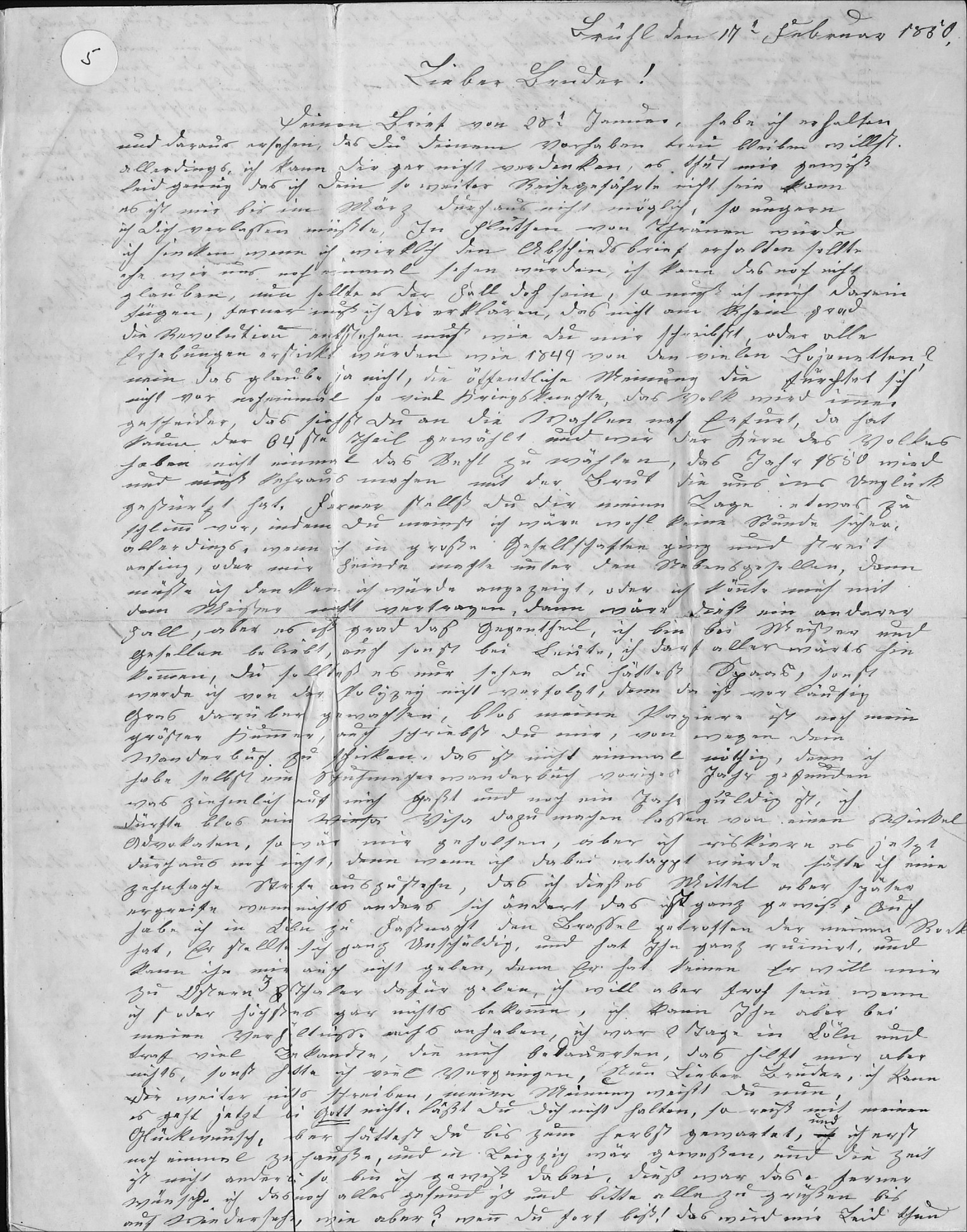
Download the English text ↓Main letter, February 17
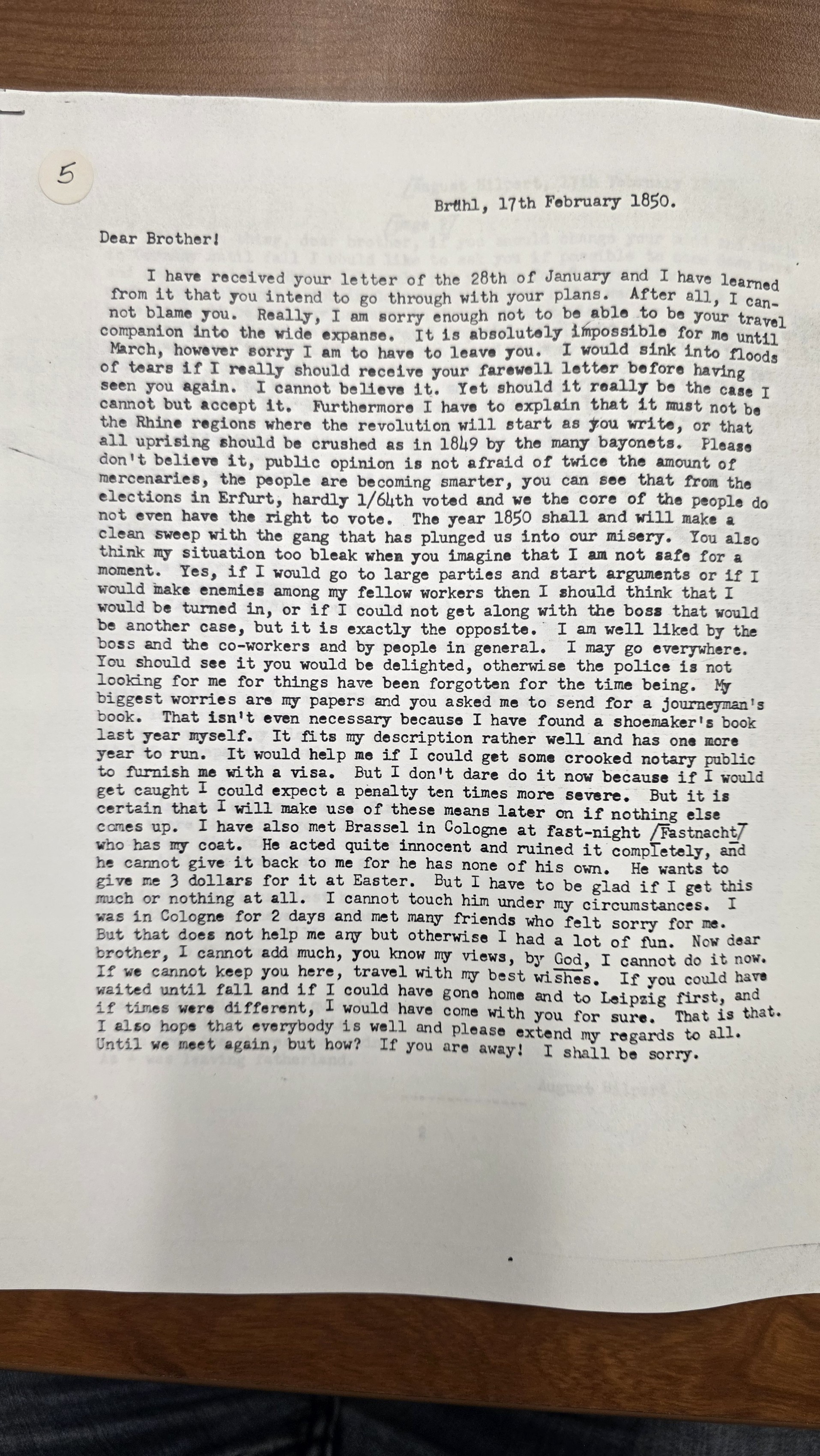
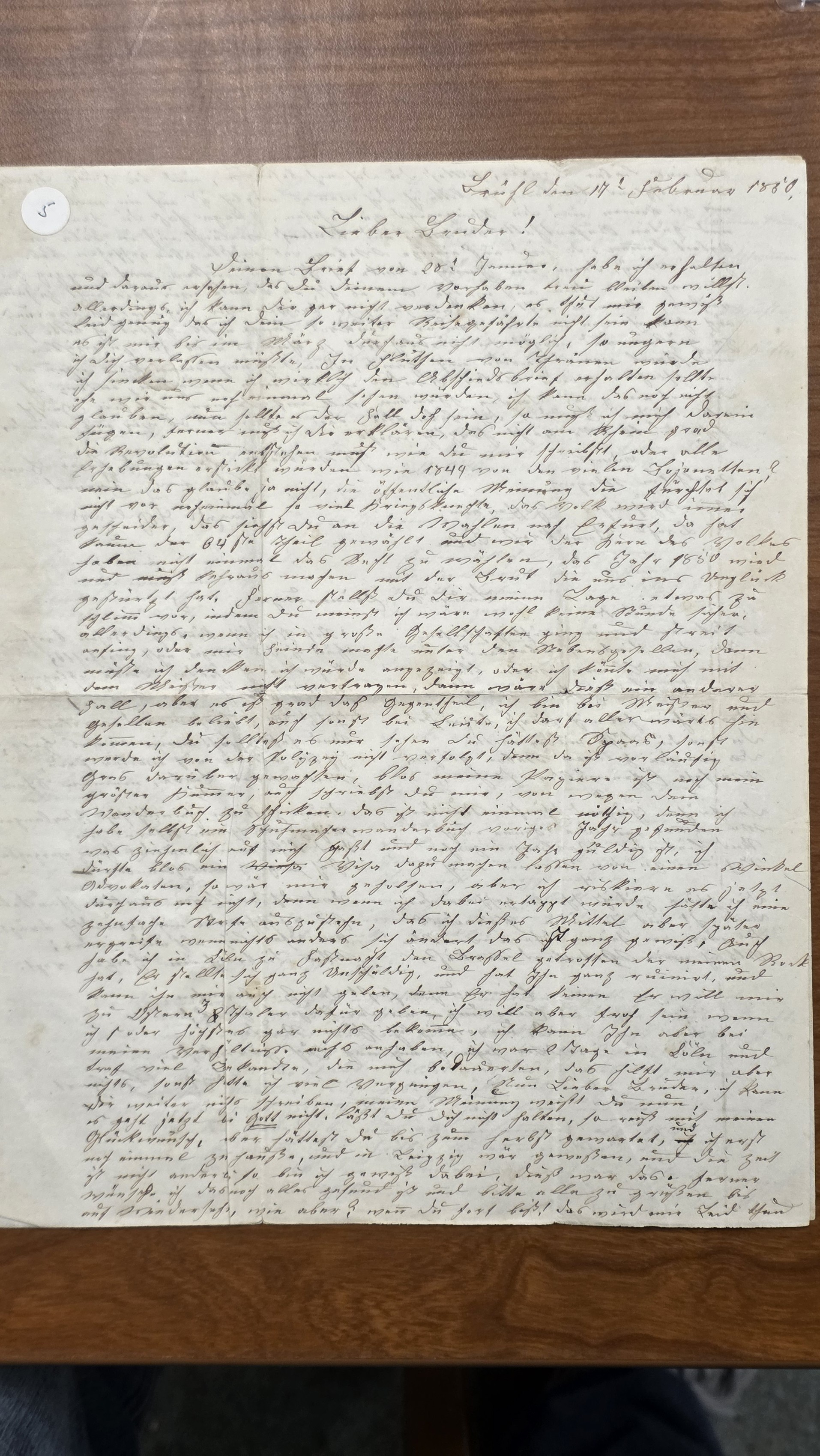
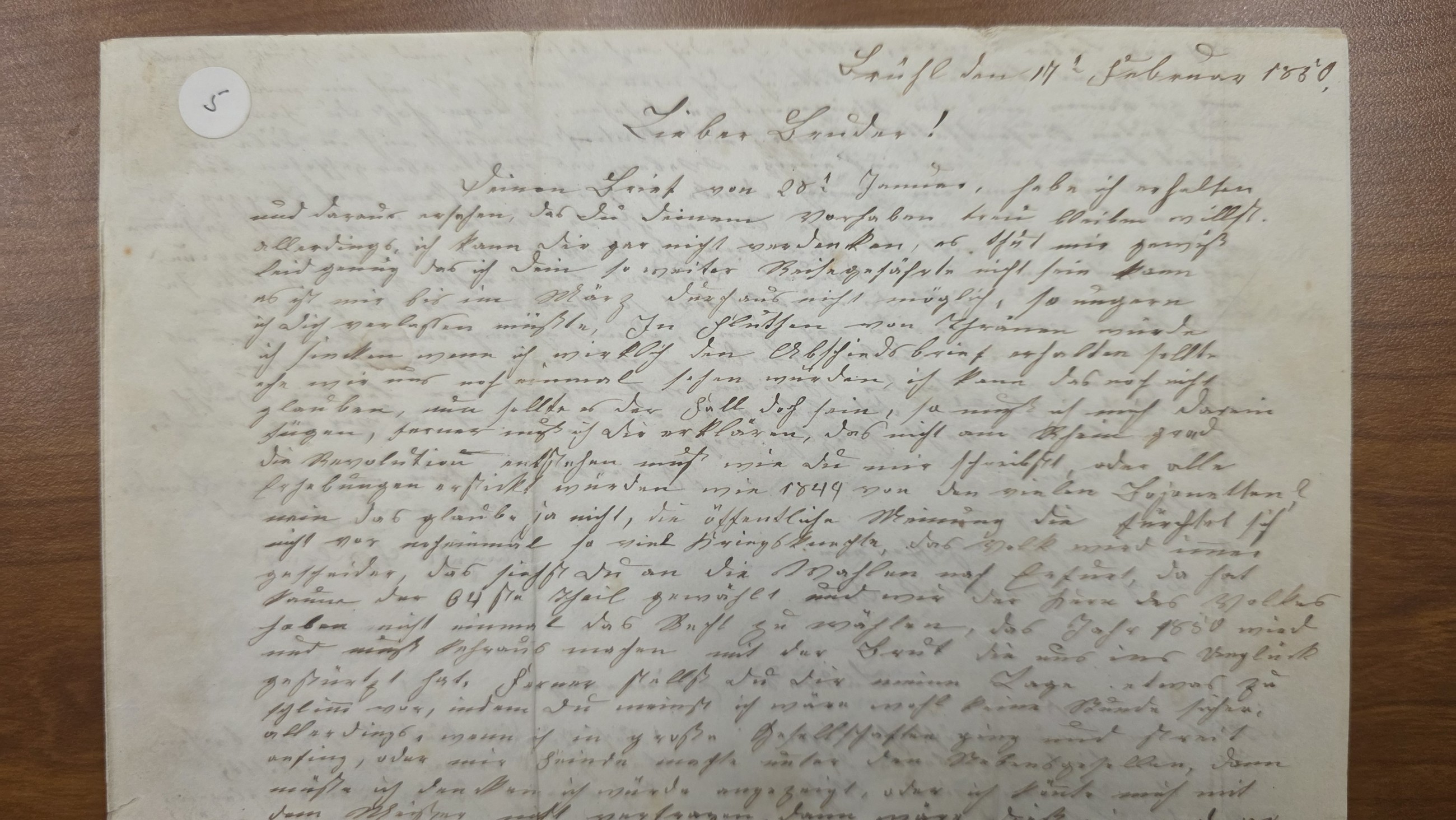
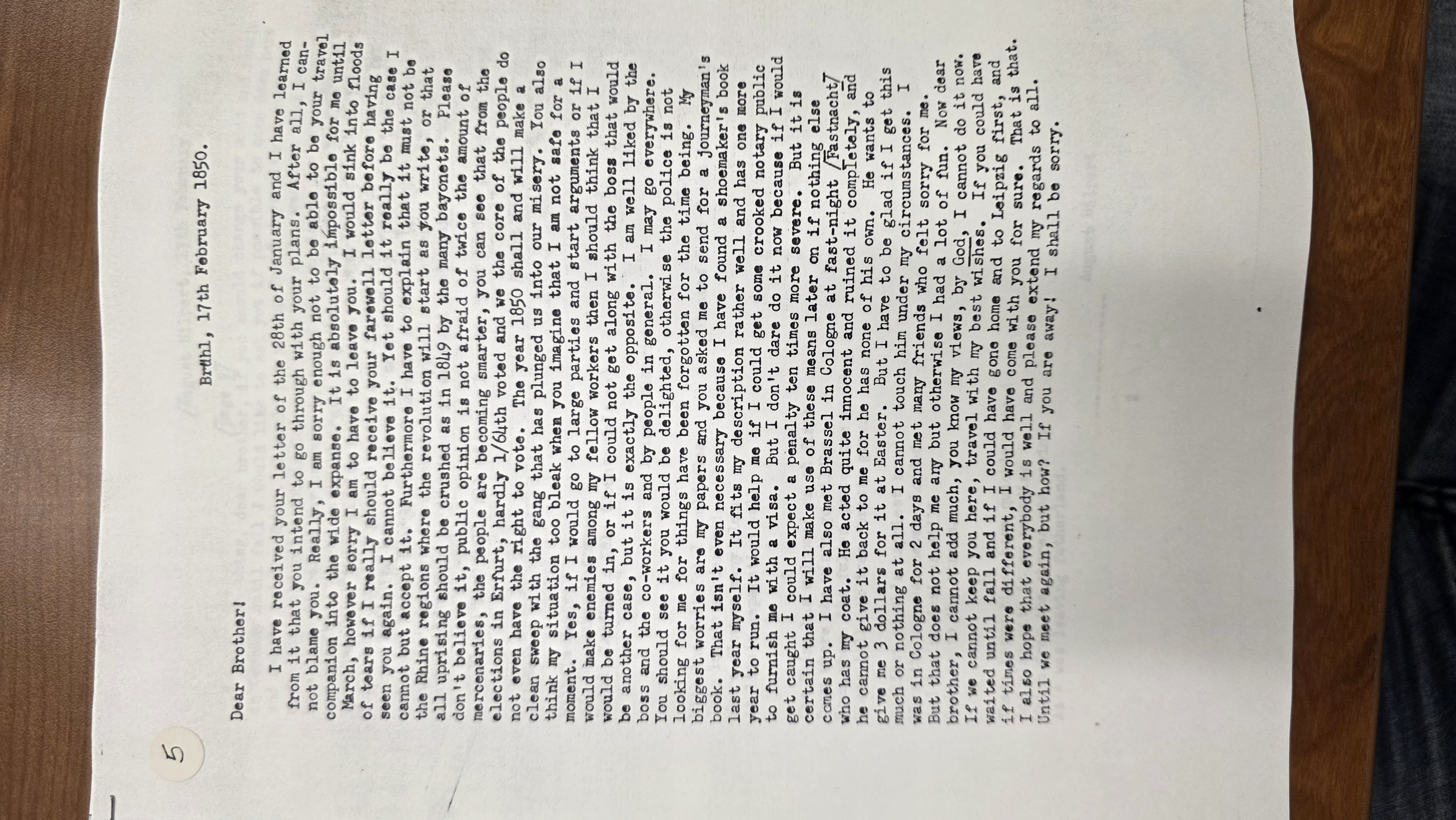
Brühl, February 17, 1850
Dear Brother,
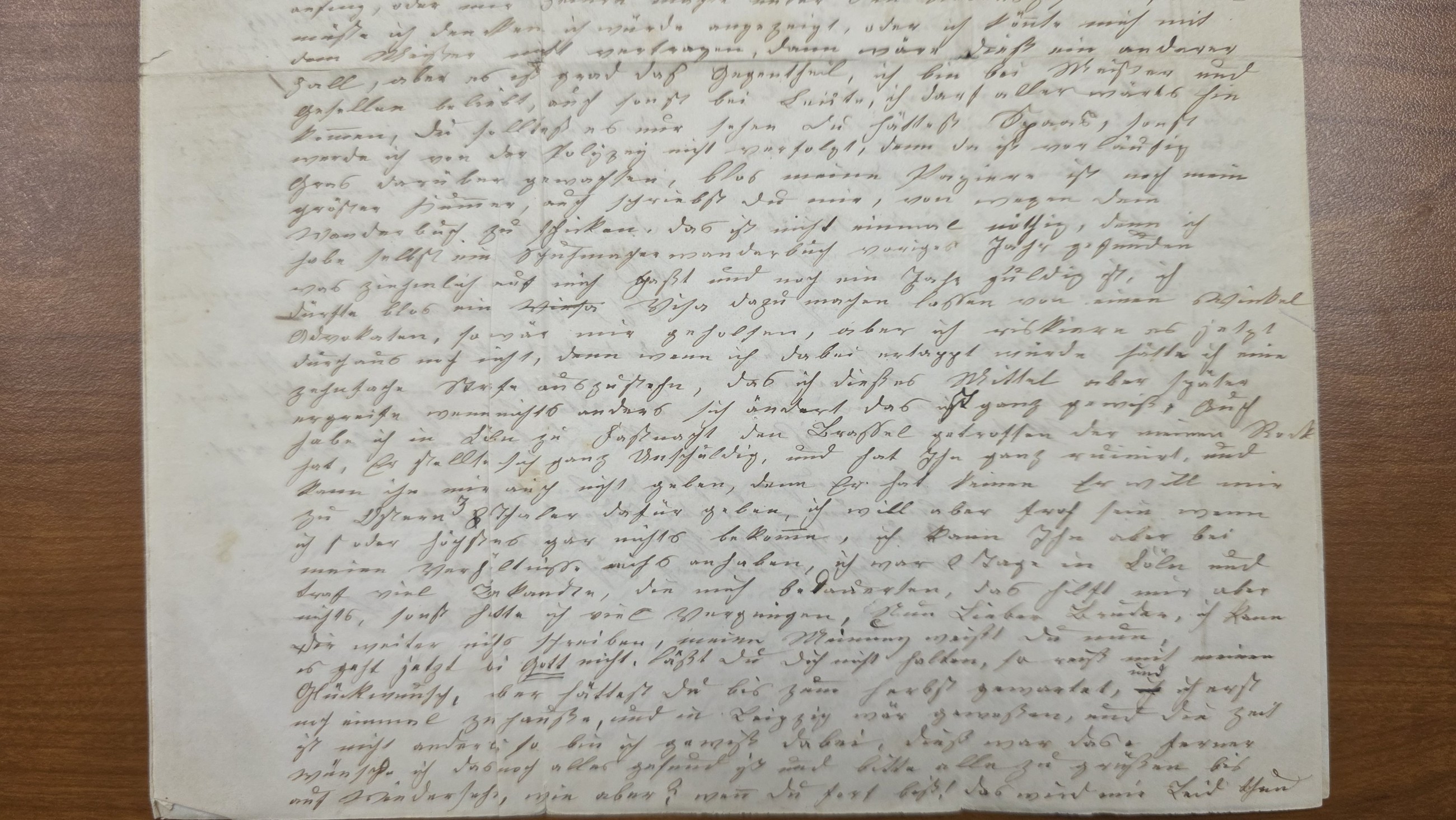
I received your letter of January 28 and learned from it that you intend to remain true to your plan. Certainly I cannot blame you for that. I am sorry enough that I cannot be your travelling companion. It is quite impossible for me in March, however unwilling I am to part from you.
I would dissolve into floods of tears if I really received your farewell letter. Whether we shall ever see one another again! I still cannot believe it. But if it should indeed happen, I must resign myself to it.
First I must explain [my disagreement with what you write about revolution on the Rhine and its suppression by bayonets; the precise opening construction remains uncertain]. No, I do not believe that. Public opinion will not let itself be led by the nose so much again. The people are becoming wiser all the time. You can see that from the elections for Erfurt: scarcely a sixty-fourth part voted, and [a large portion—apparently two thirds] of the people do not even have the right to vote.
The year 1850 will and must put an end to the [scoundrels—insulting noun uncertain] who have plunged us into misfortune.
Then you picture my situation as rather too bad, thinking that I am not safe for even an hour. Certainly, if I went into large gatherings and started arguments, or made enemies among the other journeymen, I would have to expect to be reported. Or if I were not on good terms with the master, that would be a different matter.
But it is quite the opposite. I am liked by masters and journeymen, and by other people too. I can go anywhere. [A short clause is unresolved.] Otherwise I am not being pursued by the police, because they have forgotten me. Only my papers are still my greatest trouble.
You also write about sending me a journeyman's travel book. That is not even necessary, because last year I myself found a [Schwarzburger?] travel book which suits me fairly well and is still valid for another year. I would only need to have a [passport/endorsement—corrected word uncertain] made to go with it by a shady lawyer, and I would be helped. But I absolutely will not risk that yet. If I were caught, I would have a much heavier punishment to serve. That I shall use this means later, if nothing else changes, is quite certain.
At Carnival in Cologne I also met the scoundrel who has my coat. He acted very innocently, but has completely ruined it and cannot return it to me, [he says he has no coat himself]. He says he will give me three thalers for it at Easter. I shall be glad if I receive one—or, at worst, nothing at all. But I cannot do anything against him that would harm him, because of my situation.
I spent two days in Cologne and met many acquaintances who pitied me. That does not help me, though. Otherwise I did have a good time.
Now, dear brother, I cannot write you anything more. You know my opinion now. Nothing can be done at present. If you will not let yourself be persuaded, then you have my good wishes. But if you had waited until autumn, and I had been home once more, and we had enjoyed ourselves in Leipzig, and things still had not changed by then, I would certainly have been ready to go too. That is how I would wish it.
Nevertheless, I wish everyone good health and ask you to give them all my greetings until we meet again. But when? As you say, time will tell.
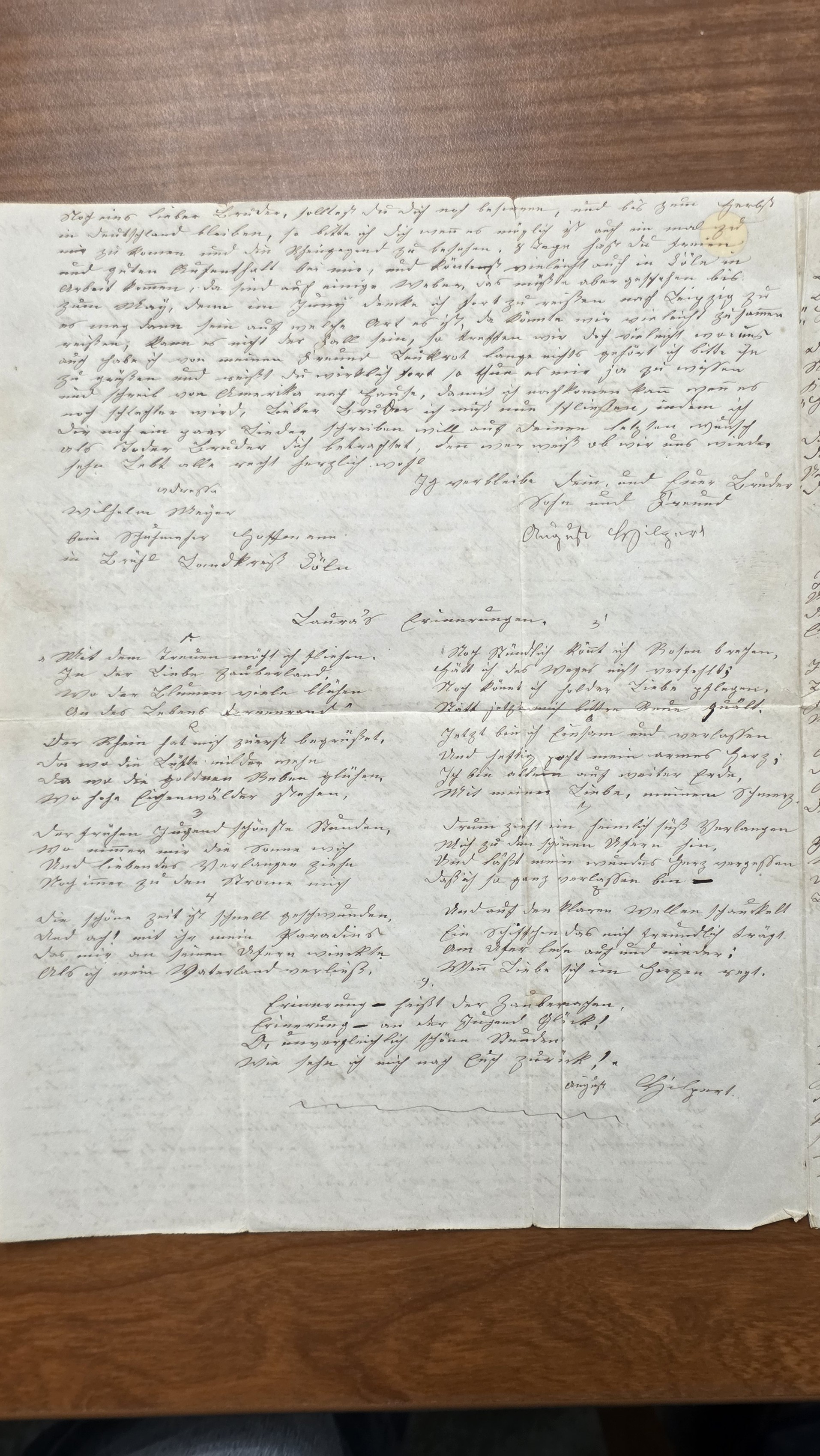
Continuation, closing and return address
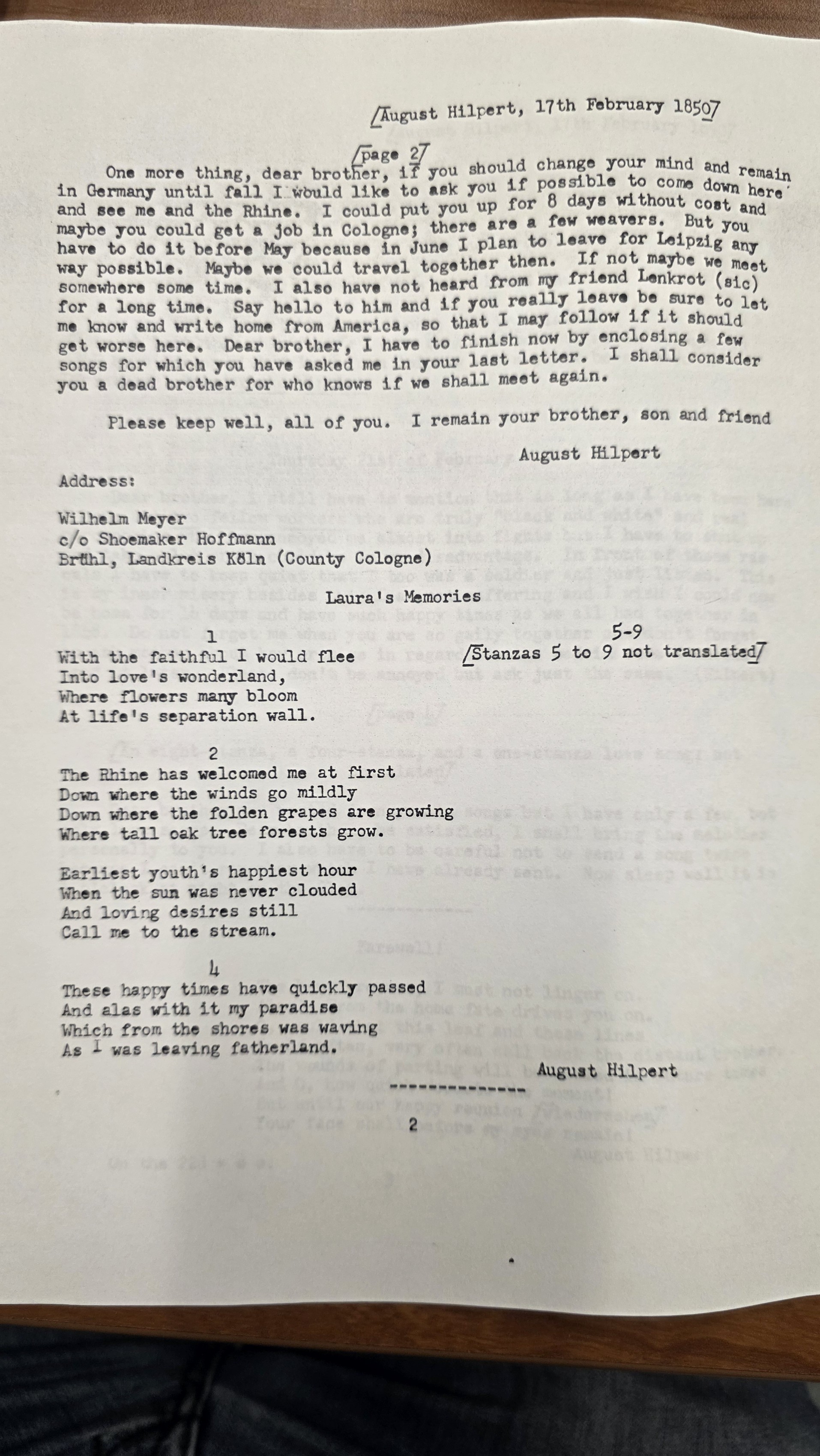
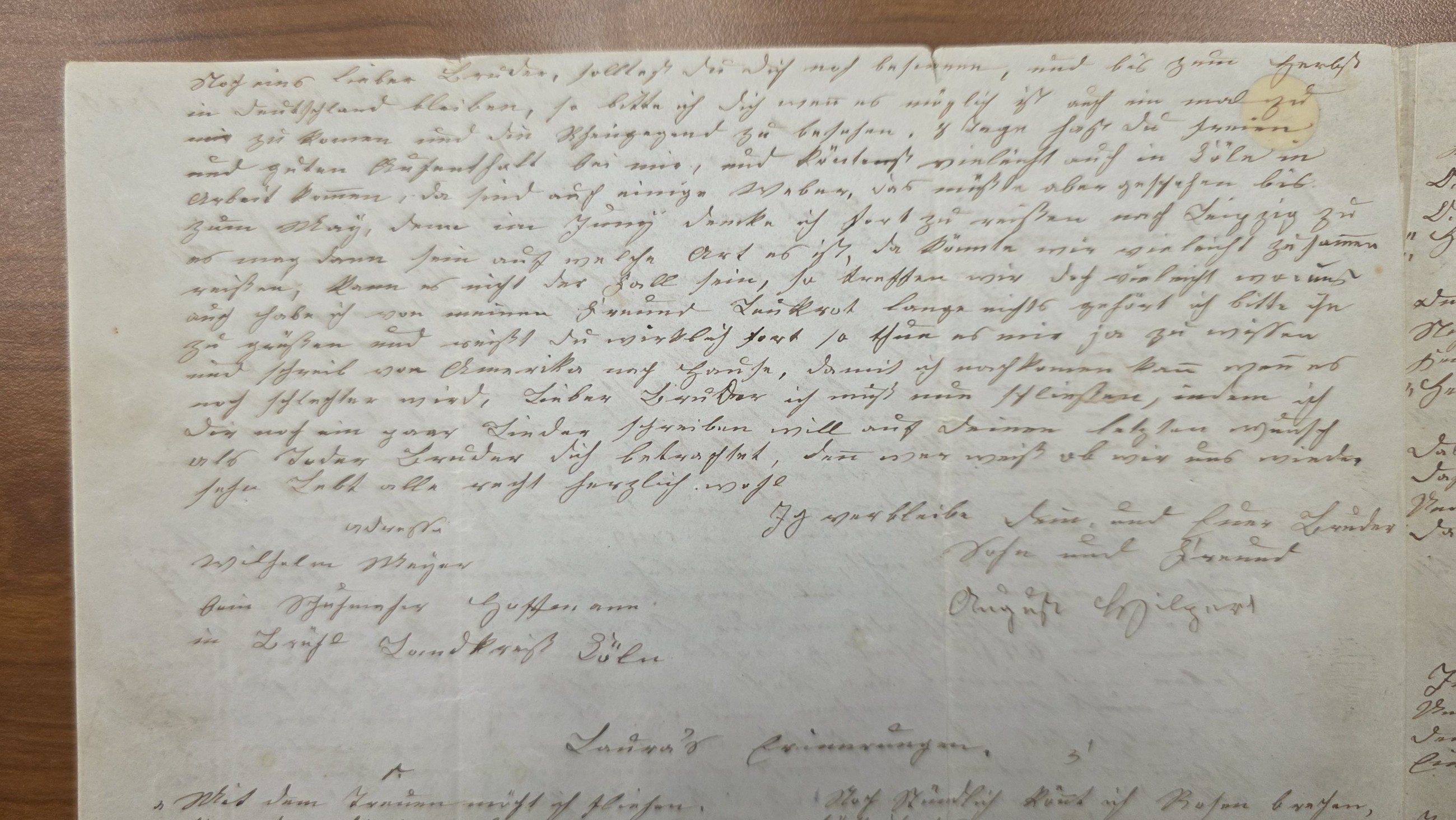
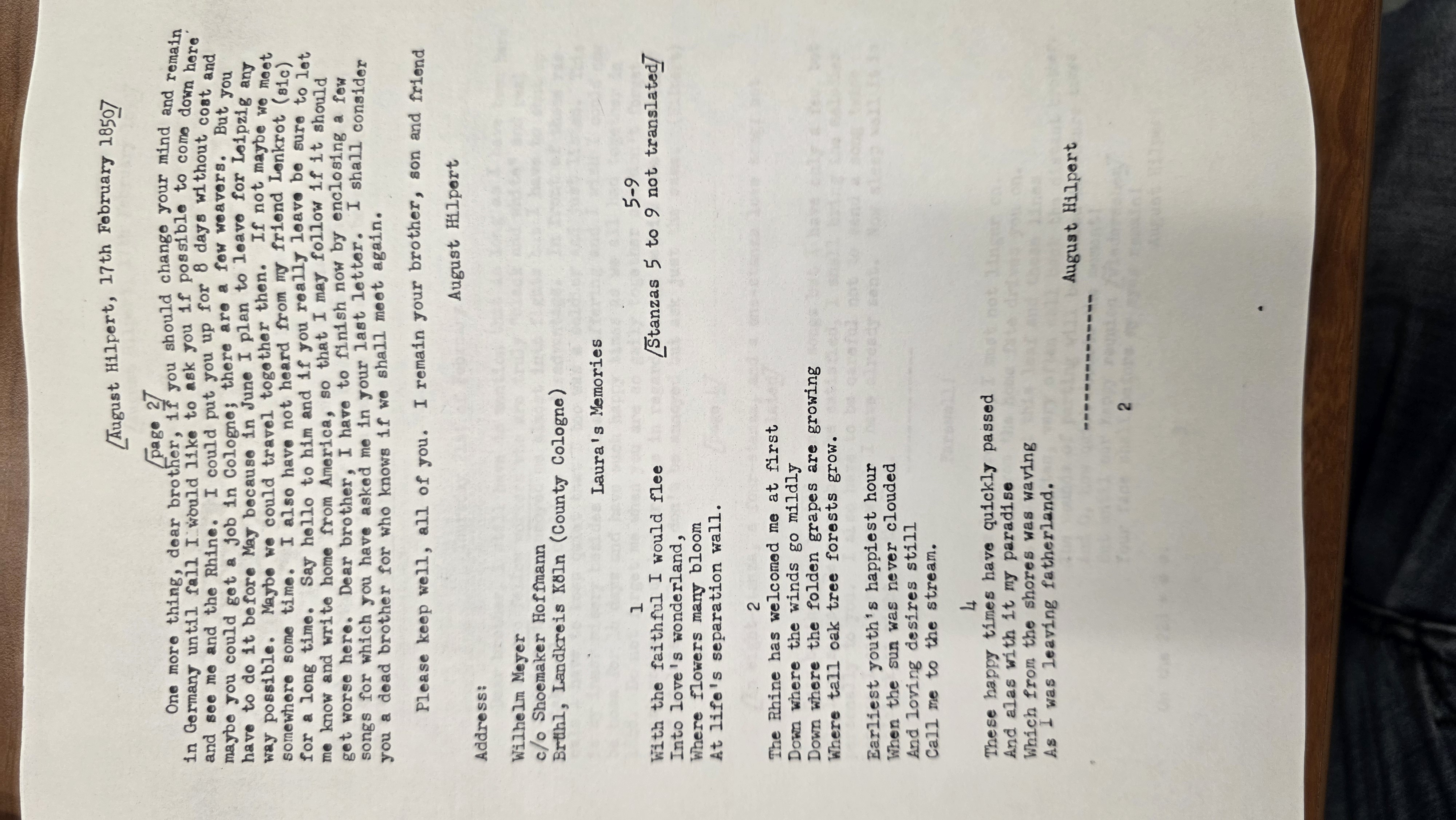
One thing more, dear brother: should you change your mind and remain in Germany until autumn, I ask you, if possible, to come to see me once more and look at the Rhineland. You would have eight days' free and comfortable lodging with me. You might also find work in Cologne; there are some weavers there too.
But that would have to happen by May, because in June I think of leaving here and going to Leipzig or somewhere else, wherever it may be. Then we could perhaps travel together. If that should not happen, perhaps we shall meet before then after all.
I have also heard nothing for a long time from my friend [surname uncertain, perhaps the friend addressed in Letter 3]. Please give him my greetings. And if you really do leave, let me know, and write home from America so that I can learn what will happen next.
Dear brother, I must finish now, since I want to write you a few more songs. From them you may see how I feel, dear brother, for who knows whether we shall see one another again. Farewell to you all, most heartily.
I remain your—and your family's—brother, son and friend,
August Hilpert
Address: Wilhelm Meyer, at shoemaker Hoffmann's, in Brühl, district of Cologne.
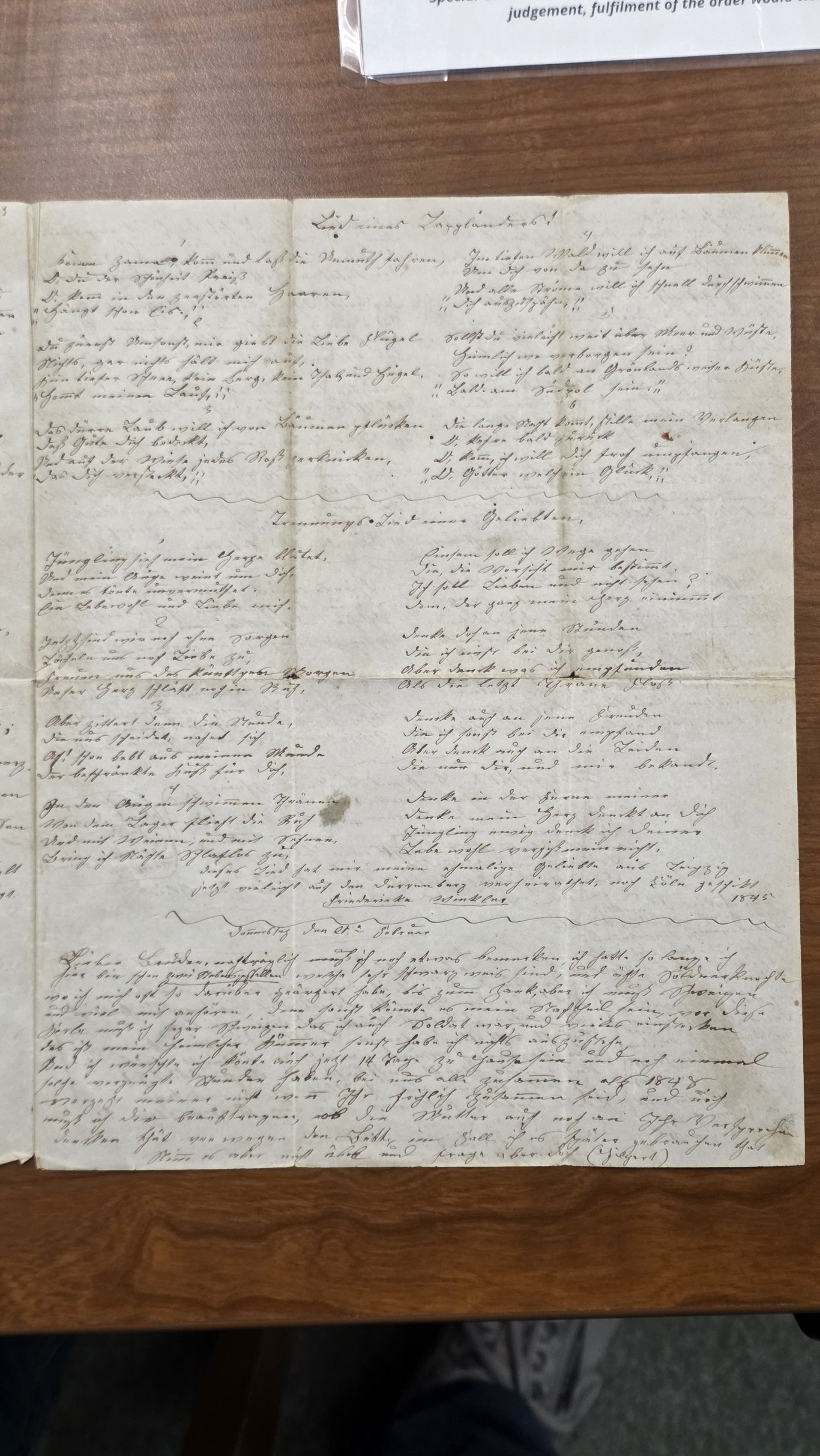
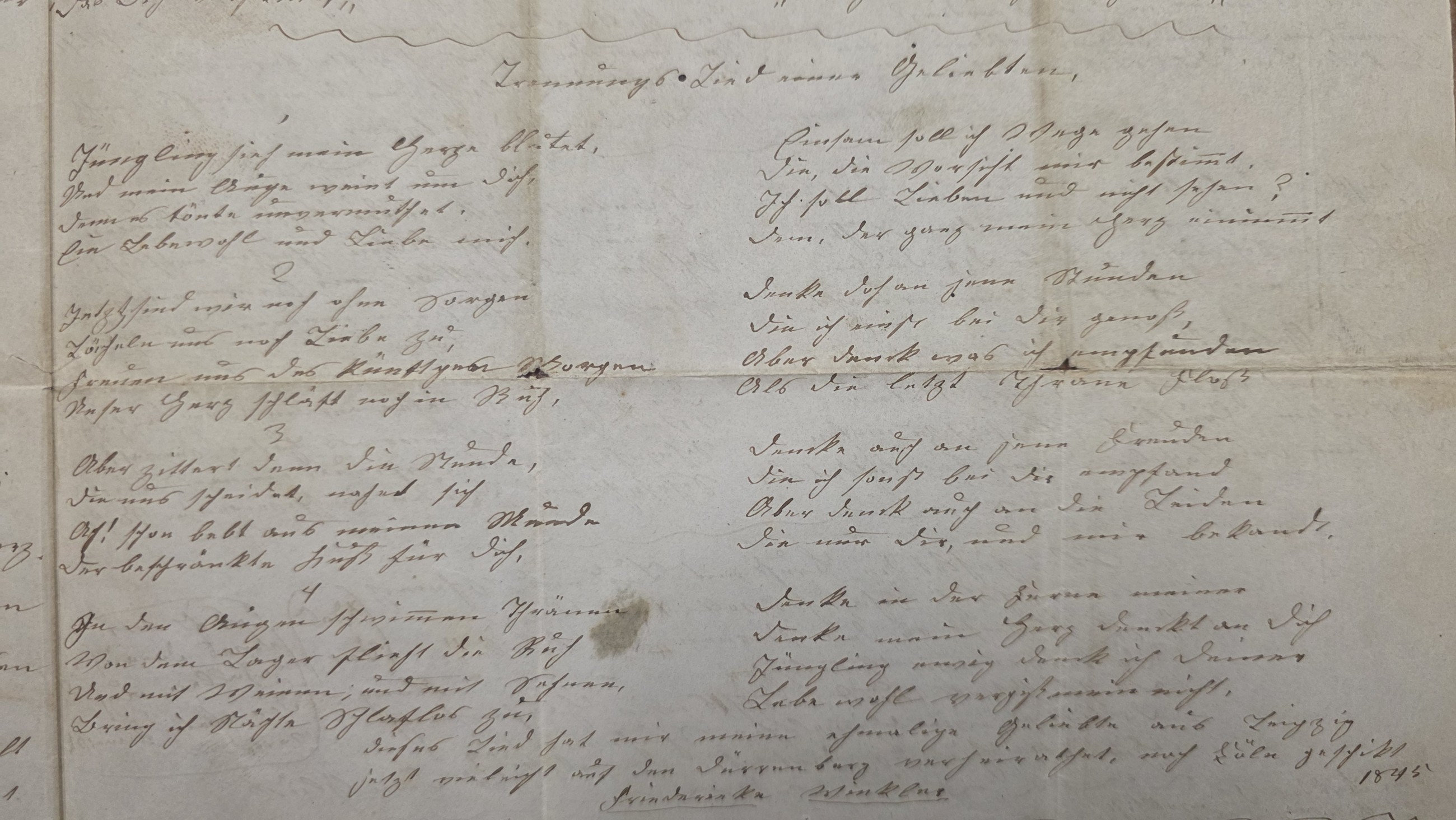
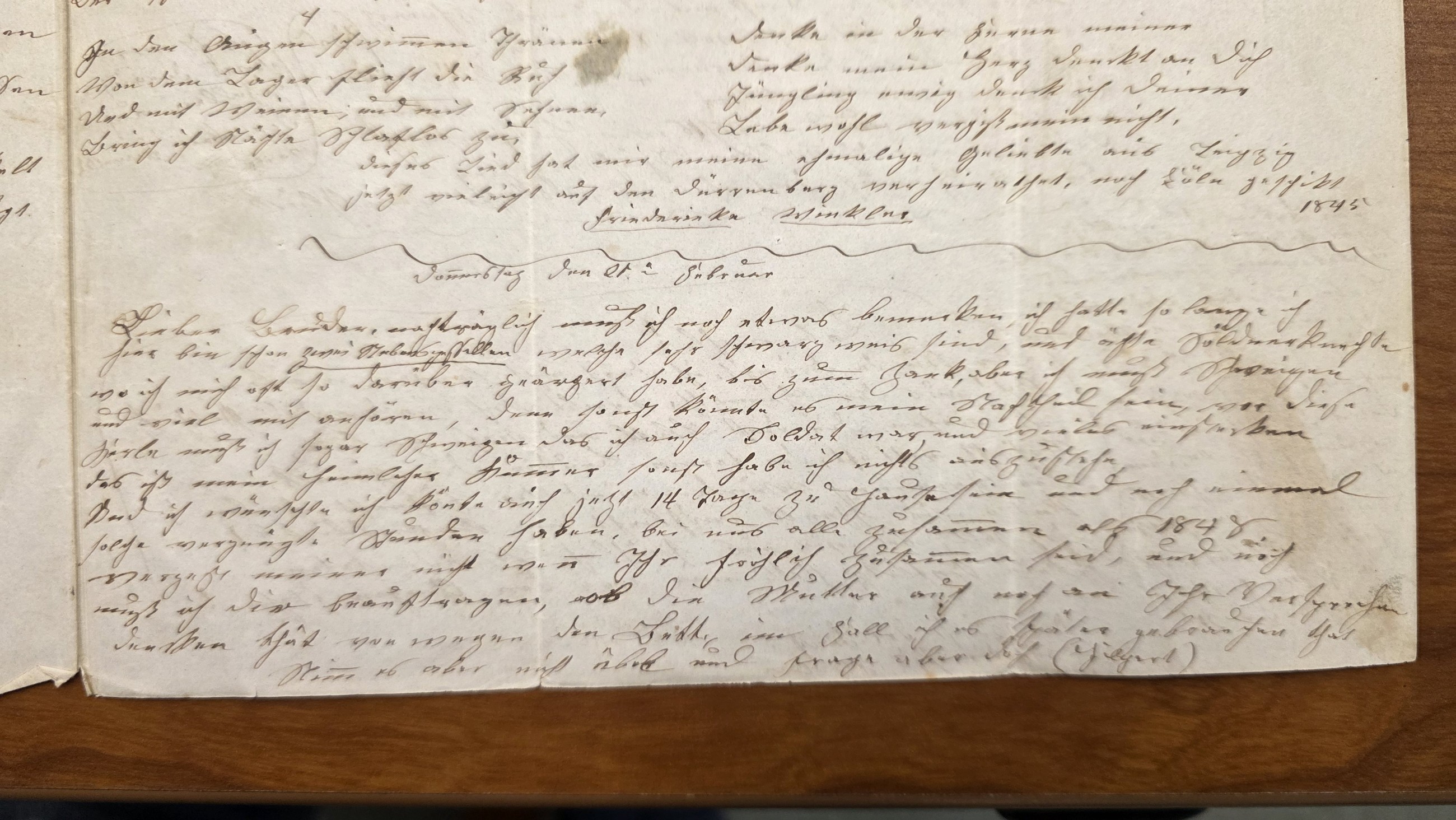
Personal note beneath the farewell song
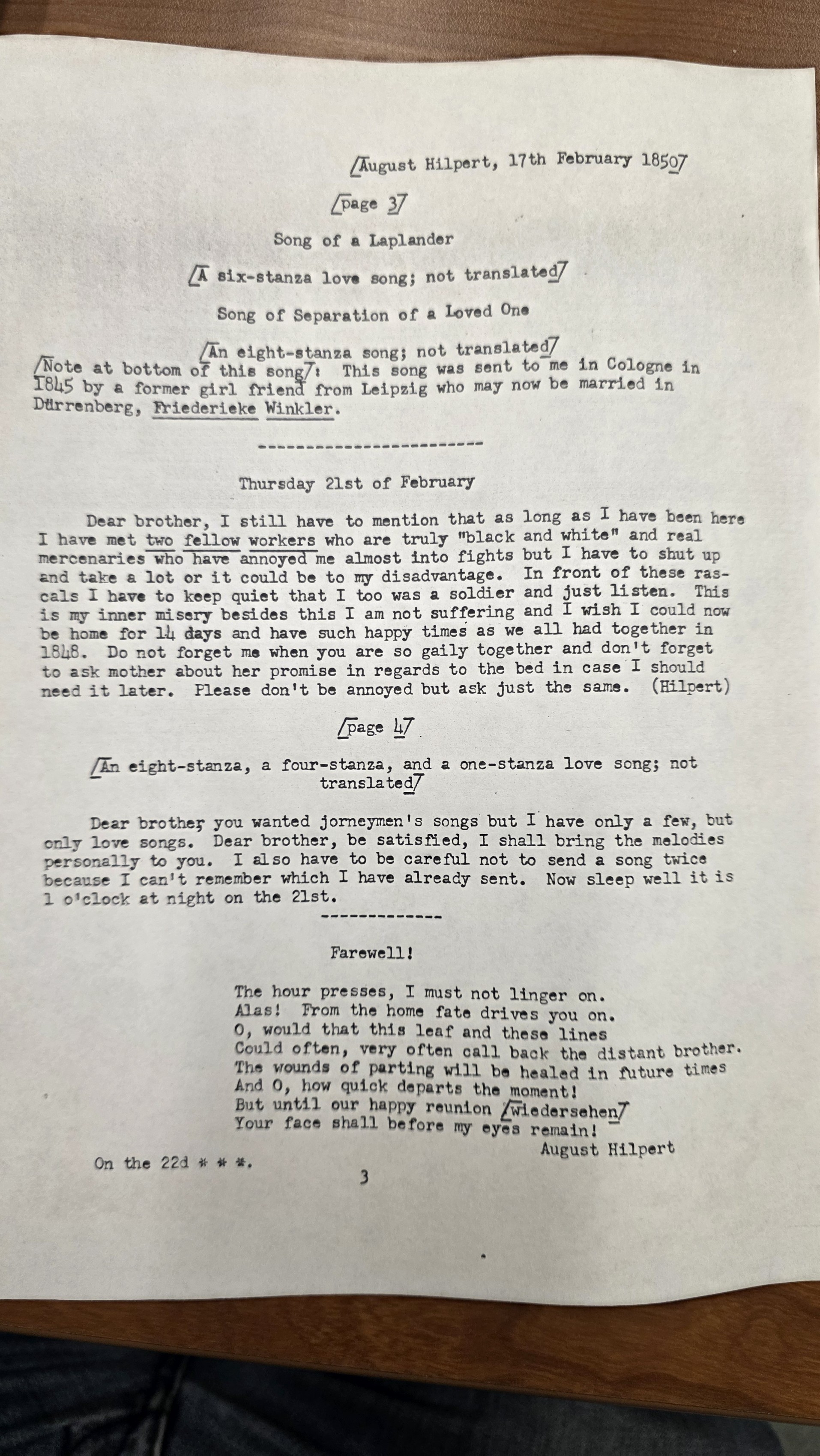
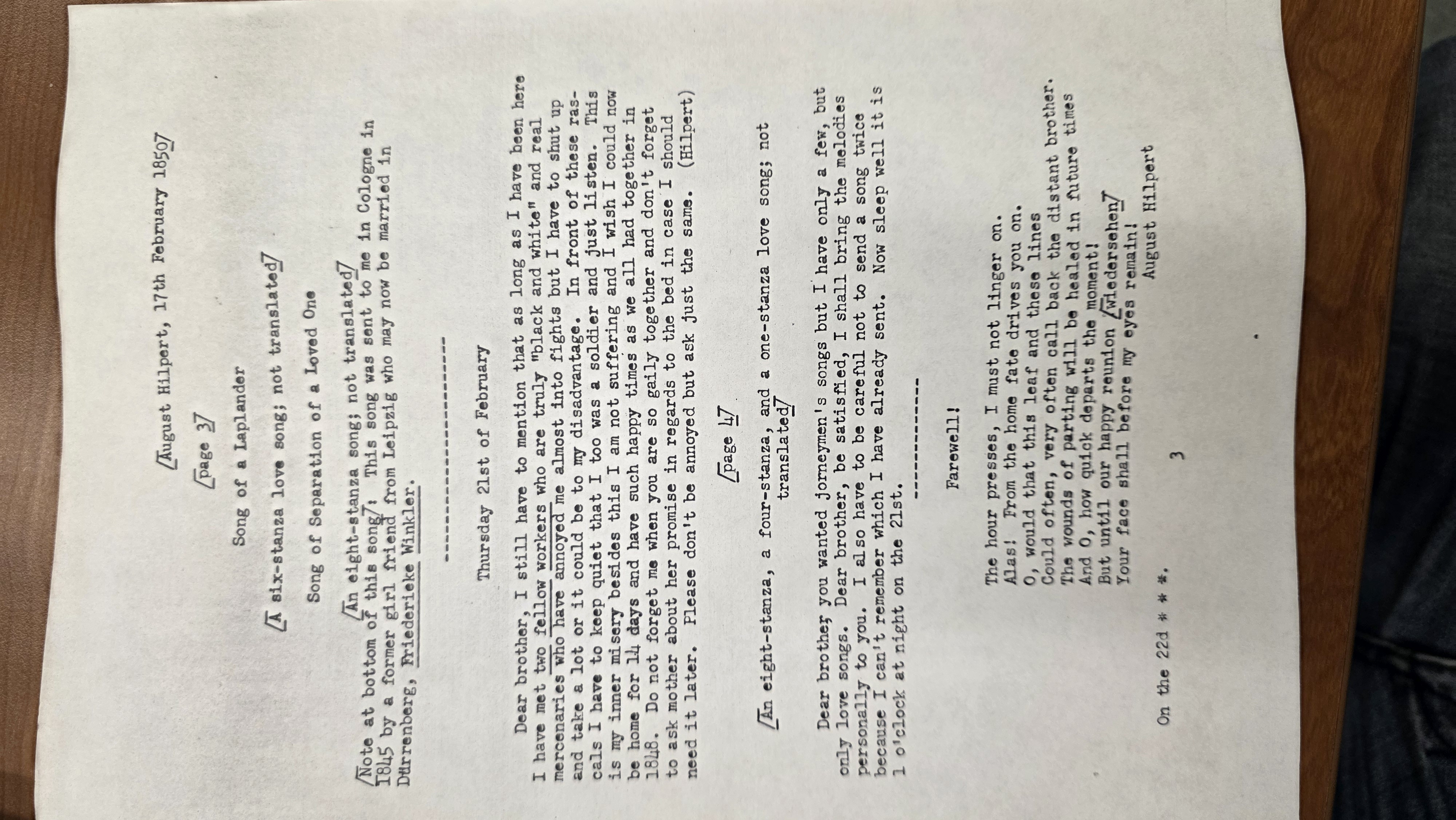
“My former sweetheart from Leipzig, now married in [Dürrenberg?], sent me this song in Cologne in 1845.”
Friederike Winkler
The year appears beside this annotation. The note identifies the sender of the song, not necessarily its author. The married surname, spouse and marriage date are not given.
Postscript — Thursday, February 21
Dear brother, I must add something afterwards. Since I have been here I have already had two fellow journeymen who are very [“black,” probably a political description; exact wording uncertain], and real soldiers' lackeys. I have often been so angry about it that it led to quarrelling. Now I must keep quiet and put up with a great deal, otherwise it could be to my disadvantage.
Before these [men—word unclear] I must even keep silent about having been a soldier myself. That is my trouble in the household; otherwise I have nothing [to complain of; closing wording uncertain].
I wish I could be at home now for fourteen days and have such happy hours once more, with all of us together, as in 1848. Do not forget me when you are happily gathered together.
I must also ask you whether Mother still thinks of her promise about the bed [the following details remain uncertain]. Do not take it amiss, but ask her. [Final parenthetical word or name unclear.]
[The promise concerns a bed. No marriage or engagement is stated.]
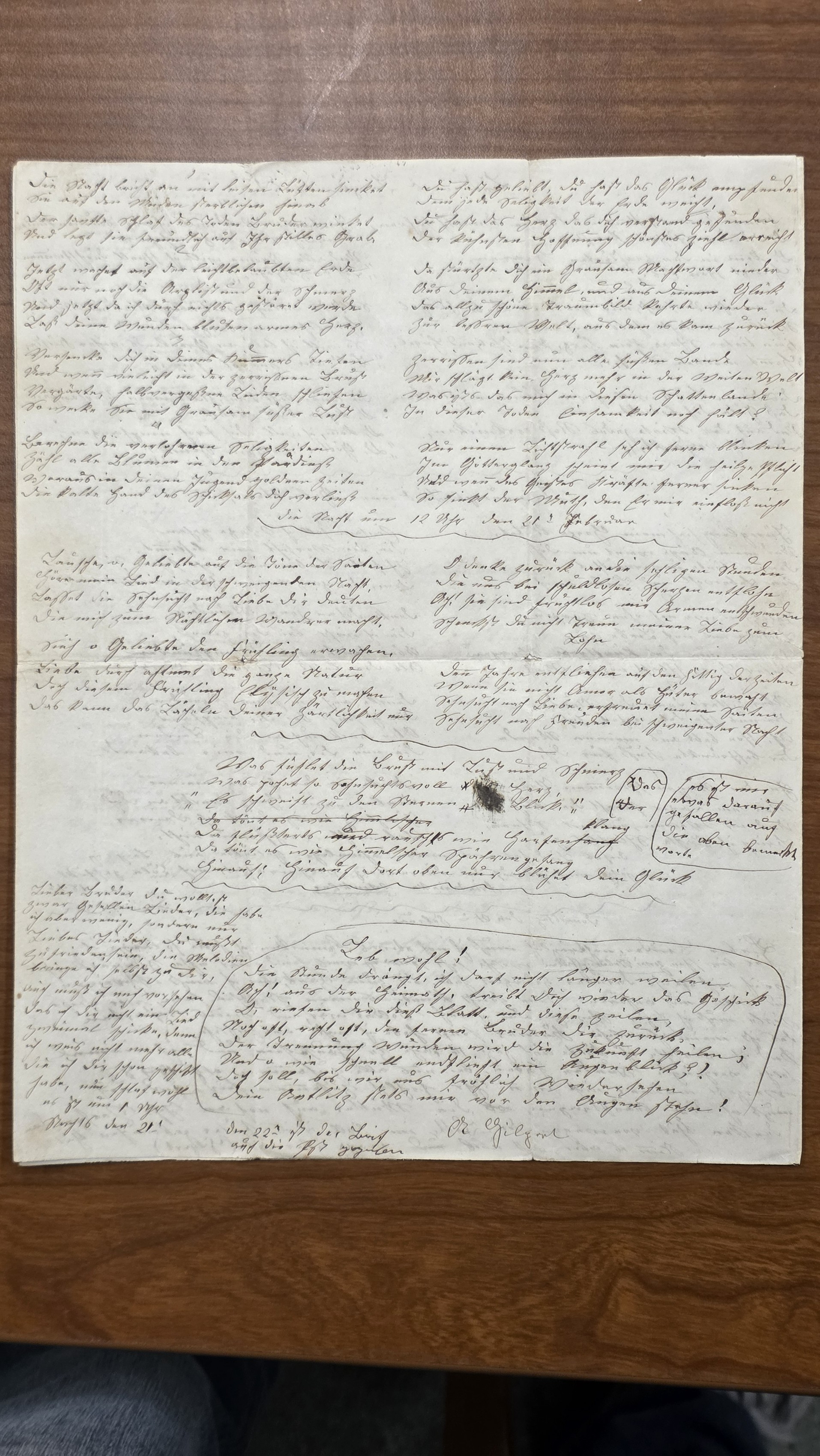
Final marginal notes
“Dear brother, you wanted [convivial/journeymen's songs—category uncertain]. I have only a few of those, mostly love songs; you must be content with them. I will teach you the tunes myself. I must also ask your pardon if I send you a song twice, because I no longer remember all those I have already sent you. Now I shall finish; it is about one o'clock.”
“At night, on the 21st.”
“The letter went into the post on the 22nd.”
English translation — enclosed songs and verses
These are meaning-based translations, not rhyming adaptations. The poems' speakers must not automatically be equated with August. Words about death, loneliness or a lost beloved inside a copied poem are not direct reports of a death in the family. Some readings remain tentative; no missing stanza has been supplied from another edition.
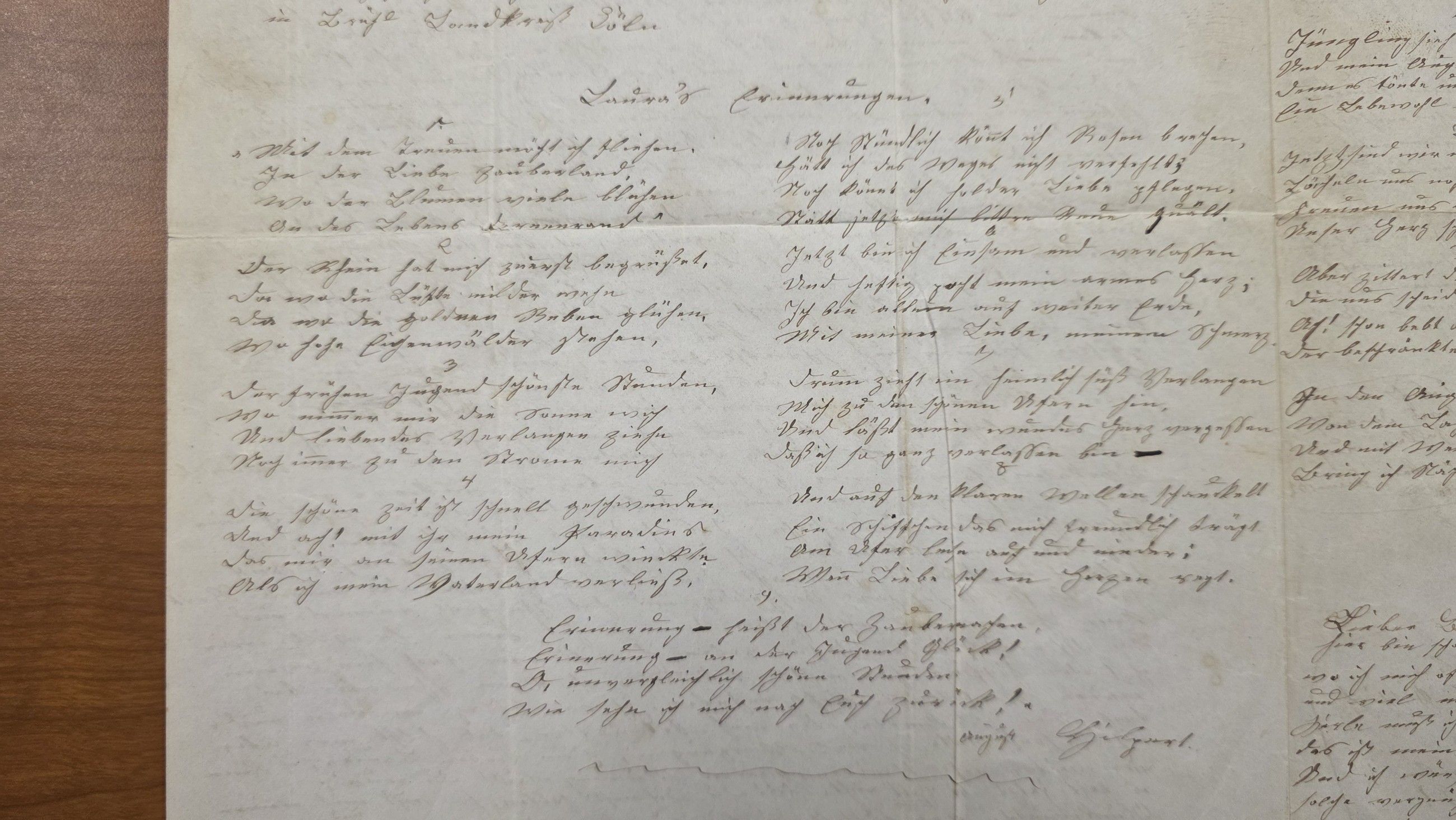
1. Laura’s Memories
1.
With dreams I long to flee
Into love's enchanted land,
Where flowers bloom again
Upon life's seashore.
2.
The [Elbe or Rhine; reading uncertain] first greeted me,
There where its gentle wave rustles,
Where the golden vines bloom,
Where tall oak woods stand.
3.
The finest hours of early youth,
When the sun smiled upon me,
And loving longing draws me
Still towards those shores.
4.
That lovely time has quickly vanished,
And with it, alas, my paradise,
Which beckoned from those shores
When I left my native land.
5.
Still I could break roses there,
Had I not left the place;
Still I could glow with ardent love,
Had [care not now enveloped me—line uncertain].
6.
Now I am lonely and forsaken,
And my poor heart beats fiercely;
I am alone upon the wide earth
With my love and my pain.
7.
Thus a sweet, heavenly longing draws me
Towards those lovely shores,
And lets my wounded heart forget
That I am so utterly forsaken.
8.
And on the clear waves a little boat rocks,
Bearing me in friendly fashion
Up and down beside the shore;
My love stirs within my heart.
9.
Memory is the name of that enchanted little boat,
Memory of the happiness of former days!
You unforgettable, lovely hours,
How I long to return to you!
August Hilpert [signature beneath the copied verse; authorship not established].
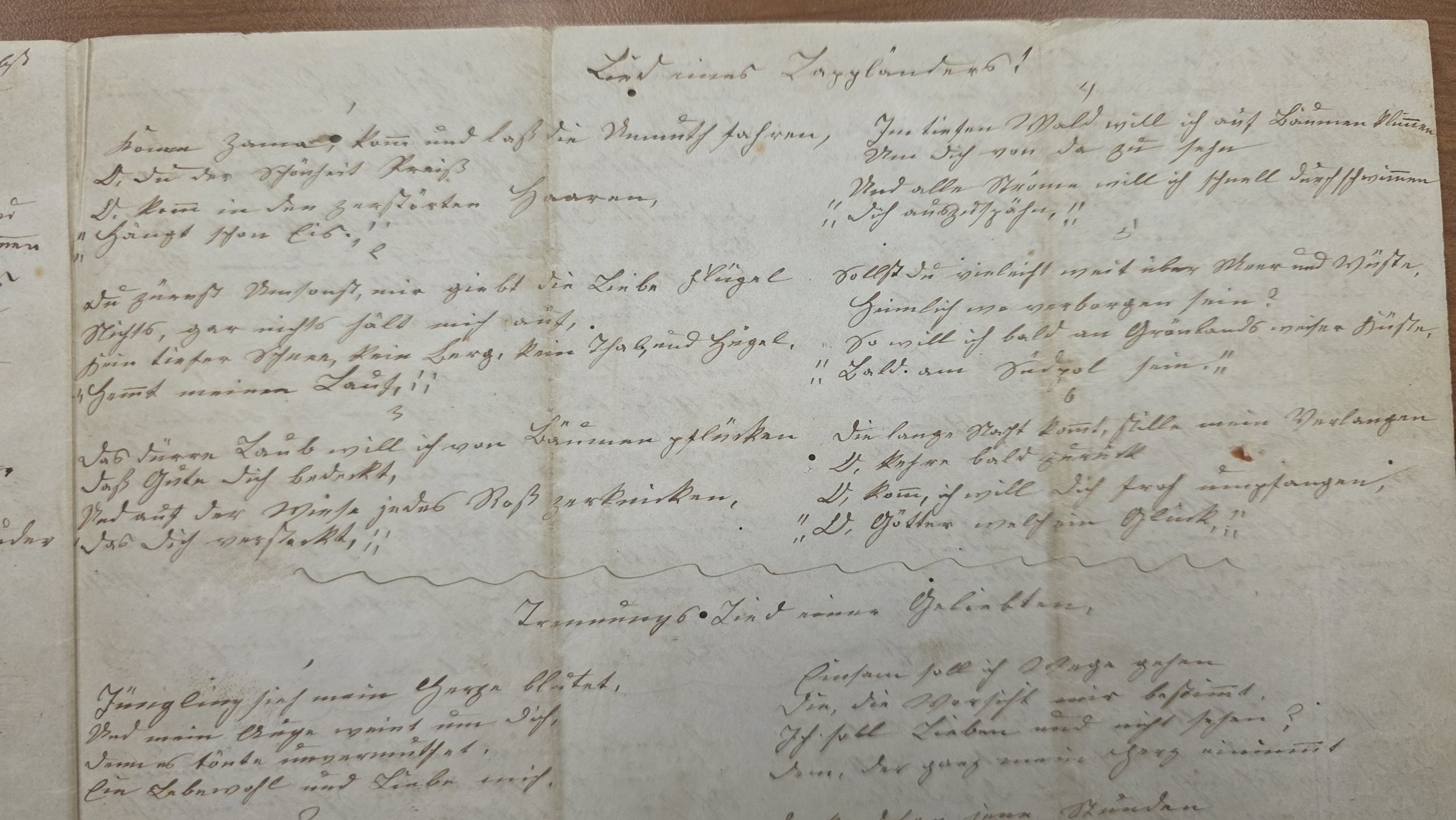
2. “Song of a Laplander” — historical title, Lied eines Lappländers
1.
Come, [Zama], come, and let your melancholy go,
O you, the prize of beauty!
O [come/look—wording uncertain]: in [the disordered hair—phrase uncertain]
Ice already hangs!
2.
You are angry in vain; love gives me wings.
Nothing, nothing at all can hold me back.
No deep snow, no mountain, no ice or ridge
Checks my course!
3.
I shall pluck the dry leaves [from the bushes—word uncertain]
That cover you;
And on the meadow break every [reed—Rohr; handwriting ambiguous]
That hides you!
4.
In the deepest forest I shall climb the trees
To look towards you;
And quickly swim through every stream
To reach you!
5.
Even if you should be hidden from me
Behind sea and desert,
I shall soon be upon Greenland's icy coasts,
Rejoicing!
6.
You long night, come and satisfy my longing;
O return soon!
O come, I want to embrace you dearly,
O [messenger of my happiness?—words uncertain]!
This is a manuscript variant of Ewald von Kleist's “Lied eines Lappländers.” A printed parallel helped resolve the title, the name Zama and the dry-leaves/reeds imagery; those restored readings remain marked where the handwriting is ambiguous. August reverses the middle stanzas and varies several lines. The cold landscape is not evidence that he visited Greenland or any other location named in the verse.
3. A beloved woman's song of parting
1.
Young man, see: my heart is bleeding,
And my eye weeps for you;
For it could never have imagined
A farewell and a life without you.
2.
Now we are still without care;
Love still smiles upon us.
Let us dream of the coming morning;
Our hearts still beat at rest.
3.
But trembling, the hour draws near
That parts us.
Ah, soon from my mouth will sound
The bitterest greeting to you.
4.
Tears swim in my eyes;
Rest flees from my bed.
With weeping and longing
I spend sleepless nights.
5.
Alone I must travel the paths
That Providence appoints for me.
Must I live and not see
The one who holds my whole heart?
6.
Think of those hours
That I once enjoyed with you;
But think what I felt
When the last tear flowed.
7.
Think also of those hours
That I once spent beside you;
But think not of the sufferings
Known only to you and me.
8.
Think of me in the distance;
Think: my heart thinks of you.
Young man, I shall always remember you.
Farewell; forget me not.
[August's note naming his former sweetheart follows this song; translated above.]
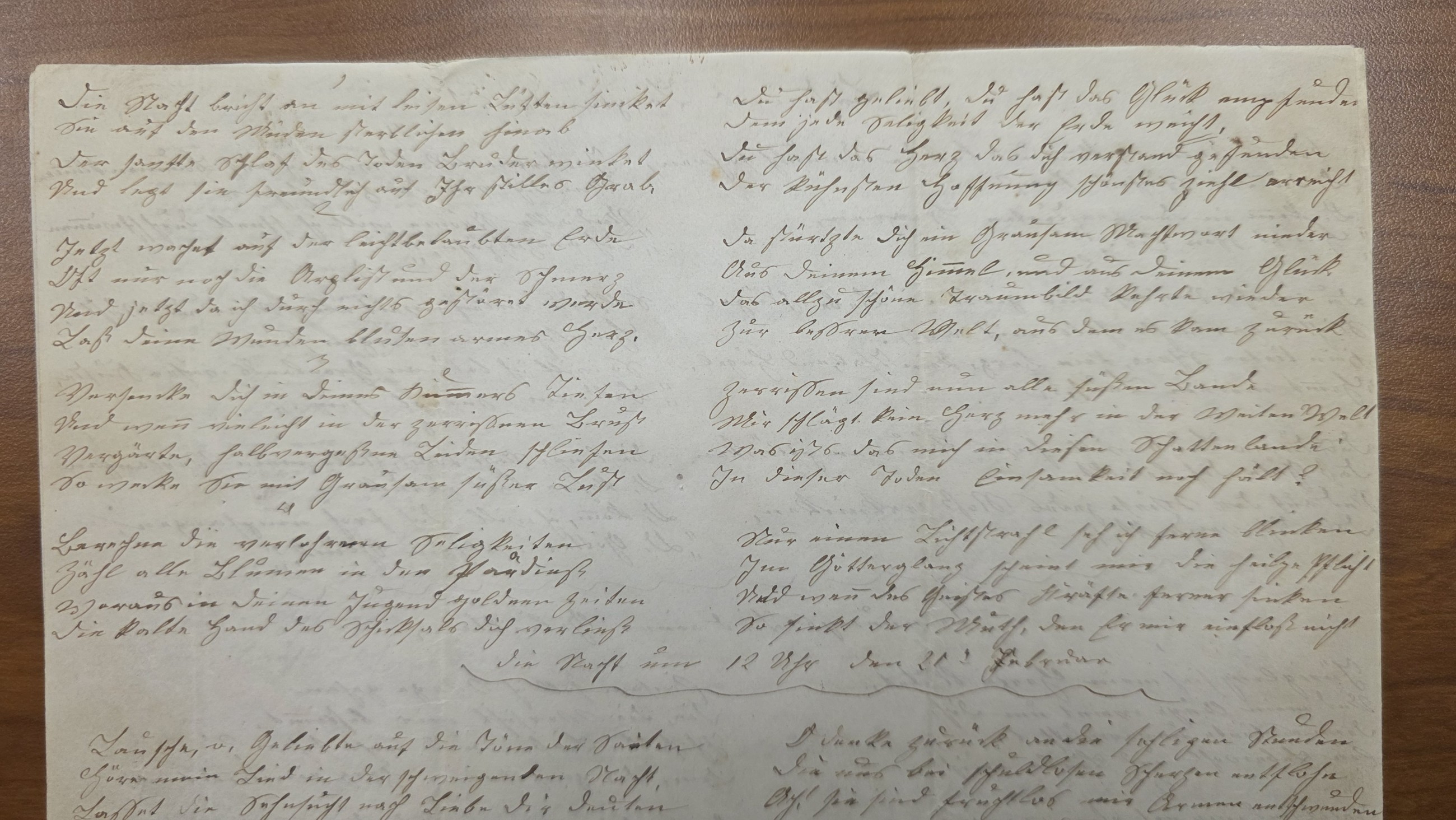
4. Night poem, beginning “Night falls”
1.
Night falls; with gentle breezes it descends
Upon weary mortals.
Gentle sleep, which beckons to every sufferer,
Lays them kindly in their quiet grave.
2.
Now upon the earth deprived of light
Only deceit and pain keep watch.
And now, with nothing to disturb me,
Let your wounds bleed, poor heart.
3.
Sink into the depths of your sorrow;
And if perhaps in your torn breast
Past, half-forgotten sufferings sleep,
Awaken them with cruel, sweet delight.
4.
Count the happiness you have lost,
Count all the flowers in the paradise
From which, in your youth's golden days,
The cold hand of fate drove you.
5.
You have loved; you have found the happiness
To which every earthly blessing yields.
You found the heart that understood you,
Reached the highest goal of the finest hope.
6.
A dreadful command cast you down
From your heaven and your happiness;
The all-too-lovely dream returned
To the better world from which it came.
7.
Now all the sweet bonds are broken;
No heart beats for me in the wide world.
What still holds me in this land of shadows,
In this desolate solitude?
8.
I see one ray of light gleaming in the distance:
In divine radiance my sacred duty appears.
Though the strength of my weary spirit sinks,
The courage that duty gives me does not fail.
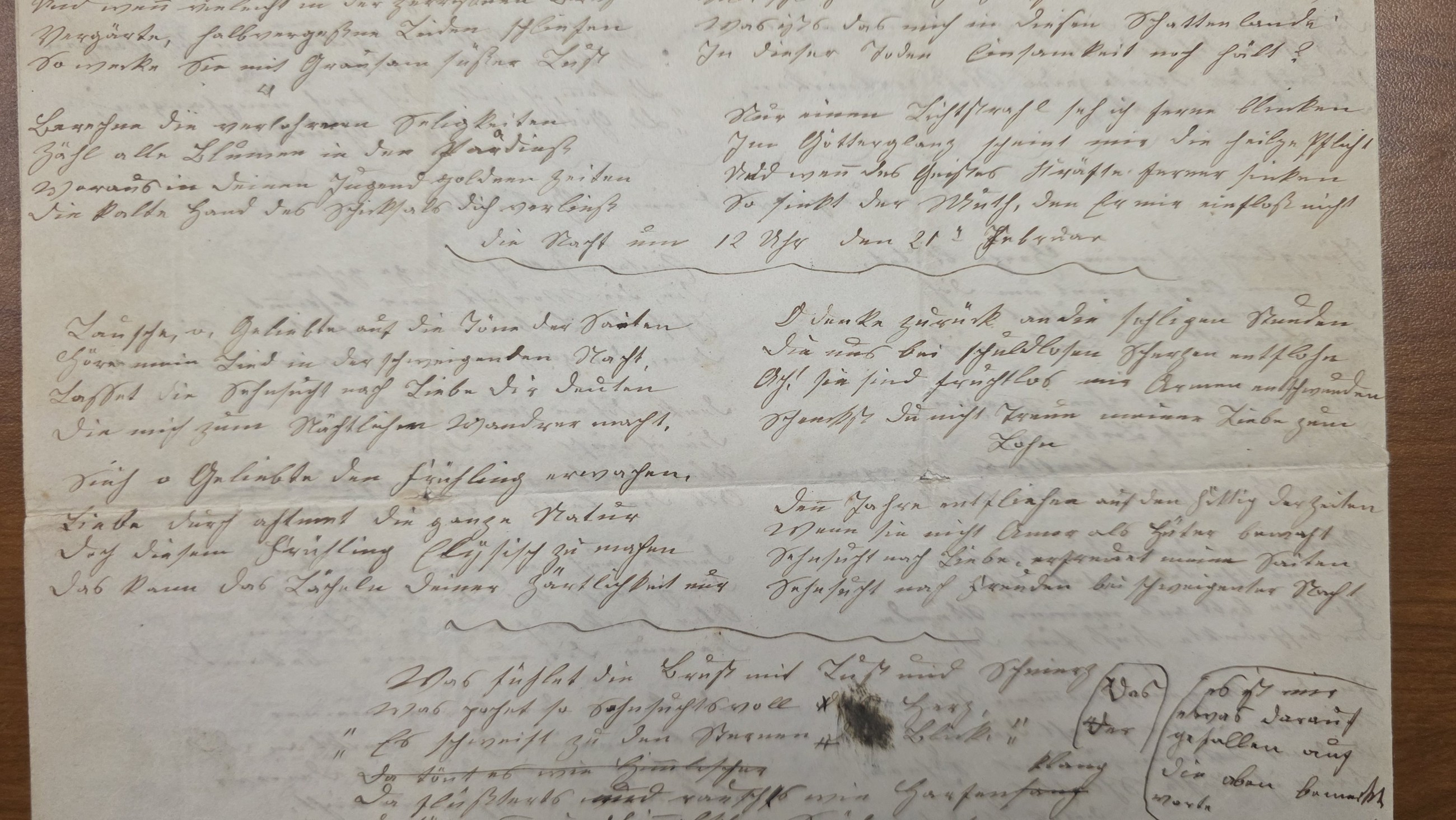
Manuscript note: “At night, twelve o'clock, February 21.”
This is a version of Karoline/Caroline Pichler's poem known through Schubert's setting as Der Unglückliche. August's wording differs in places, particularly the first stanza. The translation follows the manuscript where readable rather than silently substituting the familiar printed wording.
5. “Listen, beloved” [no separate title supplied]
Listen, beloved, to the sound of the strings;
Hear my song in the silent night.
Let it tell you of the longing for love
That makes me a restless wanderer.
See, beloved: spring has passed;
Love breathes through all of nature.
To make this spring an Elysium,
Only the smile of your tenderness can do that.
O think back to those blessed hours
That flew by in innocent play.
Ah, they have vanished like dreams;
Do not deny a tear to my love's tender longings.
The years glide away upon the wings of time
Unless Cupid guides them as charioteer.
Longing for love makes my strings resound,
Longing for joy in the silent night.
The spring imagery and a few inflections are irregular in the manuscript. This is not evidence of a particular courtship date.
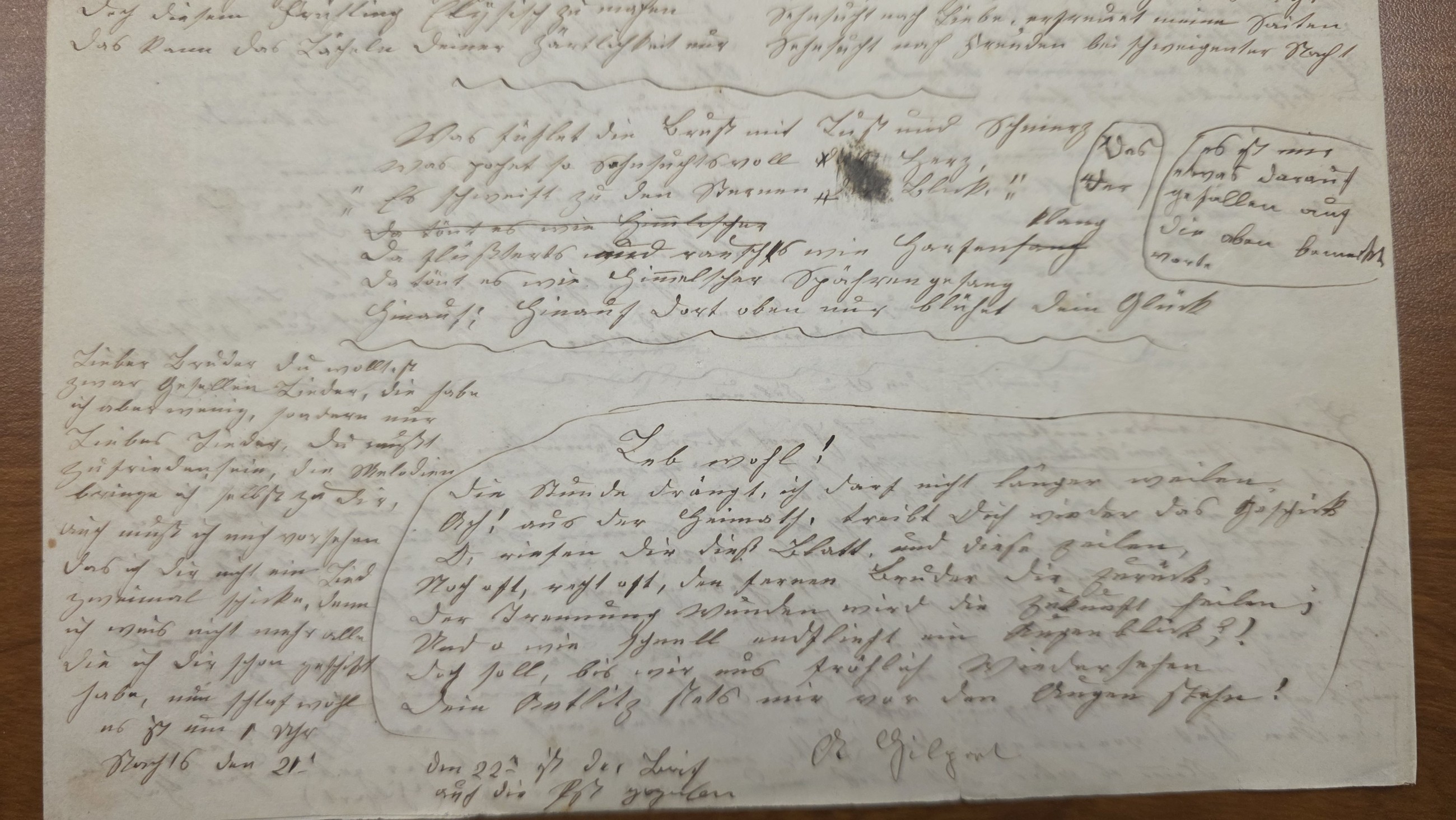
6. Short fragment beginning “What fills the breast”
What fills the breast with joy and pain?
What makes the heart beat so full of longing?
It is [consecrated/turned—word uncertain] towards the stars [damaged words].
[A cancelled line is not securely readable.]
There it whispers and rustles like the sound of a harp;
It sounds like a heavenly choir of angels.
Upwards! Upwards! Only there above does your happiness bloom.
Correction note beside the fragment: “Something has fallen onto it; you will notice that above.” There is a dark blot and cancelled wording. The missing text has not been reconstructed as certain.
7. Farewell
The hour presses; I must linger no longer.
Ah, from home fate drives you onward.
May this sheet and these lines bring you
The distant brother's greeting, now and often.
The future will heal separation's wounds;
And how quickly an instant slips away!
Yet until we meet again in happiness,
Your image shall always stand before my eyes.
A. Hilpert [signature].