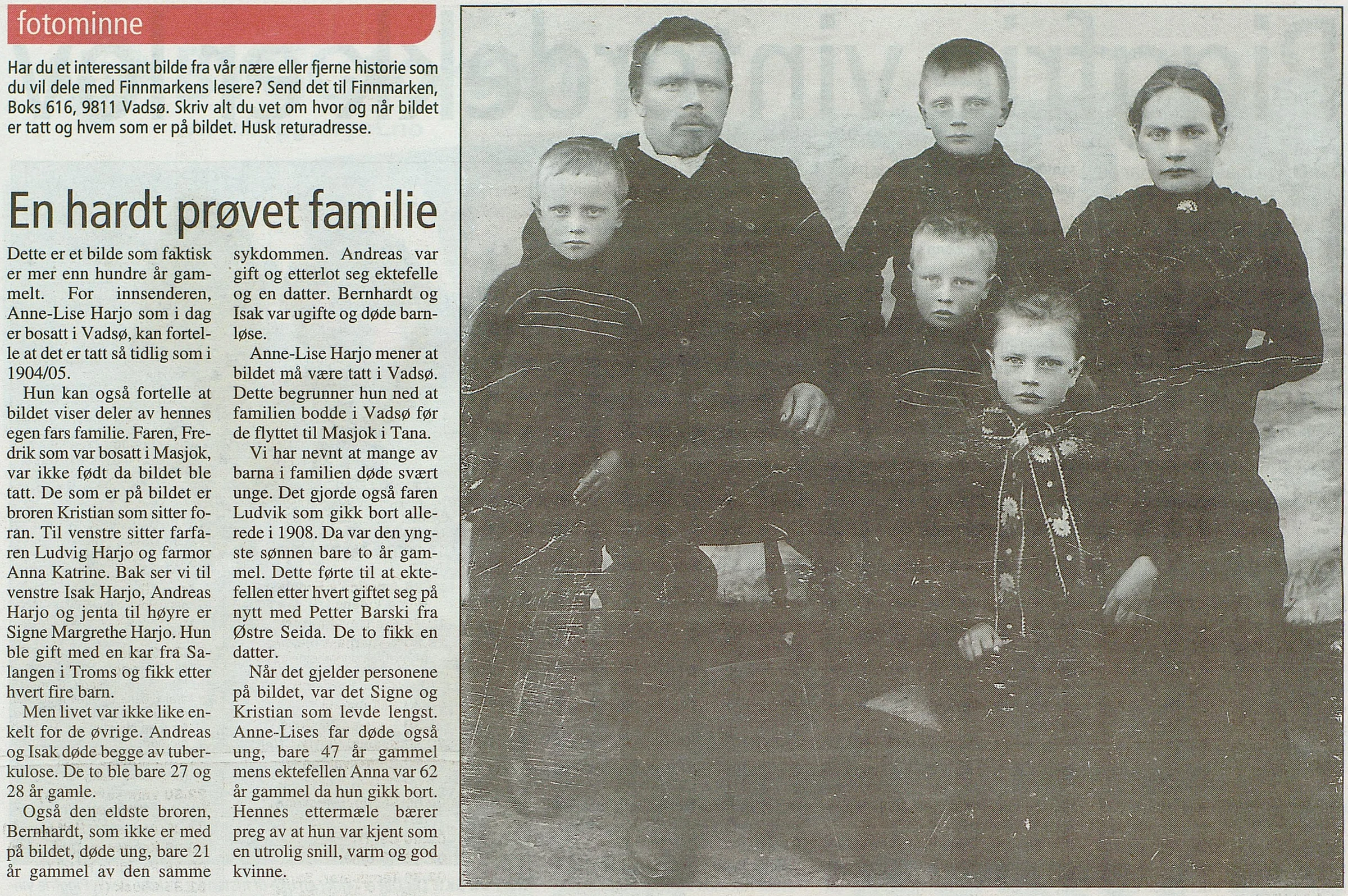
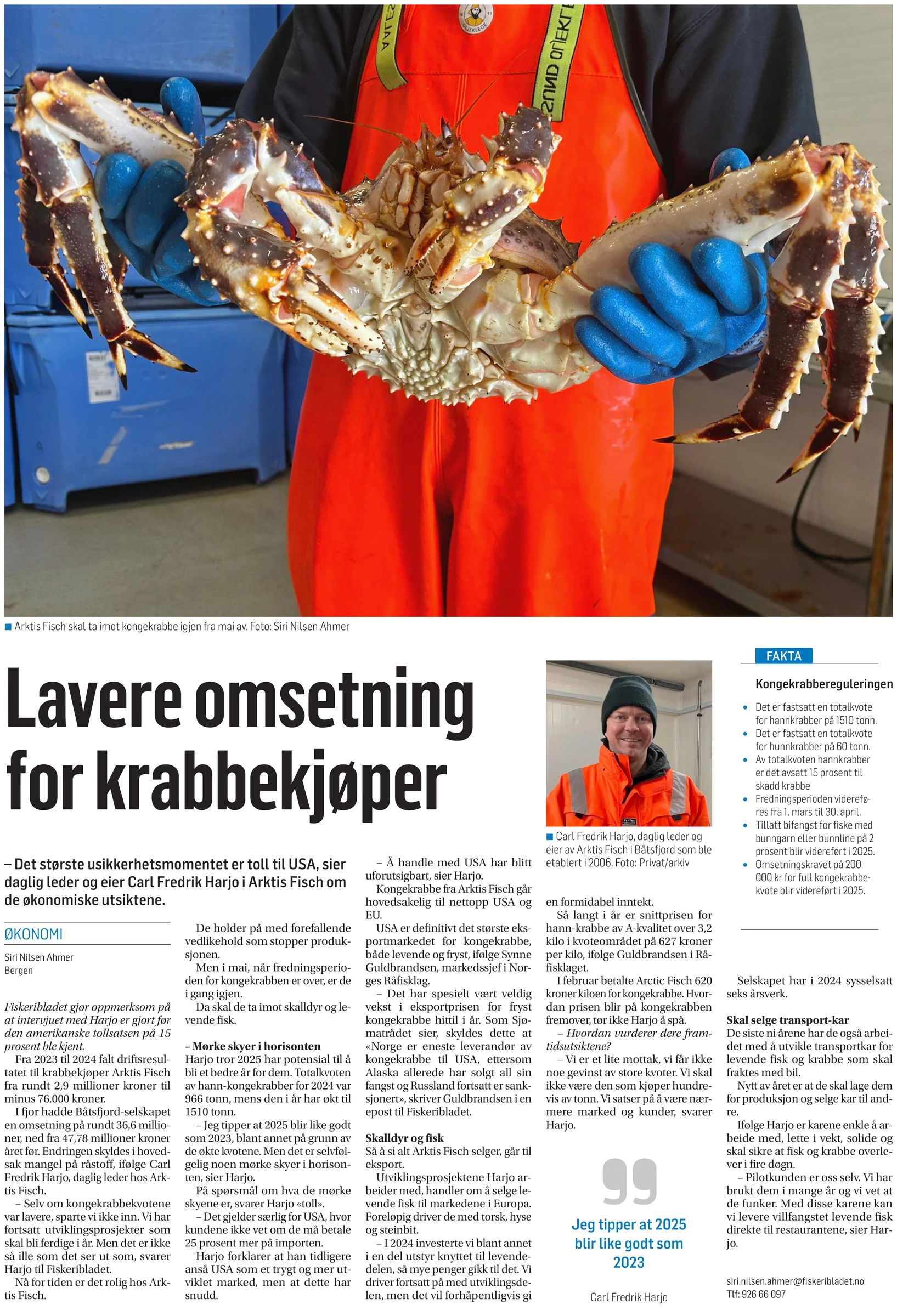
THE HARJO FAMILY · FROM THE ARCHIVES

Family Lives in the Newspaper

Weddings and farewells, work by the sea, and everyday life in Vadsø and Masjok.

These 42 articles and notices follow our family from 1896 to 2025. Read the English summaries and translations, enlarge the original clippings, and follow the links into each person’s story. Some announcements appeared in several newspapers; each clipping is kept with its own date and source.

Finmarkens Amtstidende · September 5, 1896 · p. 2

Bernt and Marie's marriage

English summary

On August 27, 1896, sailor Bernt Vilhelm Børresen married Marie Cecilie Harjo in Vadsø. Bernt was Anna Kathrine’s brother and Marie was Ludvig’s sister, joining the two families in another marriage.

English translation

Married in Vadsø, August 1896: on the 27th, sailor Bernt Vilhelm Børresen and Marie Cecilie Harjo.

Bernt and Marie's marriage · 1/2Enlarge clipping ⤢
Clipping 1 / 2
Bernt and Marie's marriage · 2/2Enlarge clipping ⤢
Clipping 2 / 2

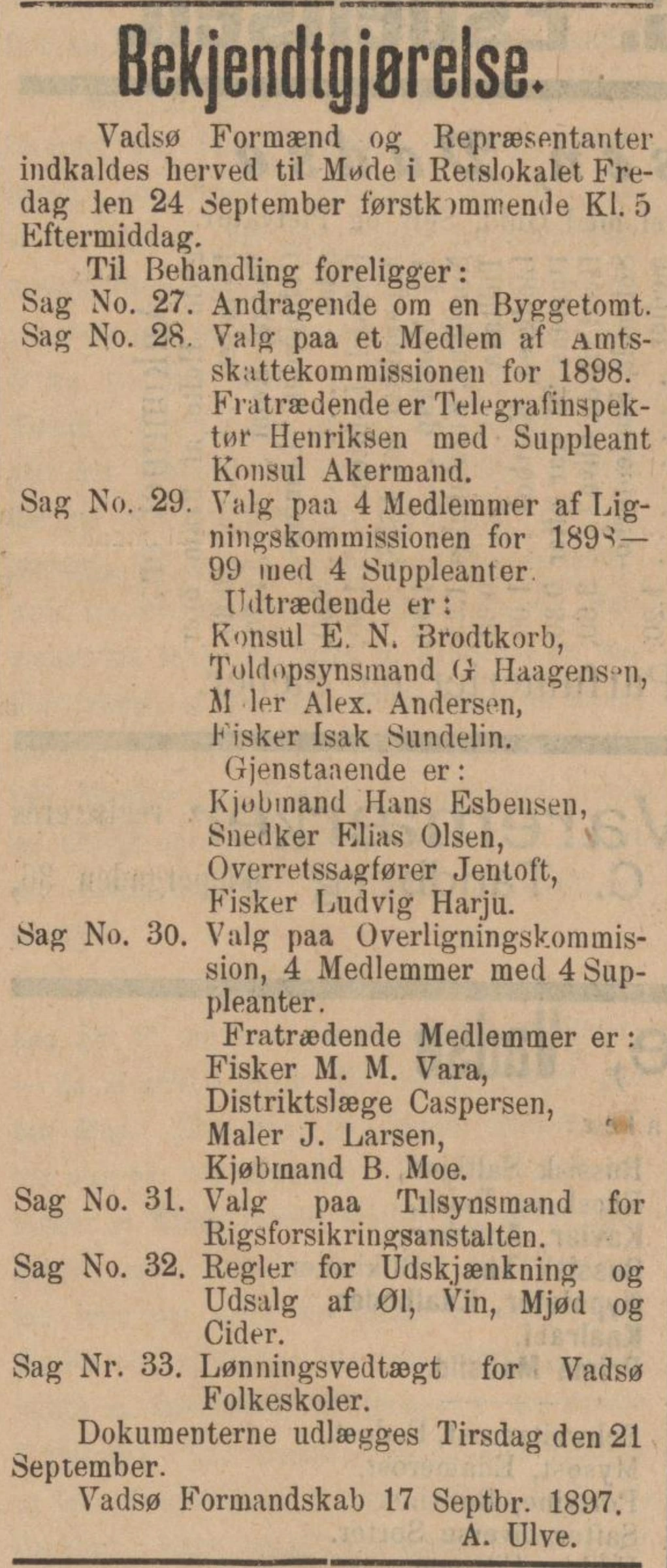
Finmarkens Amtstidende · September 17, 1897 · p. 3

Ludvig Harju on Vadsø’s tax assessment commission

English summary

Alongside his work as a fisherman, Ludvig served on Vadsø’s tax assessment commission. This September 1897 meeting notice names him among the continuing members as four other seats came up for election.

English translation

Announcement

The members of Vadsø’s municipal executive committee and council are hereby summoned to a meeting in the courtroom on Friday, 24 September, at 5 p.m.

The following matters are to be considered:

Case no. 27. Application for a building plot.

Case no. 28. Election of one member of the county tax commission for 1898. The outgoing member is Telegraph Inspector Henriksen, with Consul Akermand as alternate.

Case no. 29. Election of four members of the tax assessment commission for 1898–99, with four alternates.
Outgoing members:
Consul E. N. Brodtkorb,
Customs Officer G. Haagensen,
Painter Alex. Andersen,
Fisherman Isak Sundelin.
Continuing members:
Merchant Hans Esbensen,
Carpenter Elias Olsen,
High Court Attorney Jentoft,
Fisherman Ludvig Harju.

Case no. 30. Election of the tax assessment review commission: four members with four alternates. The outgoing members are:
Fisherman M. M. Vara,
District Physician Caspersen,
Painter J. Larsen,
Merchant B. Moe.

Case no. 31. Election of a supervisor for the National Insurance Institution.

Case no. 32. Rules for the serving and retail sale of beer, wine, mead and cider.

Case no. 33. Salary regulations for Vadsø’s elementary schools.

The documents will be made available on Tuesday, 21 September.

Vadsø municipal executive committee, 17 September 1897.
A. Ulve.

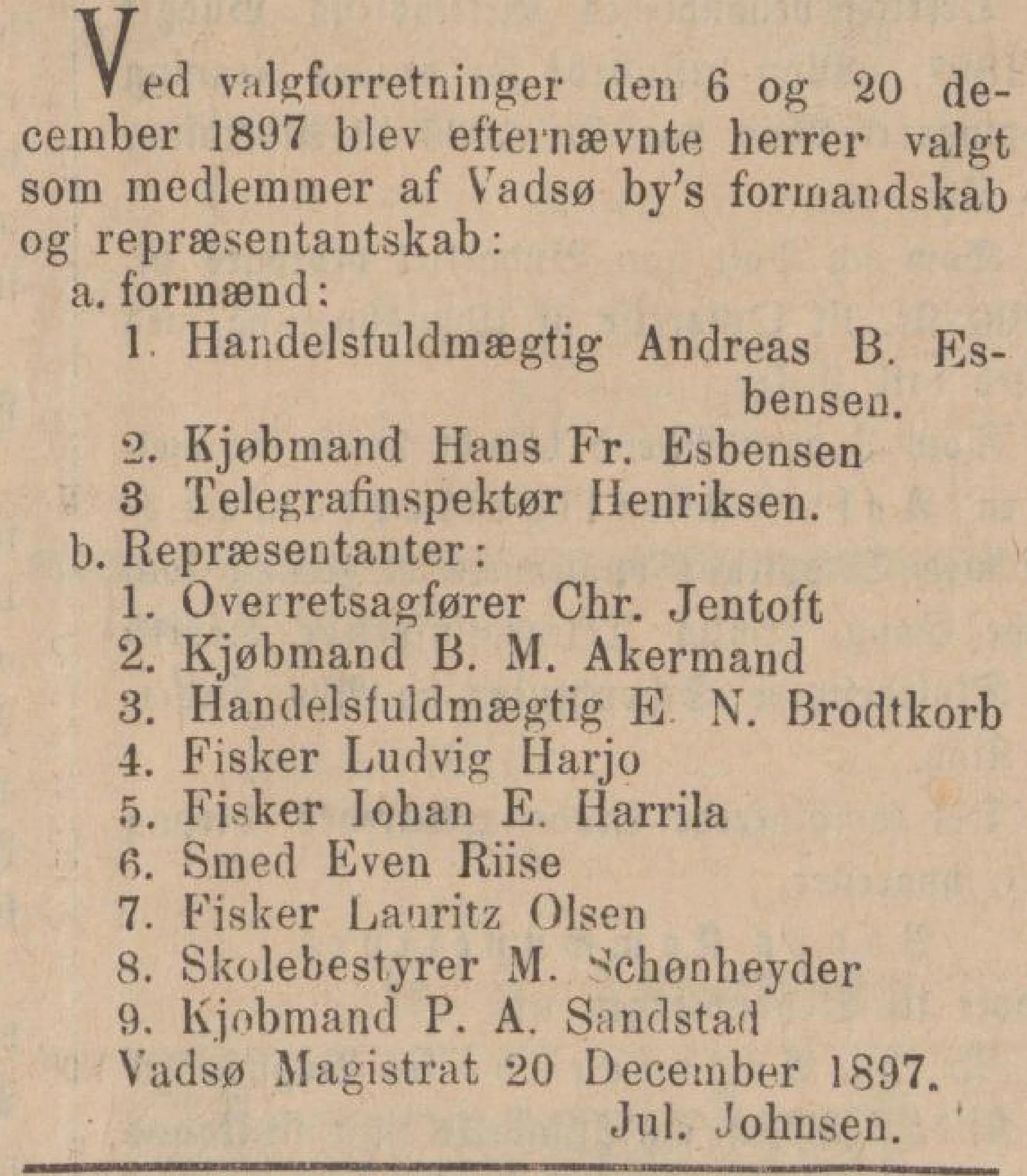
Finmarkens Amtstidende · December 23, 1897 · p. 2

Ludvig Harjo elected to Vadsø’s municipal council

English summary

Ludvig was elected to Vadsø’s municipal council in December 1897. The notice describes him as a fisherman and lists him fourth among the council representatives. It reports elections held on December 6 and 20.

English translation

At the elections held on 6 and 20 December 1897, the following gentlemen were elected as members of the town of Vadsø’s municipal executive committee and council:

a. Executive committee members:
1. Commercial clerk Andreas B. Esbensen.
2. Merchant Hans Fr. Esbensen.
3. Telegraph Inspector Henriksen.

b. Council representatives:
1. High Court Attorney Chr. Jentoft.
2. Merchant B. M. Akermand.
3. Commercial clerk E. N. Brodtkorb.
4. Fisherman Ludvig Harjo.
5. Fisherman Johan E. Harrila.
6. Blacksmith Even Riise.
7. Fisherman Lauritz Olsen.
8. Headmaster M. Schenheyder.
9. Merchant P. A. Sandstad.

Vadsø Magistrate, 20 December 1897.
Jul. Johnsen.

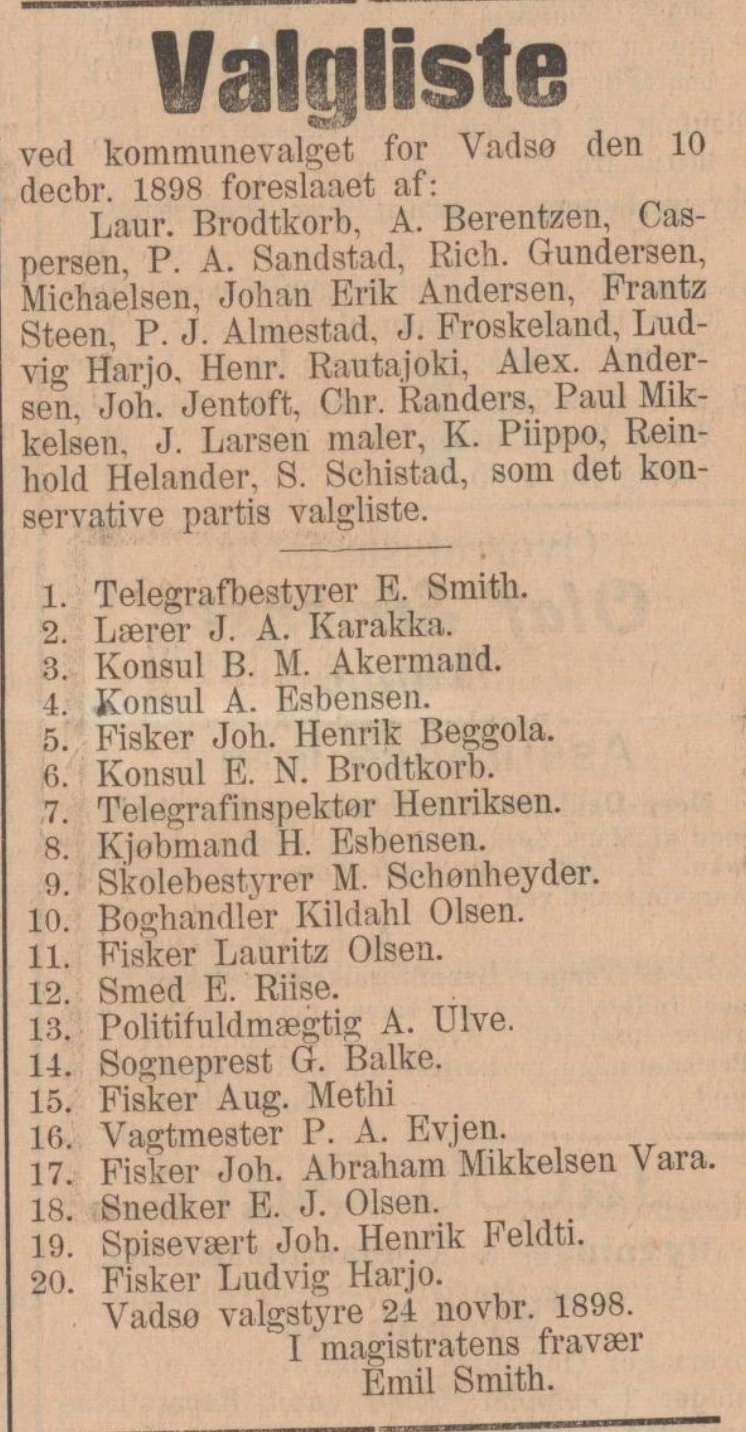
Finmarkens Amtstidende · December 2, 1898 · p. 2

Ludvig on Vadsø’s municipal election list

English summary

Ludvig, a fisherman in Vadsø, helped propose the Conservative candidate list for the municipal election on December 10, 1898. His name also appears as its twentieth candidate. The result, printed later that month, records his election with 128 votes.

English translation

Election list

For the municipal election in Vadsø on December 10, 1898, proposed by:
Laur. Brodtkorb, A. Berentzen, Caspersen, P. A. Sandstad, Rich. Gundersen, Michaelsen, Johan Erik Andersen, Frantz Steen, P. J. Almestad, J. Frøskeland, Ludvig Harjo, Henr. Rautajoki, Alex. Andersen, Joh. Jentoft, Chr. Randers, Paul Mikkelsen, J. Larsen, painter, K. Piippo, Reinhold Helander, and S. Schistad, as the Conservative Party’s election list.

1. Telegraph manager E. Smith.
2. Teacher J. A. Karakka.
3. Consul B. M. Akermand.
4. Consul A. Esbensen.
5. Fisherman Joh. Henrik Beggola.
6. Consul E. N. Brodtkorb.
7. Telegraph inspector Henriksen.
8. Merchant H. Esbensen.
9. Headmaster M. Schønheyder.
10. Bookseller Kildahl Olsen.
11. Fisherman Lauritz Olsen.
12. Blacksmith E. Riise.
13. Assistant police official A. Ulve.
14. Parish pastor G. Balke.
15. Fisherman Aug. Methi.
16. Caretaker P. A. Evjen.
17. Fisherman Joh. Abraham Mikkelsen Vara.
18. Carpenter E. J. Olsen.
19. Restaurateur Joh. Henrik Feldti.
20. Fisherman Ludvig Harjo.

Vadsø Electoral Board, November 24, 1898.
In the absence of the magistrate,
Emil Smith.

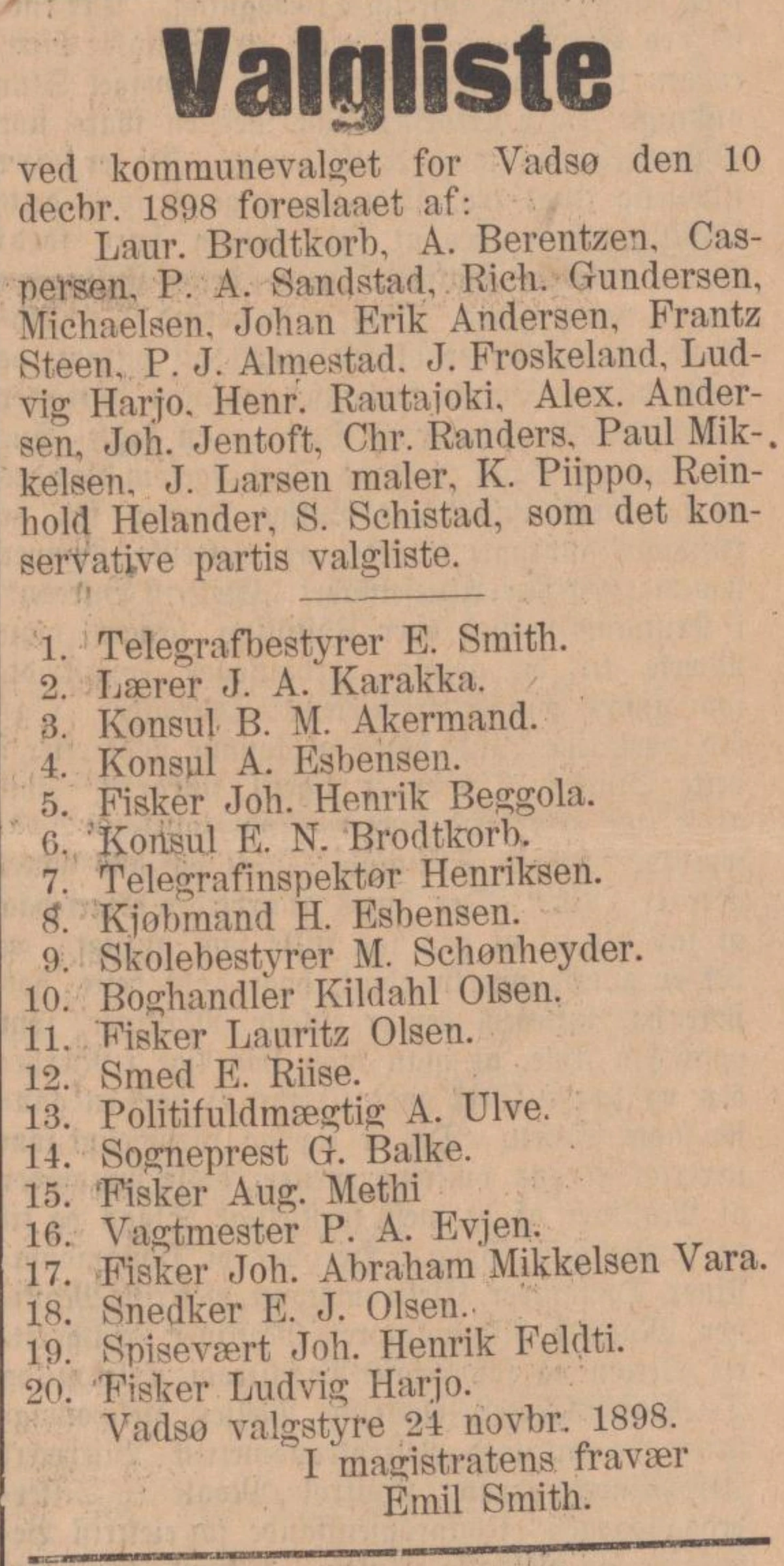
Finmarkens Amtstidende · December 9, 1898 · p. 2

Ludvig on the Conservative candidate list for Vadsø, repeated notice

English summary

On the eve of Vadsø’s December 10 election, the Conservative list appeared again. Ludvig was both a proposer and a candidate; the result a week later would record his 128 votes.

English translation

Candidate list

For the municipal election in Vadsø on 10 December 1898, proposed by:

Laur. Brodtkorb, A. Berentzen, Caspersen, P. A. Sandstad, Rich. Gundersen, Michaelsen, Johan Erik Andersen, Frantz Steen, P. J. Almestad, J. Froskeland, Ludvig Harjo, Henr. Rautajoki, Alex. Andersen, Joh. Jentoft, Chr. Randers, Paul Mikkelsen, J. Larsen, painter, K. Piippo, Reinhold Helander and S. Schistad, as the Conservative Party’s candidate list.

1. Telegraph Office Manager E. Smith.
2. Teacher J. A. Karakka.
3. Consul B. M. Akermand.
4. Consul A. Esbensen.
5. Fisherman Joh. Henrik Beggola.
6. Consul E. N. Brodtkorb.
7. Telegraph Inspector Henriksen.
8. Merchant H. Esbensen.
9. Headmaster M. Schenheyder.
10. Bookseller Kildahl Olsen.
11. Fisherman Lauritz Olsen.
12. Blacksmith E. Riise.
13. Police Officer A. Ulve.
14. Parish Priest G. Balke.
15. Fisherman Aug. Methi.
16. Custodian P. A. Evjen.
17. Fisherman Joh. Abraham Mikkelsen Vara.
18. Carpenter E. J. Olsen.
19. Eating-house keeper Joh. Henrik Feldti.
20. Fisherman Ludvig Harjo.

Vadsø electoral board, 24 November 1898.
In the magistrate’s absence,
Emil Smith.

Finmarkens Amtstidende · December 16, 1898 · p. 2

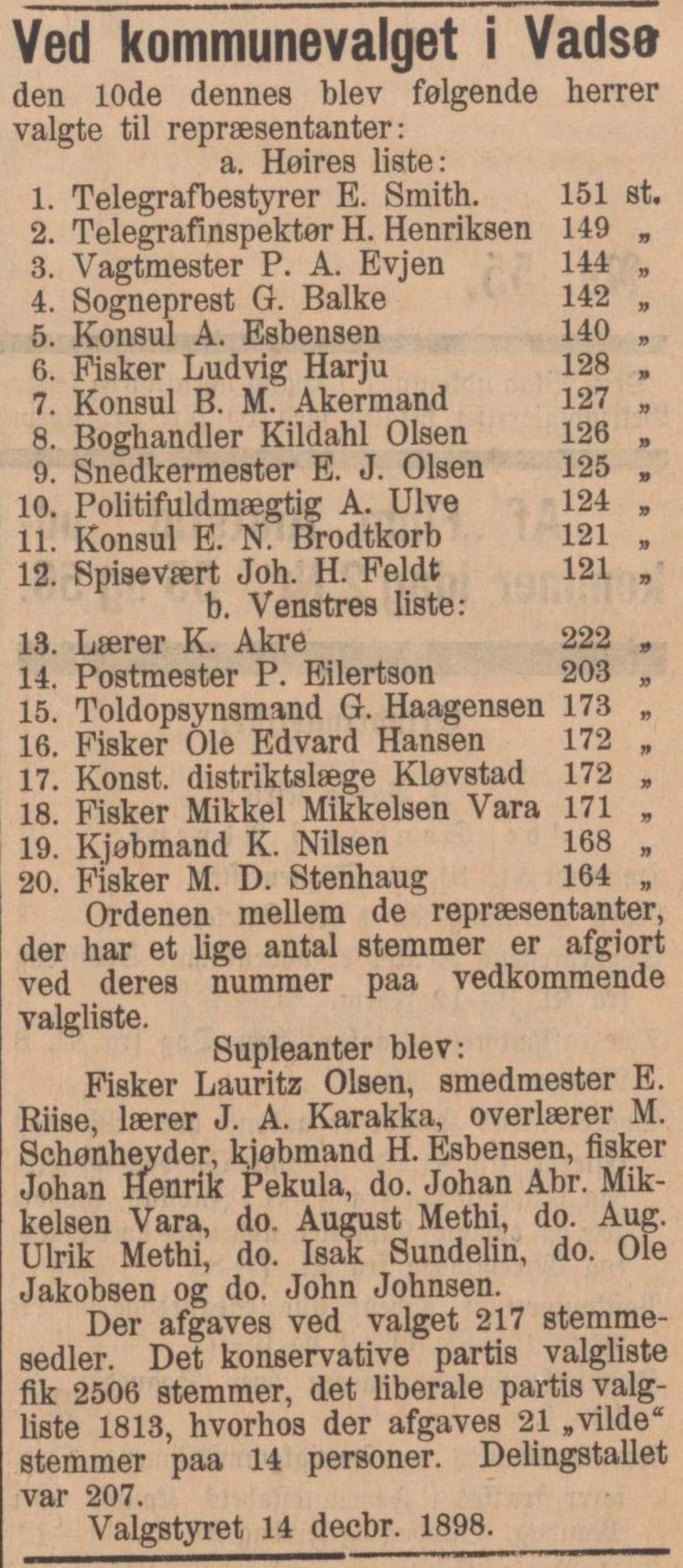
Ludvig Harju elected with 128 votes in December 1898

English summary

At Vadsø’s election on December 10, 1898, Ludvig won a council seat with 128 votes. He was sixth among twelve elected Conservative representatives; eight Liberal representatives were also elected.

English translation

At the municipal election in Vadsø

On the 10th of this month, the following gentlemen were elected as representatives:

a. Conservative list:
1. Telegraph Office Manager E. Smith: 151 votes.
2. Telegraph Inspector H. Henriksen: 149 votes.
3. Custodian P. A. Evjen: 144 votes.
4. Parish Priest G. Balke: 142 votes.
5. Consul A. Esbensen: 140 votes.
6. Fisherman Ludvig Harju: 128 votes.
7. Consul B. M. Akermand: 127 votes.
8. Bookseller Kildahl Olsen: 126 votes.
9. Master Carpenter E. J. Olsen: 125 votes.
10. Police Officer A. Ulve: 124 votes.
11. Consul E. N. Brodtkorb: 121 votes.
12. Eating-house keeper Joh. H. Feldt: 121 votes.

b. Liberal list:
13. Teacher K. Akre: 222 votes.
14. Postmaster P. Eilertson: 203 votes.
15. Customs Officer G. Haagensen: 173 votes.
16. Fisherman Ole Edvard Hansen: 172 votes.
17. Acting District Physician Kløvstad: 172 votes.
18. Fisherman Mikkel Mikkelsen Vara: 171 votes.
19. Merchant K. Nilsen: 168 votes.
20. Fisherman M. D. Stenhaug: 164 votes.

The order among representatives with an equal number of votes has been determined by their numbers on the respective candidate list.

The alternates elected were:
Fisherman Lauritz Olsen, Master Blacksmith E. Riise, Teacher J. A. Karakka, Senior Teacher M. Schønheyder, Merchant H. Esbensen, Fisherman Johan Henrik Pekula, Fisherman Johan Abr. Mikkelsen Vara, Fisherman August Methi, Fisherman Aug. Ulrik Methi, Fisherman Isak Sundelin, Fisherman Ole Jakobsen and Fisherman John Johnsen.

At the election, 217 ballot papers were cast. The Conservative Party’s candidate list received 2,506 votes and the Liberal Party’s candidate list 1,813. In addition, 21 votes outside the official lists were cast for 14 persons. The allocation divisor was 207.

The electoral board, 14 December 1898.

Finmarken · September 21, 1901 · p. 3

Difficult times for Ludvig’s shop

English summary

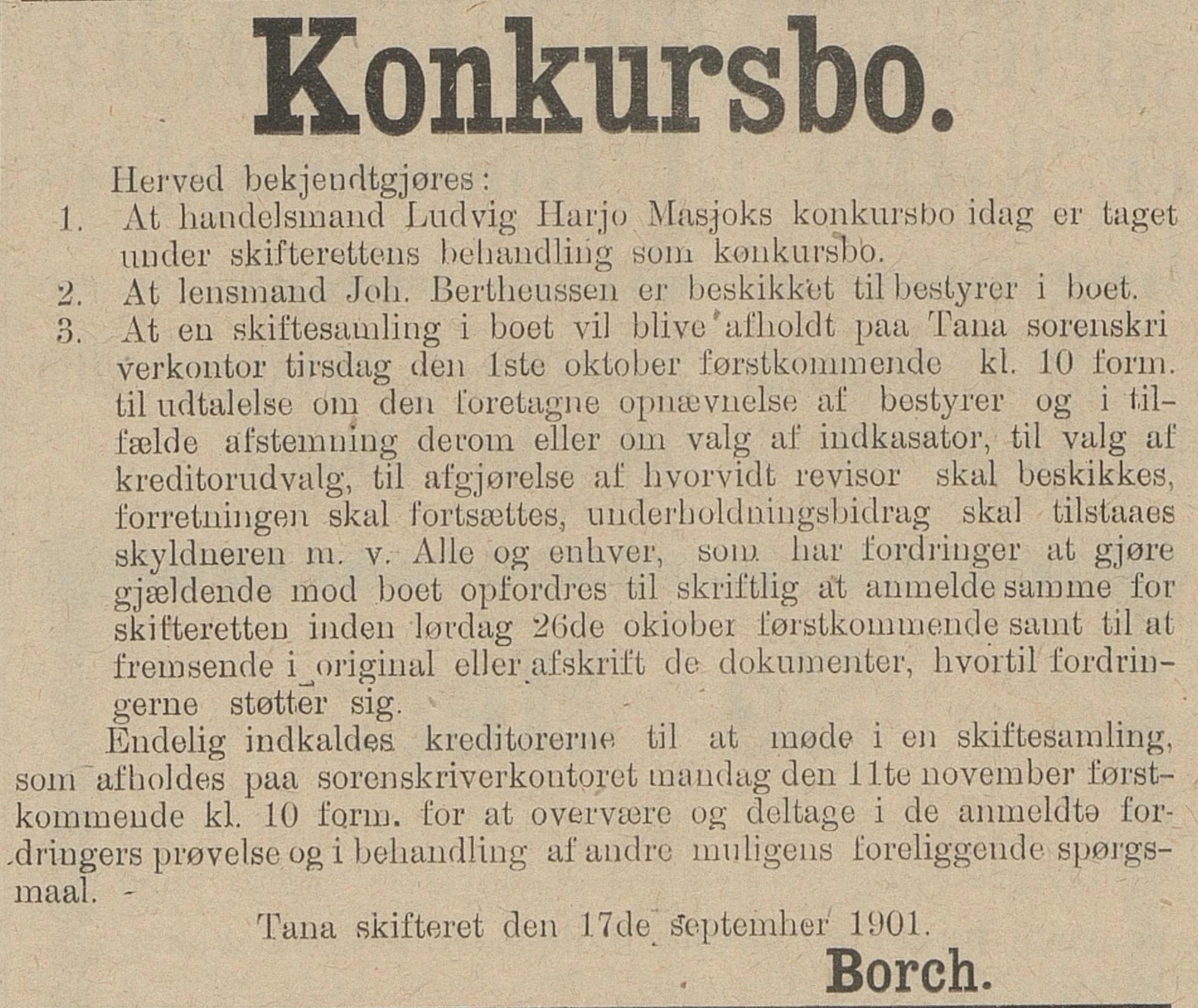
In September 1901, Ludvig’s business entered bankruptcy proceedings. Creditors were called together to discuss the estate, whether the shop could continue, and support for Ludvig. The announcement gives us a glimpse of the financial pressure behind the family’s years in Masjok.

English translation

It is hereby announced:

  1. That the estate of merchant Ludvig Harjo of Masjok has today been placed under the administration of the bankruptcy court as a bankrupt estate.
  2. That district sheriff Joh. Bertheussen has been appointed administrator of the estate.
  3. That a meeting concerning the estate will be held at the Tana district judge’s office on Tuesday, October 1 next, at 10 a.m., to consider the appointment of the estate administrator and, if necessary, vote on that appointment or on the selection of a collection agent; to elect a creditors’ committee; and to decide whether an auditor should be appointed, whether the business should continue, whether a maintenance allowance should be granted to the debtor, and other matters.

All persons having claims against the estate are requested to submit those claims in writing to the bankruptcy court by Saturday, October 26 next, and to forward the documents supporting their claims, either as originals or copies.

Finally, creditors are summoned to attend a meeting at the district judge’s office on Monday, November 11 next, at 10 a.m., to witness and participate in the examination of the submitted claims and the consideration of any other matters that may arise.

Tana Bankruptcy Court, September 17, 1901.

Borch

Finmarken · November 24, 1903 · p. 3

An auction of fabrics from Ludvig’s shop

English summary

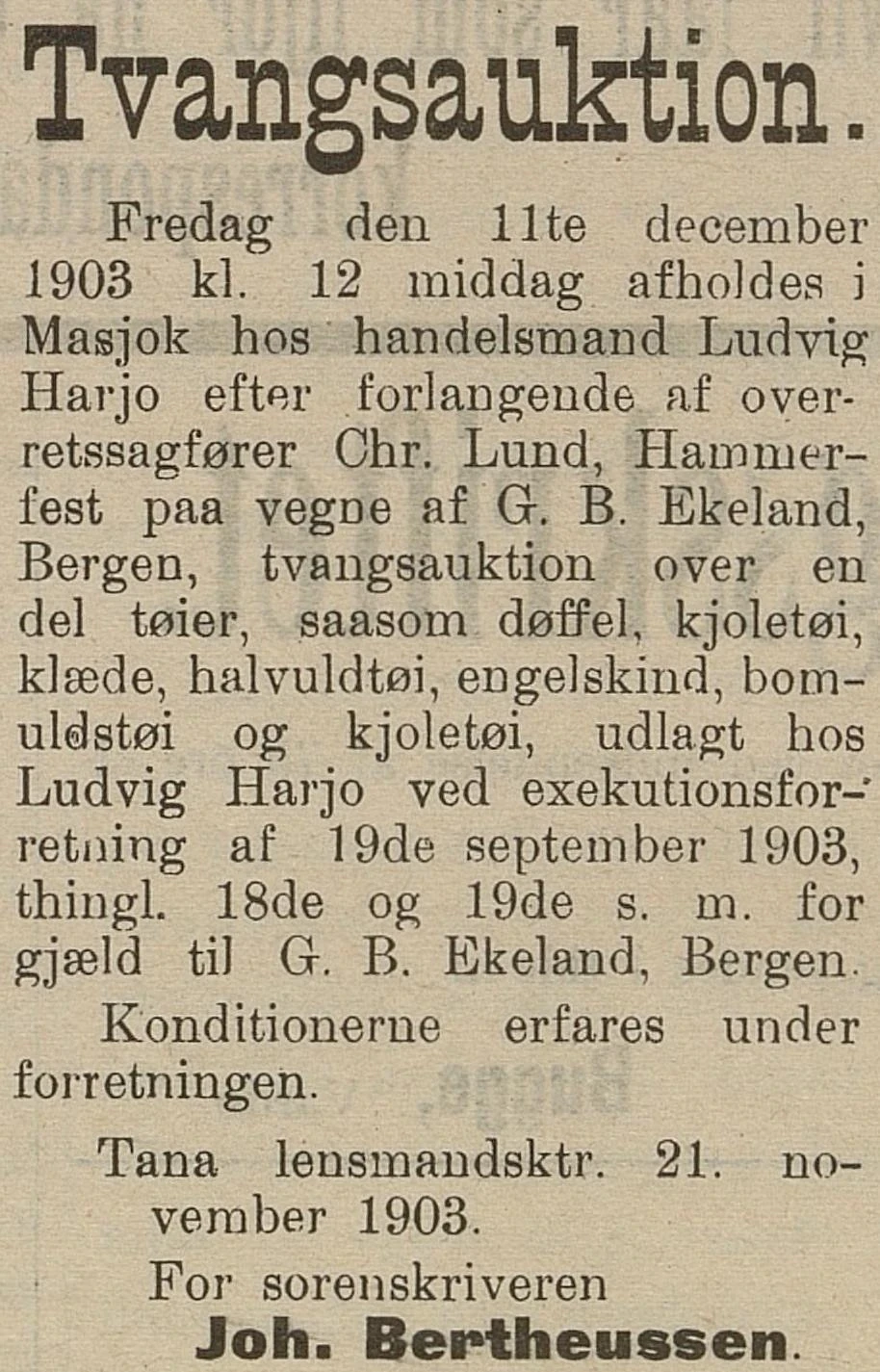
An auction of fabrics from Ludvig’s shop in Masjok was scheduled for December 11, 1903, over a debt to G. B. Ekeland of Bergen. Duffel, woollen cloth, cotton and dress fabrics were among the goods listed. The notice leaves the outcome of the planned sale untold.

English translation

On Friday, December 11, 1903, at 12 noon, a forced auction will be held in Masjok at the premises of merchant Ludvig Harjo, at the request of attorney Chr. Lund of Hammerfest, acting on behalf of G. B. Ekeland of Bergen.

The auction will comprise a quantity of fabrics, including duffel cloth, dress fabric, woollen cloth, wool-blend fabric, engelskind, cotton fabric and dress fabric, seized from Ludvig Harjo in enforcement proceedings dated September 19, 1903, registered on the 18th and 19th of the same month, for a debt owed to G. B. Ekeland of Bergen.

The conditions of sale will be announced during the proceedings.

Tana District Sheriff’s Office, November 21, 1903.

On behalf of the district judge,

Joh. Bertheussen

The auction notice repeats “dress fabric” and gives registration dates of September 18 and 19 after naming proceedings dated September 19; both details are preserved as printed. The historical fabric name engelskind is retained rather than assigned an uncertain modern equivalent.

Østfinmarkens Folkeblad · December 30, 1912 · p. 1

Petter's petition over Johan and Ludvig's taxes

English summary

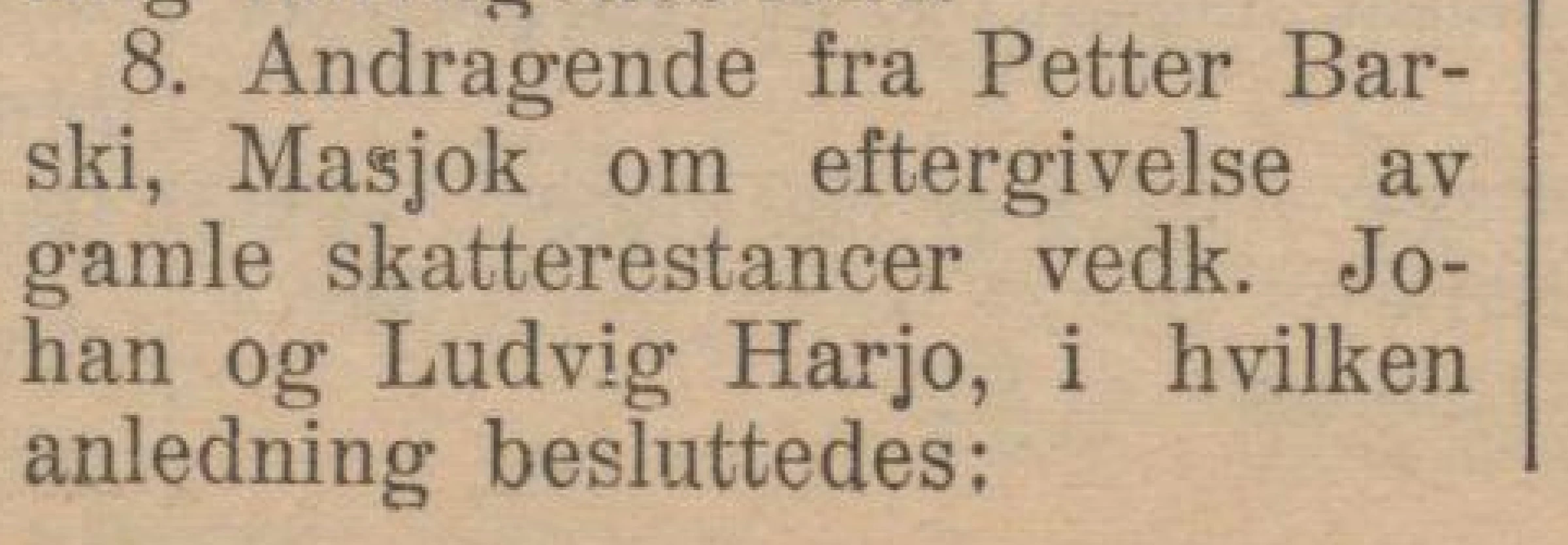
Petter asked Tana council to reduce old tax arrears concerning Johan and Ludvig Harjo. At its November 1912 meetings, the council reduced the amount to 50 kroner, provided it was paid by the end of February 1913. The entry continues from the bottom of one column to the top of the next.

English translation

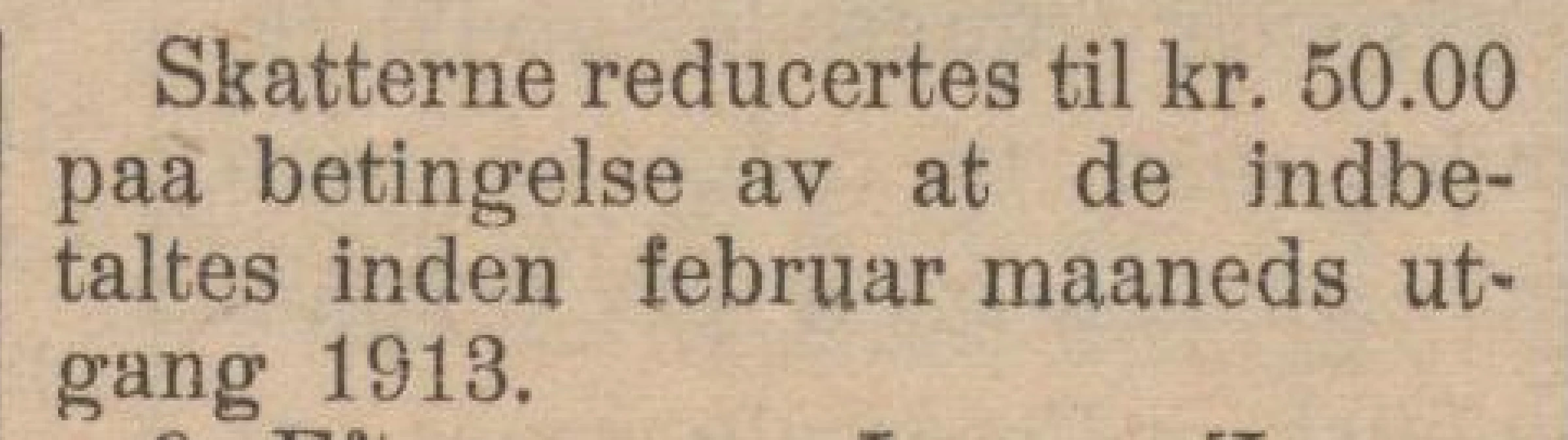
8. Petition from Petter Barski, Masjok, for remission of old tax arrears concerning Johan and Ludvig Harjo. The following decision was made:

The taxes were reduced to 50.00 kroner, on condition that they be paid by the end of February 1913.

Petter's petition over Johan and Ludvig's taxes · 1/2Enlarge clipping ⤢
Clipping 1 / 2
Petter's petition over Johan and Ludvig's taxes · 2/2Enlarge clipping ⤢
Clipping 2 / 2

Finmarkens Amtstidende · September 19, 1921 · p. 2

The electoral register at Petter’s place in Masjok

English summary

In 1921, neighbours could call at Petter’s place in Masjok to inspect Tana’s electoral register. His home was one of several local places where people could check their entries and arrange corrections before the election.

English translation

Copy of the electoral register

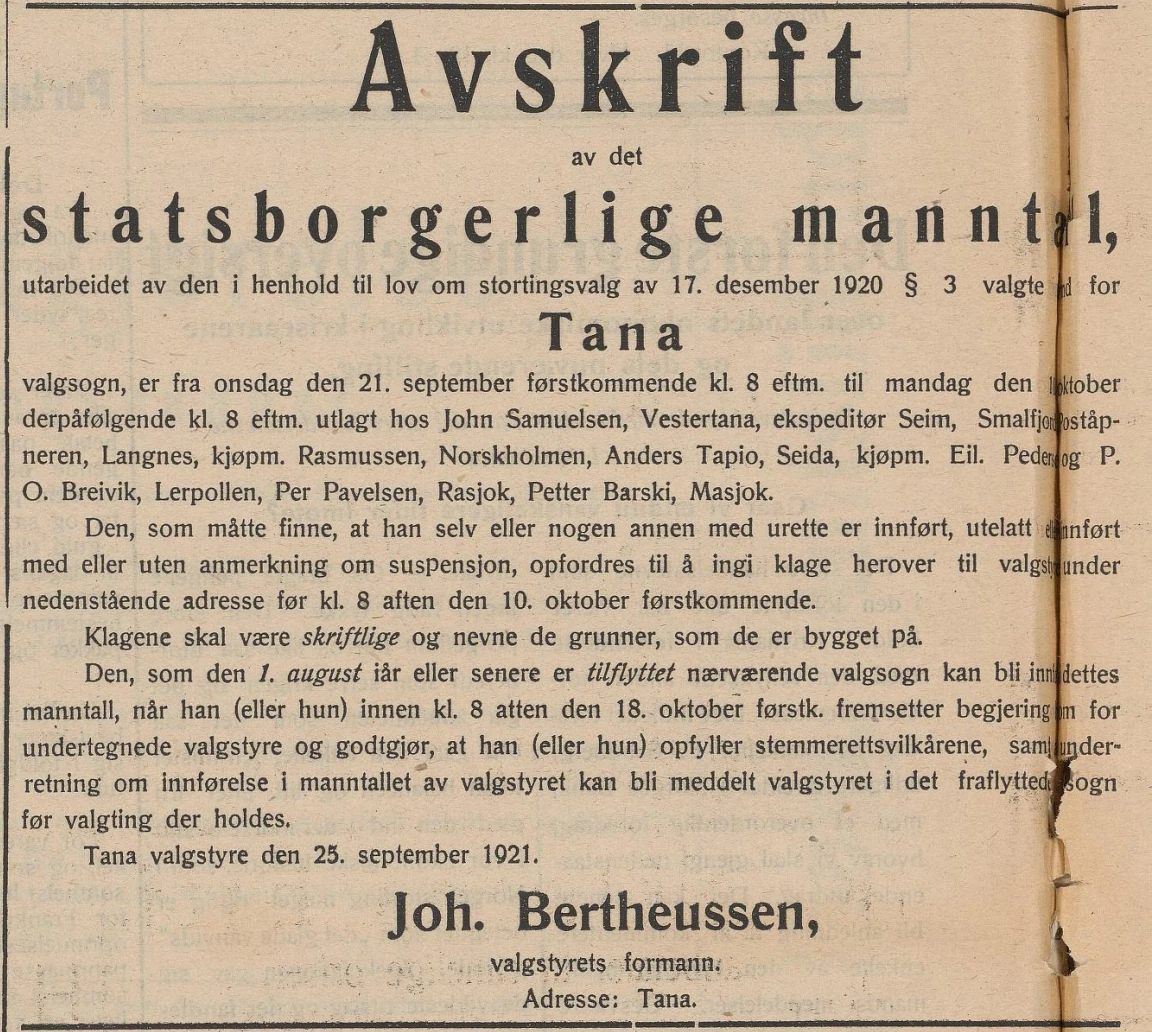
The register prepared for the Tana electoral district by the board elected under section 3 of the Parliamentary Elections Act of December 17, 1920, will be available for inspection from 8 p.m. on Wednesday, September 21, until 8 p.m. on Monday, October 10, at the following places:

John Samuelsen, Vestertana; shipping agent Seim, Smalfjord; the postmaster at Langnes; merchant Rasmussen, Norskholmen; Anders Tapio, Seida; merchant Erl. Pedersen and P. O. Breivik, Lerpollen; Per Pavelsen, Rasjok; and Petter Barski, Masjok.

Anyone who finds that they or someone else has wrongly been included in or omitted from the register, or entered with or without a note suspending voting rights, is requested to submit a complaint to the electoral board at the address below before 8 p.m. on October 10.

Complaints must be in writing and state the grounds on which they are based.

Anyone who moved into this electoral district on August 1 this year or later may be entered in its register if he or she applies to the undersigned electoral board before 8 p.m. on October 18 and establishes that the conditions for voting are met, provided that this board can notify the electoral board of the district from which the person moved before voting takes place there.

Tana Electoral Board, September 25, 1921.
Joh. Bertheussen,
Chairman of the Electoral Board.
Address: Tana.

Translation note: September 25 is the date printed beneath the notice, although this newspaper issue is dated September 19. The printed date is retained here. Words obscured by the fold in the list of locations were checked against the September 20 printing of the same notice.

Østfinmarkens Folkeblad · September 20, 1921 · p. 3

Tana’s electoral register could be inspected at Petter Barski’s

English summary

Another newspaper carried the announcement that Tana’s electoral register could be inspected at Petter’s place in Masjok. The notice lists the other hosts around the district and explains how people could request corrections.

English translation

Copy of the parliamentary electoral register

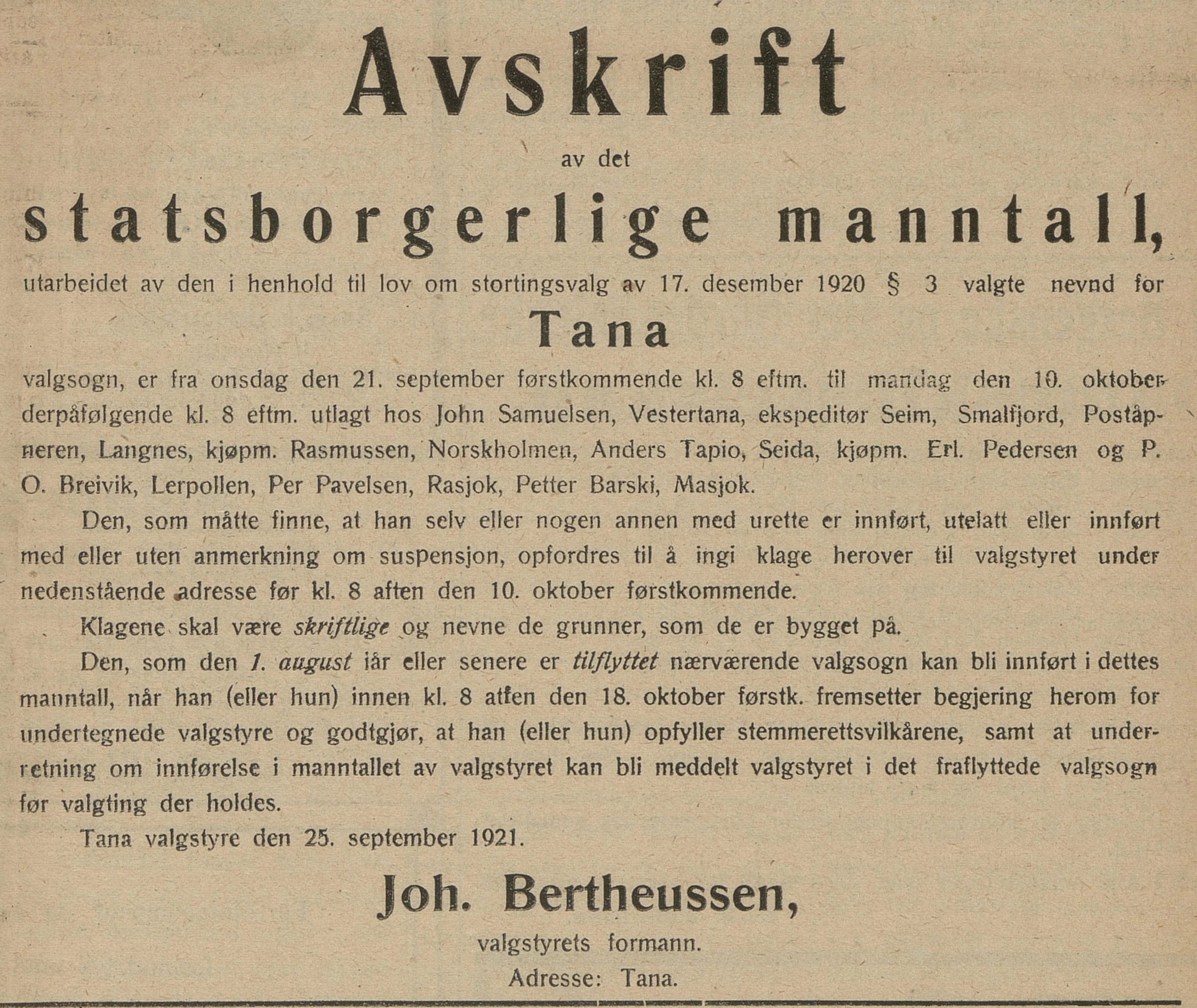
Prepared by the committee elected for the Tana electoral district under section 3 of the Parliamentary Elections Act of 17 December 1920. From Wednesday, 21 September next, at 8 p.m. until Monday, 10 October following, at 8 p.m., it is available for inspection at the following places:
John Samuelsen, Vestertana; shipping agent Seim, Smalfjord; the postmaster, Langnes; merchant Rasmussen, Norskholmen; Anders Tapio, Seida; merchant Erl. Pedersen and P. O. Breivik, Lerpollen; Per Pavelsen, Rasjok; Petter Barski, Masjok.

Anyone who finds that they themselves or another person have been wrongly entered, omitted, or entered with or without a note of suspension is invited to submit a complaint to the electoral board at the address below before 8 p.m. on 10 October next.

Complaints must be in writing and state the reasons on which they are based.

Anyone who moved into this electoral district on 1 August this year or later may be entered in its register if, before 8 p.m. on 18 October next, he or she submits a request to the undersigned electoral board and establishes that he or she meets the voting qualifications, and provided that the board can notify the electoral board of the district from which he or she moved of the entry before voting takes place there.

Tana electoral board, 25 September 1921.
Joh. Bertheussen,
Chairman of the electoral board.
Address: Tana.

Dagsposten Trønderen · January 13, 1931 · p. 6

Bernt and Alma’s banns in Dagsposten

English summary

Bernt and Alma’s plans also reached readers of Dagsposten. Its January notice names fisherman Bernt Vilhelm Børresen and the widow Alma Josefine Baumann of Vadsø.

English translation

Marriage banns
Marriage banns are announced for:
Fisherman Bernt Vilhelm Børresen and widow Alma Josefine Baumann, Vadsø.

Bernt and Alma’s banns in Dagsposten · 1/2Enlarge clipping ⤢
Clipping 1 / 2
Bernt and Alma’s banns in Dagsposten · 2/2Enlarge clipping ⤢
Clipping 2 / 2

Finmarkens Amtstidende · January 24, 1931 · p. 3

Bernt and Alma plan to marry

English summary

Years after Marie’s death, Bernt was preparing to marry again. The banns name fisherman Bernt Vilhelm Børresen and Alma Josefine Baumann, a widow in Vadsø.

English translation

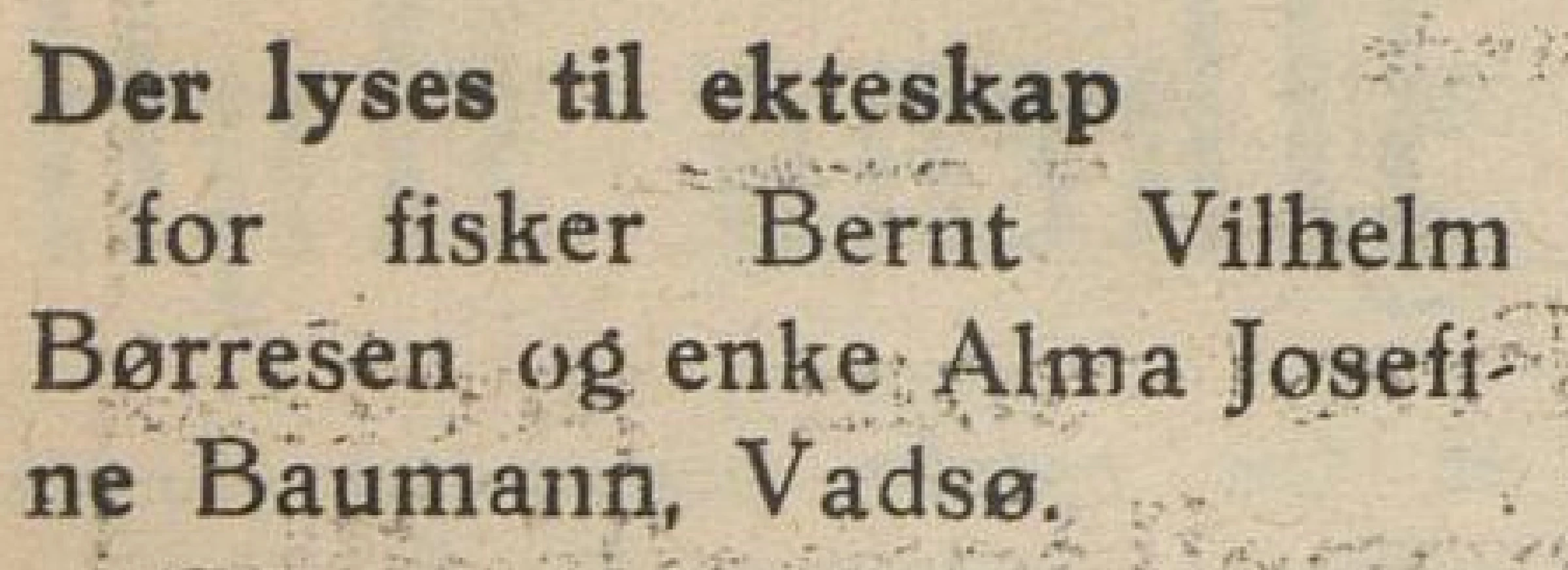
Marriage banns are announced for fisherman Bernt Vilhelm Børresen and widow Alma Josefine Baumann, Vadsø.

Finmarkens Amtstidende · January 27, 1932 · p. 3

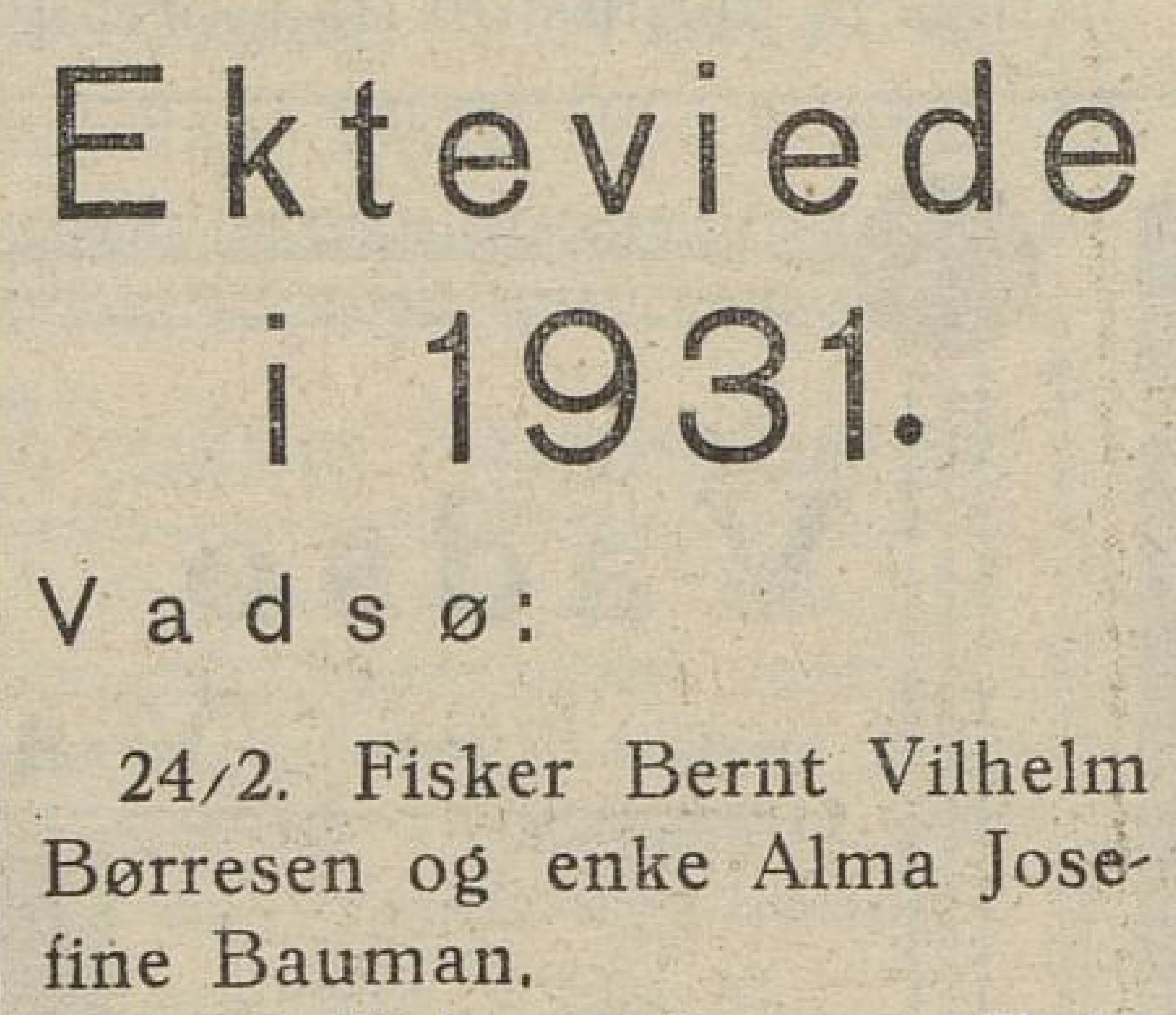
Their wedding on February 24, 1931

English summary

Bernt and Alma married on February 24, 1931. Their wedding appears in this list of the previous year’s marriages in Vadsø. Alma’s surname is printed Bauman here and Baumann in the earlier banns.

English translation

Married in 1931. Vadsø: February 24. Fisherman Bernt Vilhelm Børresen and widow Alma Josefine Bauman.

Finmarkens Amtstidende · February 6, 1935 · p. 3

Petter Barski and the planned property auction

English summary

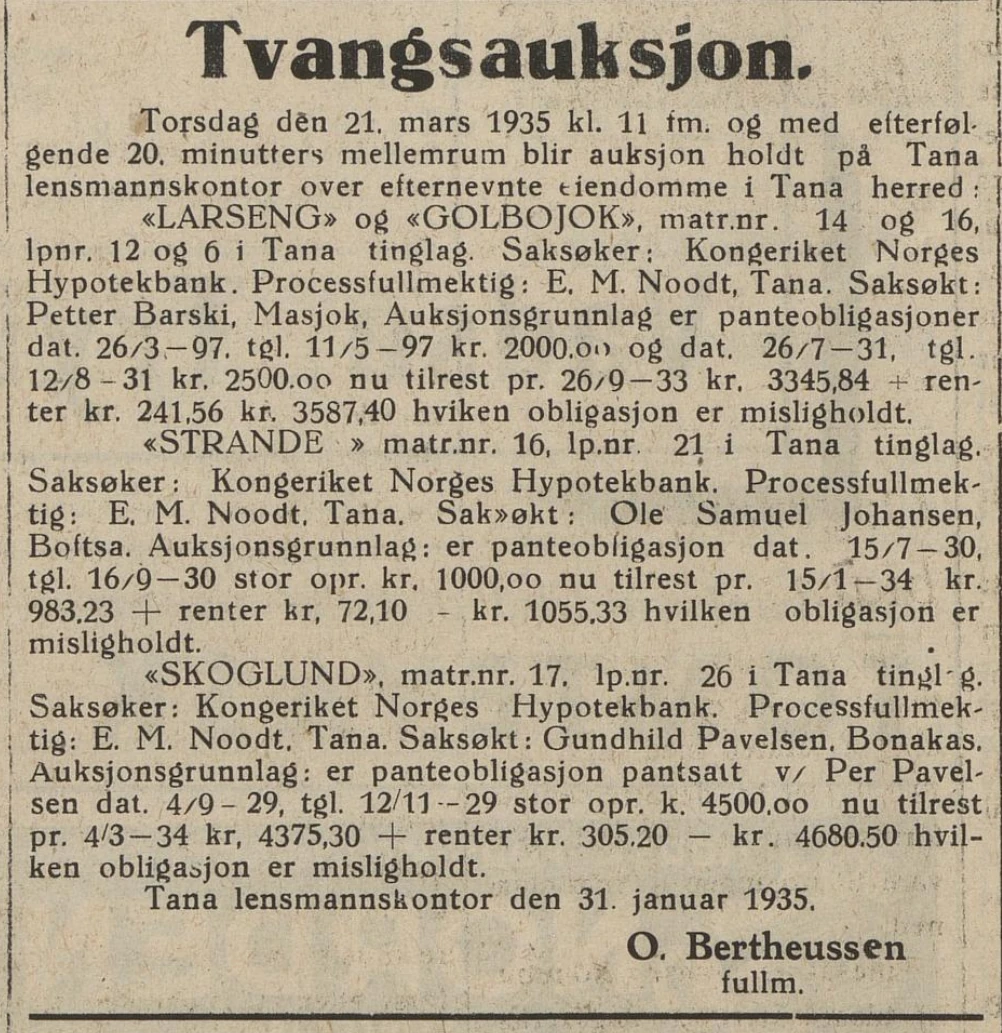
In February 1935, Petter’s properties appeared in a forced-auction notice over unpaid mortgage obligations. The sale was scheduled for March 21 at the Tana sheriff’s office. The properties are printed as Larseng, numbered 14/12, and Golbojok, 16/6; the first set of numbers matches Larsnes. The notice does not tell us the outcome of the planned sale.

English translation

Forced auction

On Thursday, March 21, 1935, at 11 a.m., and subsequently at twenty-minute intervals, auctions will be held at the Tana sheriff’s office over the following properties in Tana municipality:

“LARSENG” and “GOLBOJOK,” cadastral numbers 14 and 16, holding numbers 12 and 6, in the Tana judicial district. Plaintiff: the Kingdom of Norway’s Mortgage Bank. Legal representative: E. M. Noodt, Tana. Defendant: Petter Barski, Masjok. The grounds for auction are mortgage bonds dated March 26, 1897, registered May 11, 1897, for 2,000.00 kroner, and dated July 26, 1931, registered August 12, 1931, for 2,500.00 kroner; the outstanding amount on September 26, 1933, was 3,345.84 kroner plus 241.56 kroner in interest, totaling 3,587.40 kroner. The obligation is in default.

“STRANDE,” cadastral number 16, holding number 21, in the Tana judicial district. Plaintiff: the Kingdom of Norway’s Mortgage Bank. Legal representative: E. M. Noodt, Tana. Defendant: Ole Samuel Johansen, Boftsa. The grounds for auction are a mortgage bond dated July 15, 1930, registered September 16, 1930, originally for 1,000.00 kroner; the outstanding amount on January 15, 1934, was 983.23 kroner plus 72.10 kroner in interest, totaling 1,055.33 kroner. The obligation is in default.

“SKOGLUND,” cadastral number 17, holding number 26, in the Tana judicial district. Plaintiff: the Kingdom of Norway’s Mortgage Bank. Legal representative: E. M. Noodt, Tana. Defendant: Gundhild Pavelsen, Bonakas. The grounds for auction are a mortgage bond secured by Per Pavelsen, dated September 4, 1929, registered November 12, 1929, originally for 4,500.00 kroner; the outstanding amount on March 4, 1934, was 4,375.30 kroner plus 305.20 kroner in interest, totaling 4,680.50 kroner. The obligation is in default.

Tana sheriff’s office, January 31, 1935.
O. Bertheussen,
Deputy.

Nordlys · August 3, 1937 · p. 2

Karl and Gunvor’s marriage banns in Nordlys

English summary

Karl and Gunvor were both living in Kirkenes when their marriage banns appeared in the summer of 1937. This is another newspaper’s announcement of the same wedding.

English translation

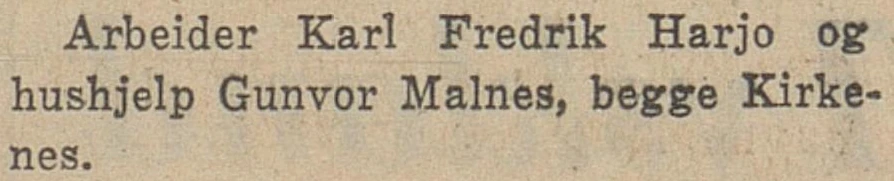
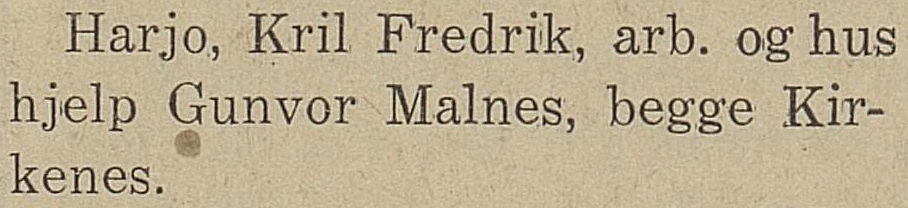
Marriage banns are announced for labourer Karl Fredrik Harjo and domestic helper Gunvor Malnes, both of Kirkenes.

Karl and Gunvor’s marriage banns in Nordlys · 1/2Enlarge clipping ⤢
Clipping 1 / 2
Karl and Gunvor’s marriage banns in Nordlys · 2/2Enlarge clipping ⤢
Clipping 2 / 2

Tromsø · August 5, 1937 · p. 2

Karl and Gunvor’s marriage banns in Tromsø

English summary

Karl and Gunvor were both living in Kirkenes when their marriage banns appeared in the summer of 1937. This is another newspaper’s announcement of the same wedding.

English translation

Marriage banns are announced for labourer Karl Fredrik Harjo and domestic helper Gunvor Malnes, both of Kirkenes.

Karl and Gunvor’s marriage banns in Tromsø · 1/2Enlarge clipping ⤢
Clipping 1 / 2
Karl and Gunvor’s marriage banns in Tromsø · 2/2Enlarge clipping ⤢
Clipping 2 / 2

Vestfinnmark Arbeiderblad · August 6, 1937 · p. 4

Karl and Gunvor’s marriage banns in Vestfinnmark Arbeiderblad

English summary

Karl and Gunvor were both living in Kirkenes when their marriage banns appeared in the summer of 1937. This is another newspaper’s announcement of the same wedding.

English translation

Marriage banns are announced for Karl Fredrik Harjo, labourer, and Gunvor Malnes, domestic helper, both of Kirkenes.

Karl and Gunvor’s marriage banns in Vestfinnmark Arbeiderblad · 1/2Enlarge clipping ⤢
Clipping 1 / 2
Karl and Gunvor’s marriage banns in Vestfinnmark Arbeiderblad · 2/2Enlarge clipping ⤢
Clipping 2 / 2

Lofotposten · August 7, 1937 · p. 6

Karl and Gunvor’s marriage banns in Lofotposten

English summary

Karl and Gunvor were both living in Kirkenes when their marriage banns appeared in the summer of 1937. This is another newspaper’s announcement of the same wedding.

English translation

Marriage banns are announced for labourer Karl Fredrik Harjo and Gunvor Malnes, both of Kirkenes.

Karl and Gunvor’s marriage banns in Lofotposten · 1/2Enlarge clipping ⤢
Clipping 1 / 2
Karl and Gunvor’s marriage banns in Lofotposten · 2/2Enlarge clipping ⤢
Clipping 2 / 2

Finmarken · August 18, 1937 · p. 2

Karl and Gunvor’s wedding announcement

English summary

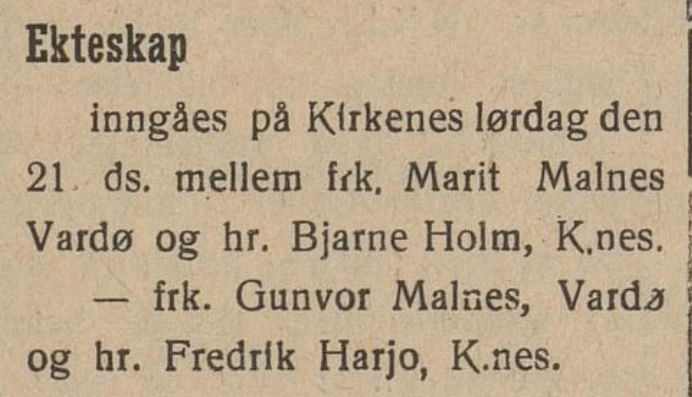
Gunvor and Karl were preparing to marry in Kirkenes on August 21, 1937. Her sister Marit and Bjarne Holm were to marry there that same Saturday. This little announcement brought the two couples together in print three days before their weddings.

English translation

Marriage. Miss Marit Malnes, Vardø, and Bjarne Holm, Kirkenes, will marry in Kirkenes on Saturday, August 21. Miss Gunvor Malnes, Vardø, and Fredrik Harjo, Kirkenes, will marry in Kirkenes on Saturday, August 21.

Finnmarken · September 27, 1948 · p. 2

Karl’s injury and the journey to Vadsø hospital

English summary

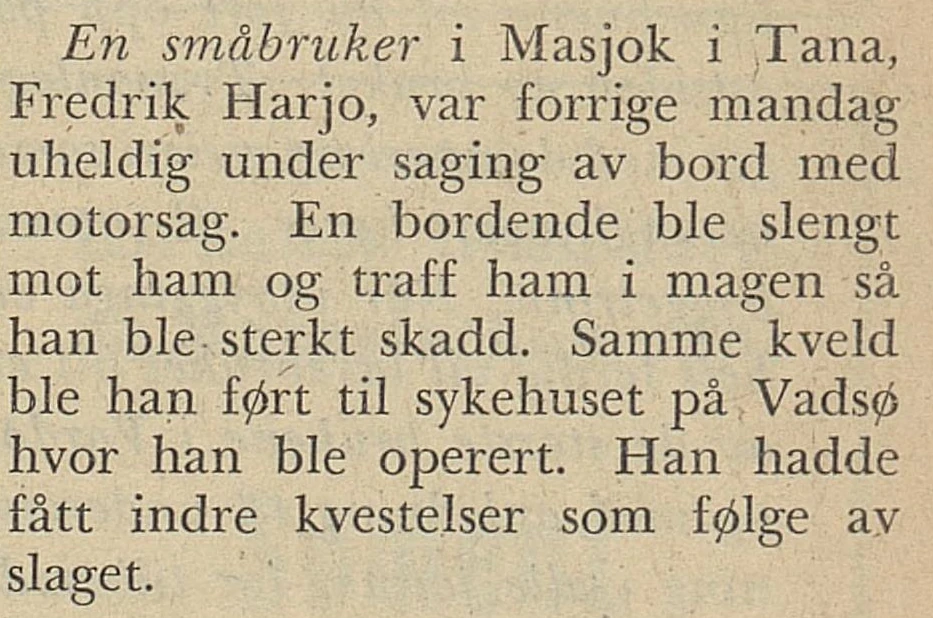
On Monday, September 20, 1948, Karl was helping a friend with a powered saw when a board struck him in the abdomen. He was taken to Vadsø hospital and operated on that evening. When Gunnar saw this notice, he recognized the accident his father had suffered and was glad to learn its date.

English translation

A smallholder in Masjok in Tana, Fredrik Harjo, had an accident last Monday while sawing boards with a powered saw. The end of a board was thrown towards him and struck him in the abdomen, seriously injuring him. That same evening he was taken to the hospital in Vadsø, where he underwent an operation. He had suffered internal injuries as a result of the blow.

Finnmarken · December 6, 1960 · p. 3

Anna Henninen named in a patient-hotel fundraising challenge

English summary

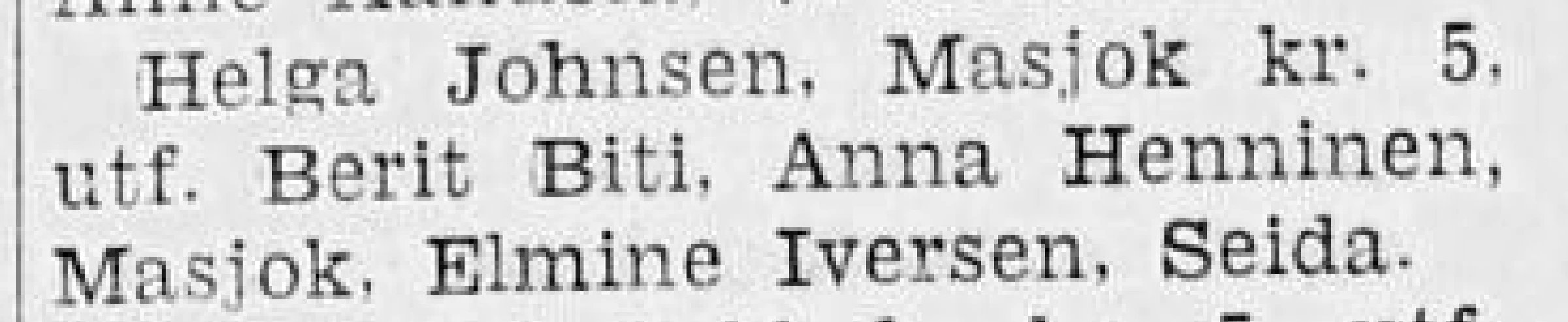
In December 1960, Helga Johnsen donated five kroner towards the patient hotel and challenged Anna and two other women to join in. It is a small glimpse of the local circle around Anna.

English translation of the selected passage

Fundraising drive for the patient hotel.

Helga Johnsen, Masjok: 5 kroner. Challenges Berit Biti and Anna Henninen, Masjok, and Elmine Iversen, Seida.

Anna Henninen named in a patient-hotel fundraising challenge · 1/2Enlarge clipping ⤢
Clipping 1 / 2
Anna Henninen named in a patient-hotel fundraising challenge · 2/2Enlarge clipping ⤢
Clipping 2 / 2

Finnmarken · November 3, 1969 · p. 8

Anna Henninen is nominated for Tana’s parish council

English summary

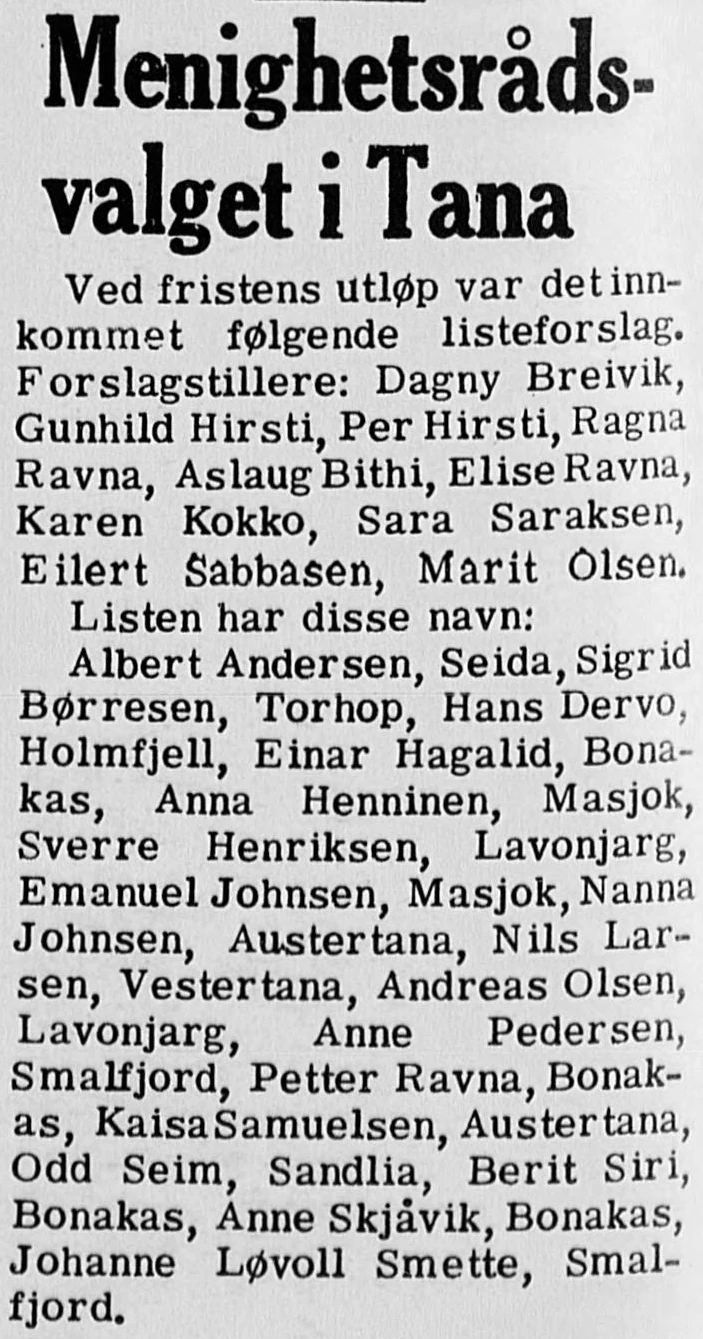
Anna was among the people nominated for Tana’s parish council in November 1969. She is listed with Masjok as her home.

English translation

The parish-council election in Tana

By the deadline, the following proposed list had been received.
Proposers: Dagny Breivik, Gunhild Hirsti, Per Hirsti, Ragna Ravna, Aslaug Bithi, Elise Ravna, Karen Kokko, Sara Saraksen, Eilert Sabbasen, Marit Olsen.

The list contains these names:
Albert Andersen, Seida;
Sigrid Børresen, Torhop;
Hans Dervo, Holmfjell;
Einar Hagalid, Bonakas;
Anna Henninen, Masjok;
Sverre Henriksen, Lavonjarg;
Emanuel Johnsen, Masjok;
Nanna Johnsen, Austertana;
Nils Larsen, Vestertana;
Andreas Olsen, Lavonjarg;
Anne Pedersen, Smalfjord;
Petter Ravna, Bonakas;
Kaisa Samuelsen, Austertana;
Odd Seim, Sandlia;
Berit Siri, Bonakas;
Anne Skjåvik, Bonakas;
Johanne Løvoll Smette, Smalfjord.

Finnmarken · December 4, 1969 · p. 5

Anna Henninen becomes a deputy on Tana’s parish council

English summary

The following month’s election results named Anna as a deputy member of Tana’s parish council. She appears fourth in the list of deputies.

English translation

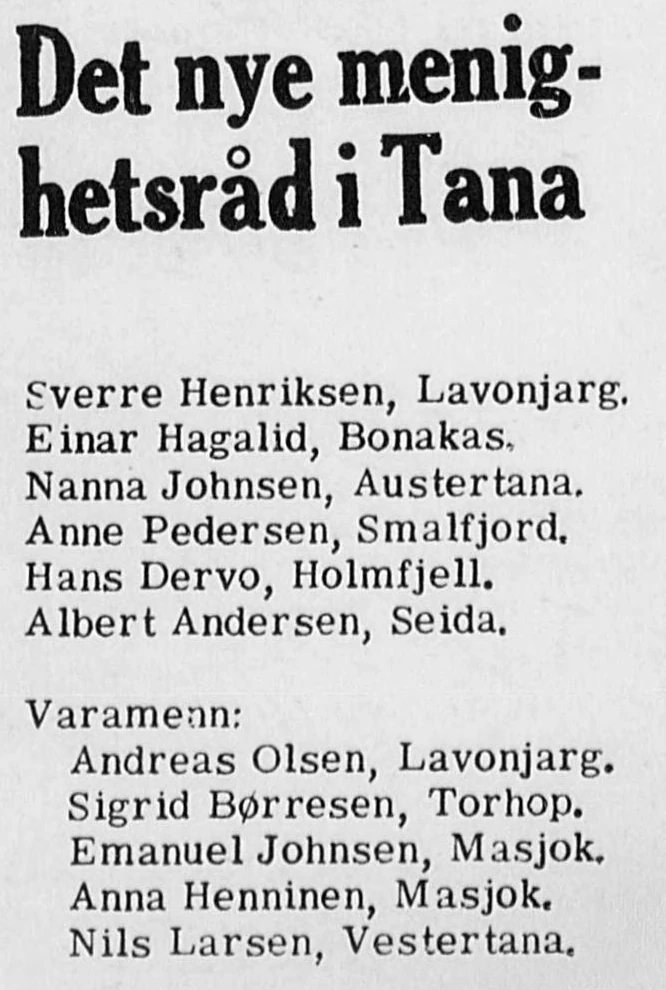
The new parish council in Tana

Sverre Henriksen, Lavonjarg.
Einar Hagalid, Bonakas.
Nanna Johnsen, Austertana.
Anne Pedersen, Smalfjord.
Hans Dervo, Holmfjell.
Albert Andersen, Seida.

Deputies:
Andreas Olsen, Lavonjarg.
Sigrid Børresen, Torhop.
Emanuel Johnsen, Masjok.
Anna Henninen, Masjok.
Nils Larsen, Vestertana.

Finnmarken · June 20, 1984 · p. 23

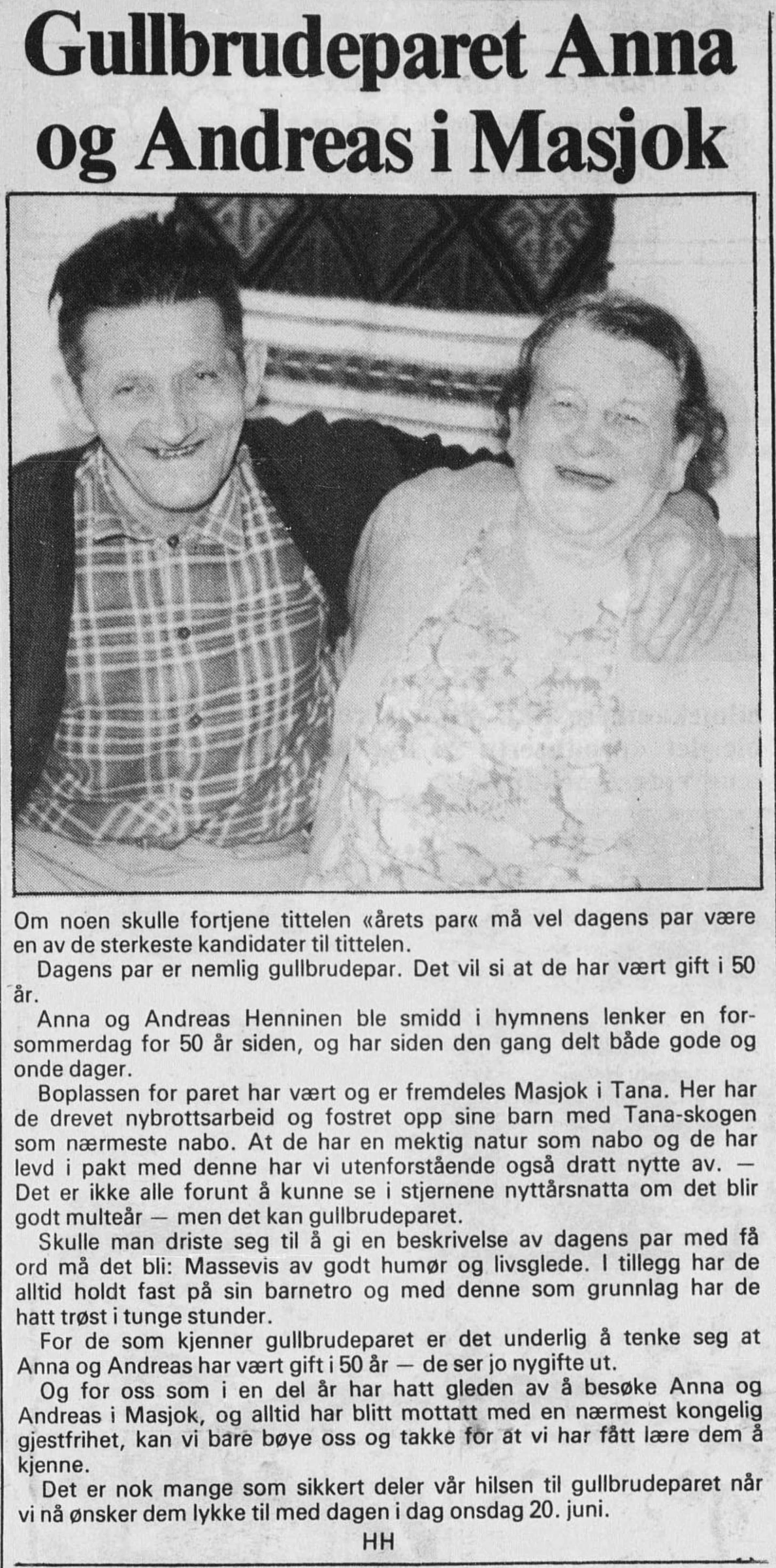
Anna and Andreas celebrate fifty years together

English summary

Finnmarken celebrates Anna and Andreas Henninen’s fiftieth wedding anniversary on 20 June 1984, alongside a photograph of them together. They had made their home in Masjok, clearing land and raising their children beside the Tana forest. The writer, signing HH, remembers their warmth, humour and pleasure in life, and the generous welcome visitors received. Their Christian faith had sustained them through difficult times. Living close to nature had also given them knowledge they shared with others; the article recalls their belief that the stars on New Year’s night could foretell the cloudberry harvest.

English translation

Golden-wedding couple Anna and Andreas in Masjok

If anyone deserves the title “couple of the year,” today’s couple must be among the strongest candidates.

For today’s couple are celebrating their golden wedding. That means they have been married for fifty years.

Anna and Andreas Henninen were joined in matrimony one early summer’s day fifty years ago, and since then they have shared both good days and bad.

Their home has been, and still is, Masjok in Tana. Here they have cleared new land and brought up their children, with the Tana forest as their nearest neighbor. Those of us outside the family have also benefited from their having such magnificent nature on their doorstep and living in harmony with it. Not everyone can tell from the stars on New Year’s night whether there will be a good cloudberry harvest—but this golden-wedding couple can.

If one dared describe today’s couple in a few words, they would have to be: an abundance of good humor and joy in life. They have also always held fast to the faith of their childhood, and it has given them comfort in difficult times.

For those who know them, it is strange to think that Anna and Andreas have been married for fifty years—they look like newlyweds.

And those of us who for some years have had the pleasure of visiting Anna and Andreas in Masjok, and have always been received with almost royal hospitality, can only bow our heads and give thanks that we have been able to get to know them.

Many will surely join us in sending greetings to the golden-wedding couple as we wish them happiness on their special day today, Wednesday, June 20.

HH

Finnmarken · October 1, 1990 · p. 5

Anna and Andreas at Masjok

English summary

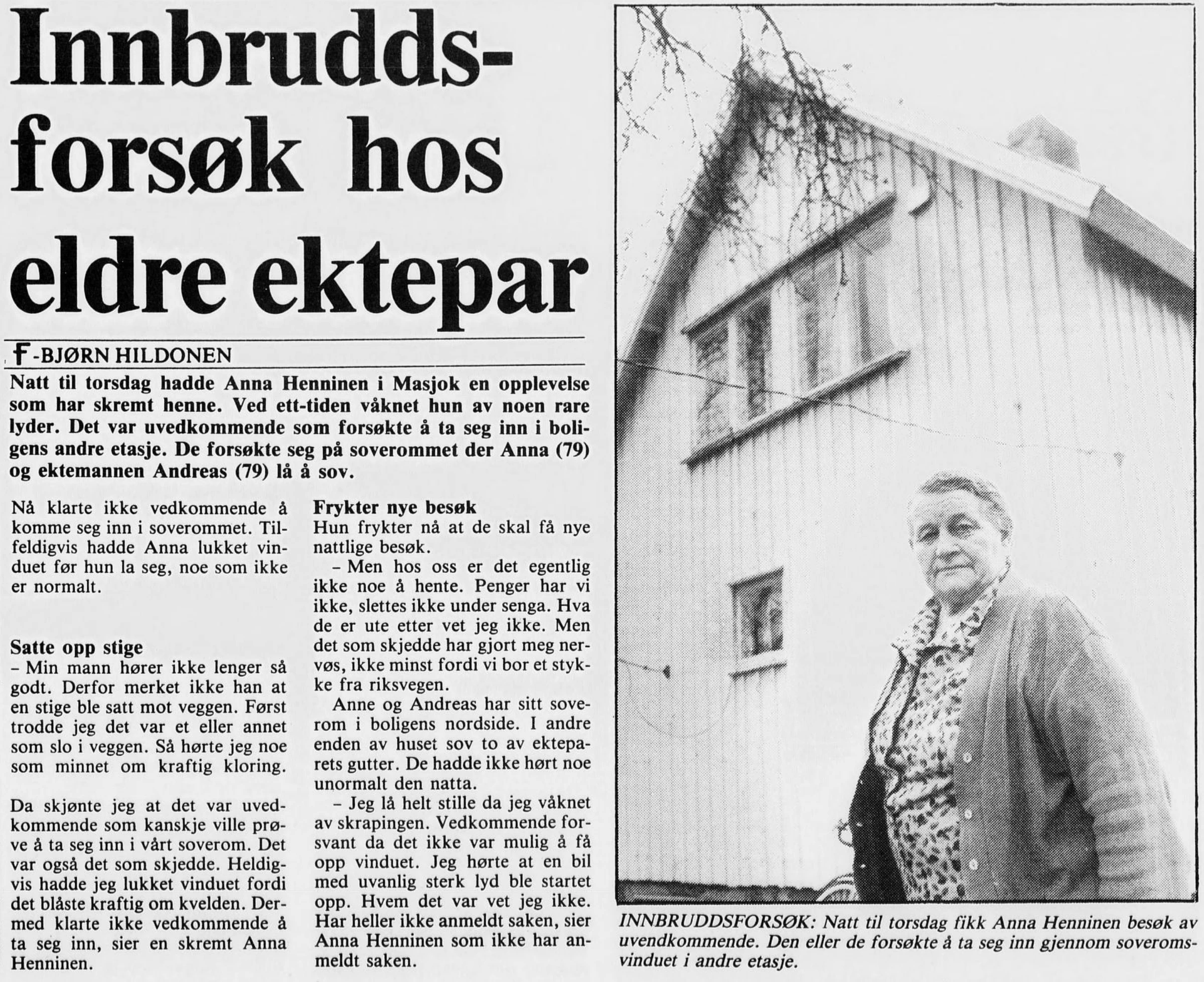
An attempted break-in disturbed Anna and Andreas’s home in Masjok in September 1990. Anna told reporter Bjørn Hildonen how frightened she had been. The intruder did not get inside. The article includes a photograph of Anna outside their house.

English translation

Attempted break-in at an elderly couple’s home

By Bjørn Hildonen

During the night before Thursday, Anna Henninen in Masjok had an experience that frightened her. Around one o’clock she woke to some strange noises. Someone was trying to get into the second floor of the house. They tried the bedroom where Anna, 79, and her husband Andreas, 79, were sleeping.

The intruder did not manage to get into the bedroom. As it happened, Anna had closed the window before going to bed, something she did not usually do.

Put up a ladder

“My husband can no longer hear very well. That was why he did not notice a ladder being placed against the wall. At first I thought something was knocking against the wall. Then I heard something like loud scratching.

“Then I realized that someone was there who might be trying to get into our bedroom. And that was exactly what was happening. Fortunately, I had closed the window because it was very windy that evening. That meant the person could not get in,” a frightened Anna Henninen says.

Fears further visits

She now fears that they will have more nighttime visitors.

“But there is really nothing to take from us. We have no money, certainly none under the bed. I do not know what they were after. But what happened has made me nervous, especially because we live some distance from the main road.”

Anna and Andreas have their bedroom on the north side of the house. Two of the couple’s sons were sleeping at the other end of the house. They had heard nothing unusual that night.

“I lay completely still when the scraping woke me. The person left when it proved impossible to open the window. I heard a car with an unusually loud engine being started. I do not know who it was. Nor have I reported the matter,” says Anna Henninen, who has not reported it to the police.

Photograph caption: ATTEMPTED BREAK-IN: During the night before Thursday, Anna Henninen had an unwelcome visitor. The person or people tried to get in through the second-floor bedroom window.

Finnmarken · October 23, 1990 · p. 16

Hans Kristian’s death notice from the family in Norway

English summary

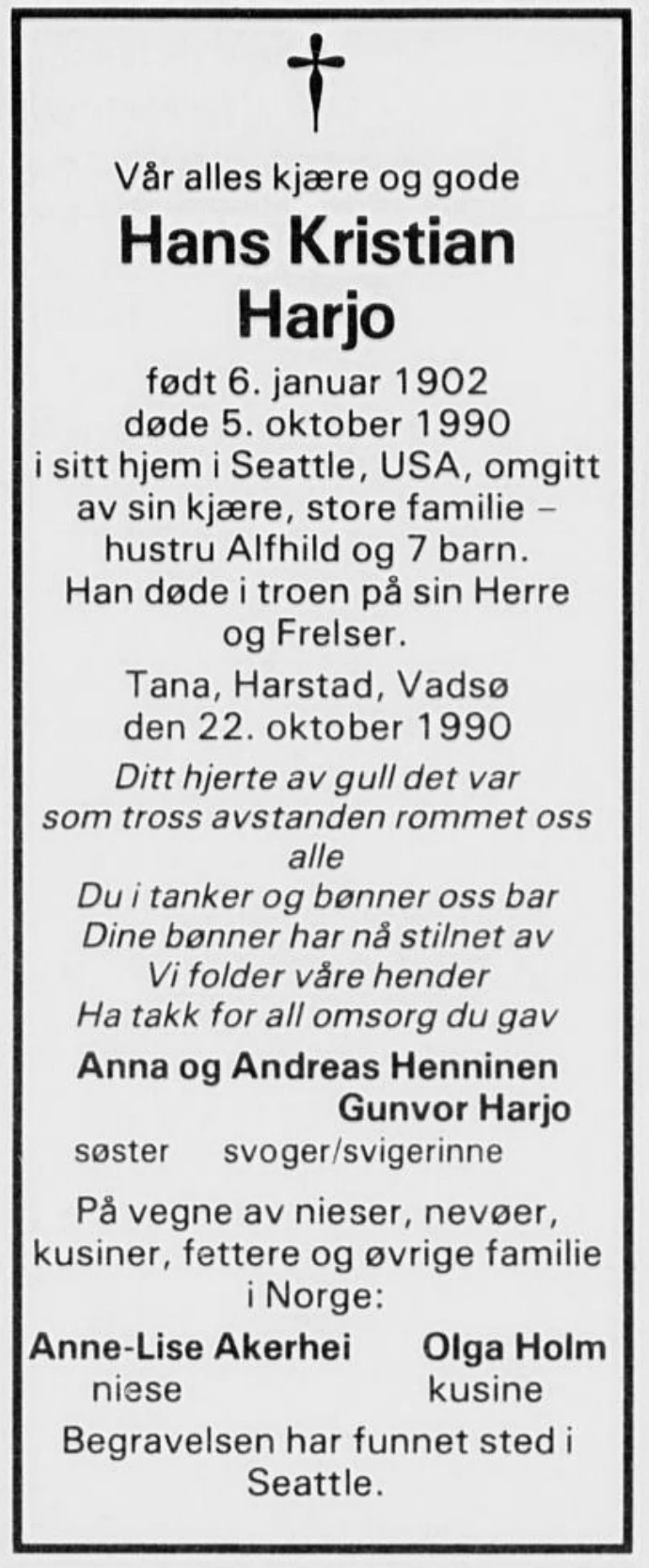
The family in Norway remembered Hans after his death at home in Seattle on October 5, 1990, with Alfhild and their seven children around him. Anna and Andreas Henninen, Gunvor Harjo, Anne-Lise Akerhei and Olga Holm are named in this farewell from relatives in Tana, Harstad and Vadsø. His funeral had already taken place in Seattle.

English translation

Our dear and kind
Hans Kristian Harjo,
beloved by us all,
born January 6, 1902,
died October 5, 1990,
at his home in Seattle, USA, surrounded by his dear, large family—his wife Alfhild and seven children.
He died in faith in his Lord and Savior.

Tana, Harstad, Vadsø,
October 22, 1990

Yours was a heart of gold,
which, despite the distance, held us all.
You carried us in your thoughts and prayers.
Your prayers have now fallen silent.
We fold our hands.
Thank you for all the care you gave.

Anna and Andreas Henninen
Gunvor Harjo
Sister, brother-in-law and sister-in-law

On behalf of nieces, nephews, cousins and the rest of the family in Norway:
Anne-Lise Akerhei, niece
Olga Holm, cousin

The funeral has taken place in Seattle.

Family death notice · 1995 · publication date unknown

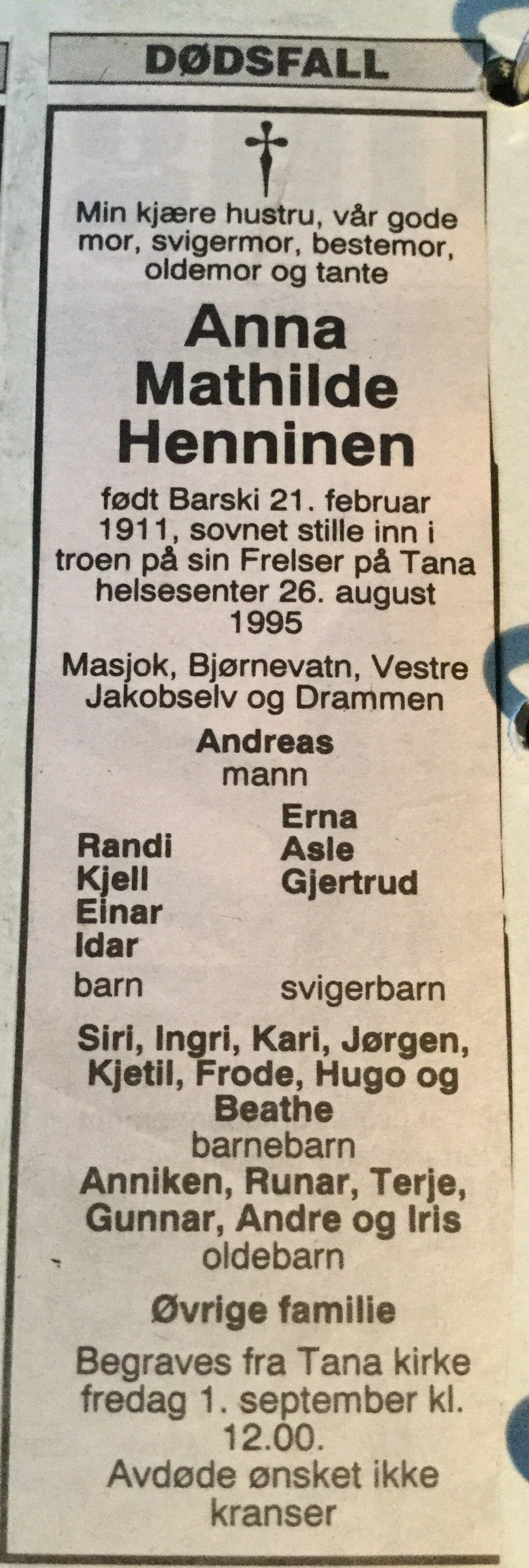
Remembering Anna Mathilde

English summary

Anna died at Tana health centre on August 26, 1995. Her family remembered a beloved wife, mother, grandmother, great-grandmother and aunt. Her funeral was announced for September 1 at Tana Church.

English translation

My dear wife, our dear mother, mother-in-law, grandmother, great-grandmother and aunt, Anna Mathilde Henninen, née Barski, born February 21, 1911, passed peacefully away in faith in her Saviour at Tana health centre on August 26, 1995.

Masjok, Bjørnevatn, Vestre Jakobselv and Drammen.

Andreas, husband. Randi, Kjell, Einar and Idar, children. Erna, Asle and Gjertrud, children-in-law.

Siri, Ingri, Kari, Jørgen, Kjetil, Frode, Hugo and Beathe, grandchildren. Anniken, Runar, Terje, Gunnar, Andre and Iris, great-grandchildren. Other family.

Funeral from Tana Church on Friday, September 1, at 12 noon. The deceased did not wish for wreaths.

Finnmarken · September 6, 1995 · p. 18

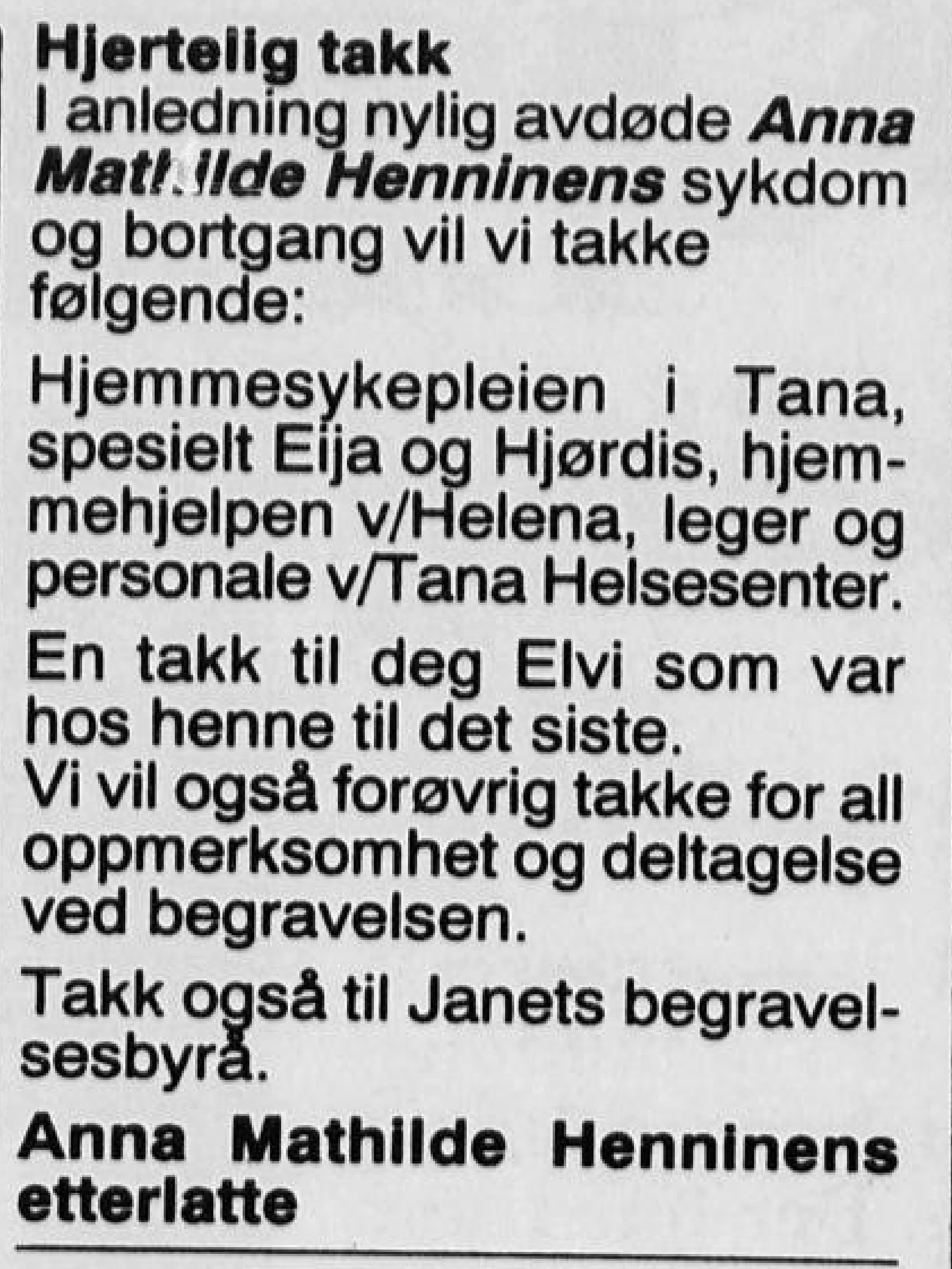
The family's thanks after Anna's death

English summary

After Anna’s death, her family thanked the people who had cared for her: Tana’s home nurses, especially Eija and Hjørdis; Helena from the home-help service; the staff at Tana health centre; and Elvi, who stayed with her until the end. They also thanked everyone who offered sympathy or attended the funeral, and Janets funeral service.

English translation

Heartfelt thanks

Following the illness and passing of the recently deceased Anna Mathilde Henninen, we would like to thank the following:

The home nursing service in Tana, especially Eija and Hjørdis; Helena from the home-help service; and the doctors and staff at Tana Health Centre.

Thank you, Elvi, for staying with her until the end.

We would also like to thank everyone for their kindness and sympathy, and for attending the funeral.

Thanks also to Janets Funeral Service.

Anna Mathilde Henninen’s surviving family

Drammens Tidende · April 15, 2000 · p. 3

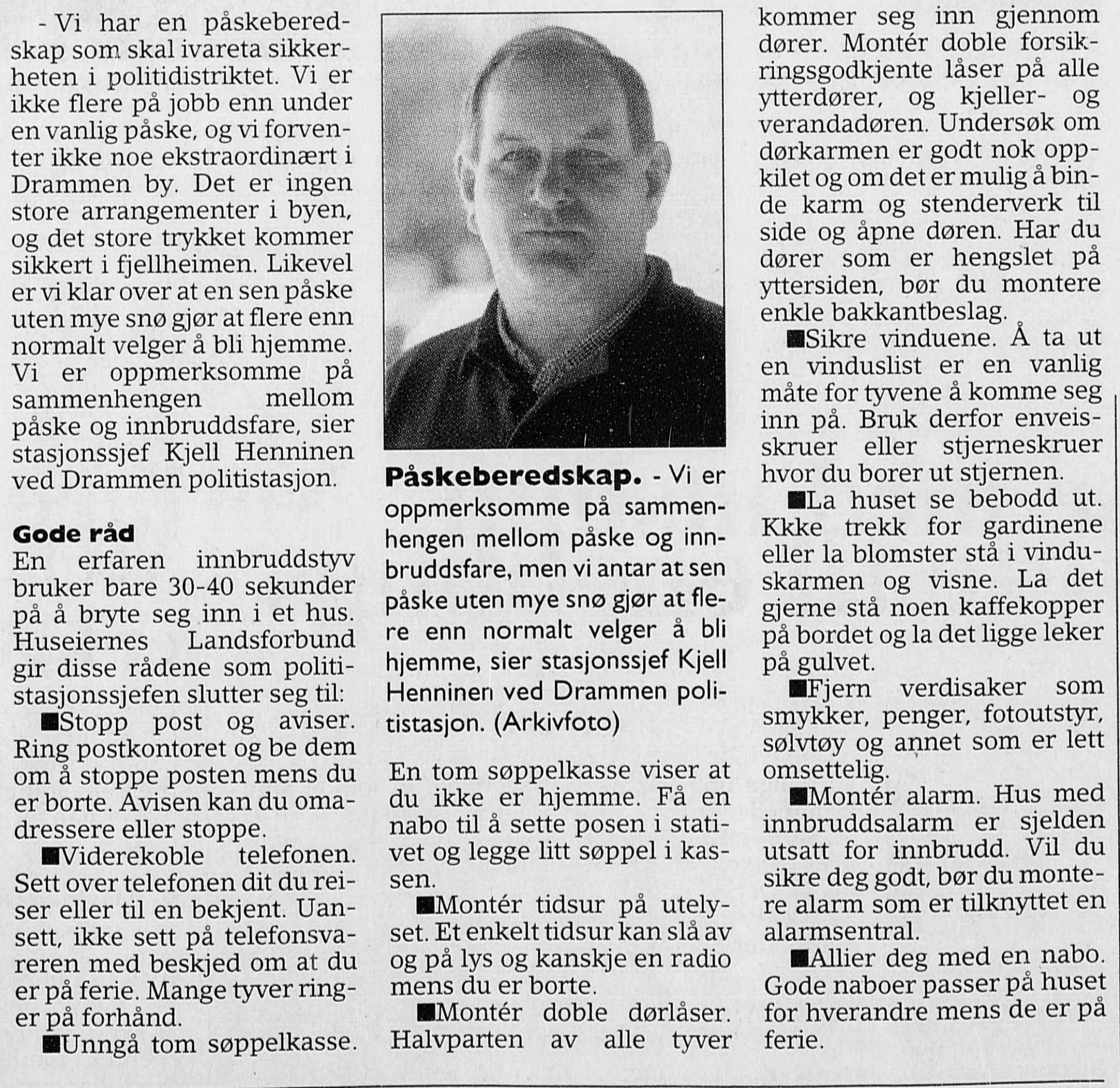
Kjell Henninen discusses Easter policing in Drammen

English summary

Drammen police station chief Kjell Henninen discusses preparations for Easter with Drammens Tidende. He expects routine staffing and no unusual pressure in the city, while noting that a late Easter with little snow may keep more people at home. The article discusses the police response to repeat burglars and offers household security advice endorsed by Henninen, including making homes appear occupied and arranging help from neighbors. A portrait identifies him as station chief. The statements about detention are attributed to another officer, Erik Grundstrøm, rather than to Kjell.

English translation

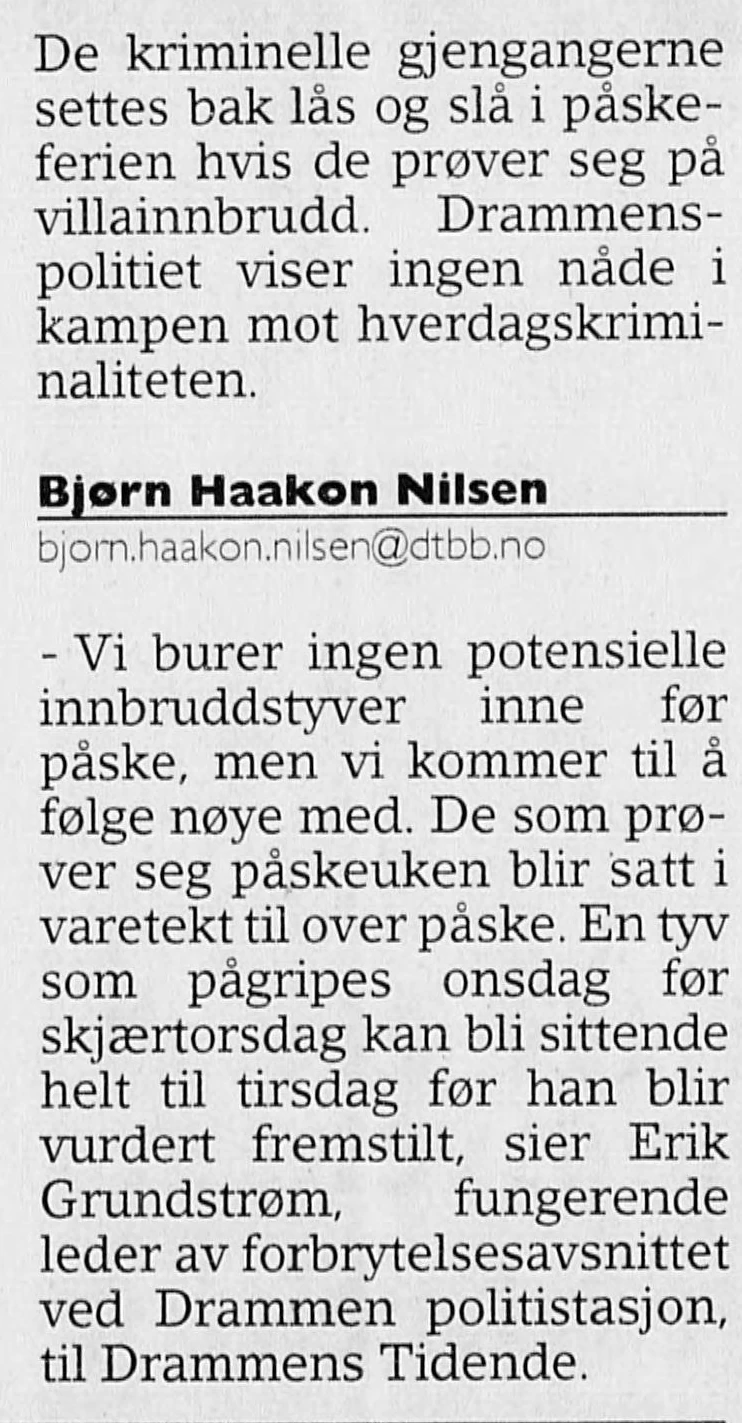
Easter thieves go straight to jail

Repeat offenders will be put behind bars over the Easter holiday if they try to burgle houses. Drammen police are showing no mercy in the fight against everyday crime.

By Bjørn Haakon Nilsen
Printed contact: bjorn.haakon.nilsen@dtbb.no

“We are not locking up any potential burglars before Easter, but we will be watching closely. Those who try their luck during Easter week will be held in custody until after Easter. A thief arrested on the Wednesday before Maundy Thursday could remain in custody until Tuesday before a court appearance is considered,” Erik Grundstrøm, acting head of the crime section at Drammen police station, tells Drammens Tidende.

“Our Easter arrangements are intended to maintain safety in the police district. We have no more people at work than during a normal Easter, and we do not expect anything out of the ordinary in Drammen. There are no major events in the city, and the greatest pressure will probably be in the mountains. Nevertheless, we know that a late Easter without much snow means more people than usual choose to stay at home. We are aware of the connection between Easter and the risk of burglary,” says Drammen police station chief Kjell Henninen.

Good advice

An experienced burglar needs only thirty to forty seconds to break into a house. The Norwegian Homeowners’ Association offers the following advice, which the station chief endorses:

• Stop mail and newspaper deliveries. Call the post office and ask it to hold your mail while you are away. Your newspaper can be redirected or suspended.
• Forward your telephone calls. Redirect calls to where you are staying or to someone you know. In any case, do not leave an answering-machine message saying you are on holiday. Many thieves call beforehand.
• Avoid an empty rubbish bin. An empty bin shows that you are not at home. Ask a neighbor to put out the bag and place some rubbish in the bin.
• Put a timer on the outdoor lighting. A simple timer can switch lights, and perhaps a radio, on and off while you are away.
• Fit two door locks. Half of all thieves enter through doors. Fit two insurance-approved locks to every exterior door, including the basement and veranda doors. Check that the door frame is properly secured and whether the frame and studs can be forced aside to open the door. If your doors have exposed external hinges, fit simple hinge-security devices.
• Secure the windows. Removing a glazing bead is a common way for thieves to get in. Use one-way screws, or cross-head screws with the cross drilled out.
• Make the house look occupied. Do not draw the curtains or leave flowers wilting on the windowsill. Leave a few coffee cups on the table and toys on the floor.
• Put away valuables such as jewelry, money, photographic equipment, silverware and other items that are easy to sell.
• Install an alarm. Houses with burglar alarms are seldom burgled. For good protection, install an alarm connected to a monitoring centre.
• Team up with a neighbor. Good neighbors look after one another’s houses while they are on holiday.

Photograph caption: EASTER READINESS. “We are aware of the connection between Easter and the risk of burglary, but we assume that a late Easter without much snow will mean that more people than usual choose to stay at home,” says Drammen police station chief Kjell Henninen. Archive photograph.

Kjell Henninen discusses Easter policing in Drammen · 1/3Enlarge clipping ⤢
Clipping 1 / 3
Kjell Henninen discusses Easter policing in Drammen · 2/3Enlarge clipping ⤢
Clipping 2 / 3
Kjell Henninen discusses Easter policing in Drammen · 3/3Enlarge clipping ⤢
Clipping 3 / 3

Finnmarken · May 9, 2006 · p. 4

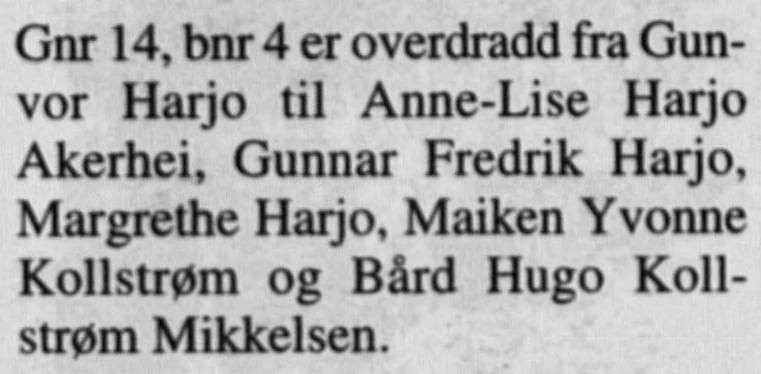
Gunvor’s property is transferred to her children and grandchildren

English summary

After Gunvor’s death, a property notice named her children Anne-Lise, Gunnar Fredrik and Margrethe, and her grandchildren Maiken Yvonne and Bård Hugo, as the new owners of property 14/4 in Tana. The notice does not name the property or give a transfer date.

English translation

Property transactions in Tana municipality:

Property gnr. 14, bnr. 4 has been transferred from Gunvor Harjo to Anne-Lise Harjo Akerhei, Gunnar Fredrik Harjo, Margrethe Harjo, Maiken Yvonne Kollstrøm and Bård Hugo Kollstrøm Mikkelsen.

Source: the Norwegian Mapping Authority.

Gunvor’s property is transferred to her children and grandchildren · 1/3Enlarge clipping ⤢
Clipping 1 / 3
Gunvor’s property is transferred to her children and grandchildren · 2/3Enlarge clipping ⤢
Clipping 2 / 3
Gunvor’s property is transferred to her children and grandchildren · 3/3Enlarge clipping ⤢
Clipping 3 / 3

Finnmarken · June 14, 2006 · p. 7

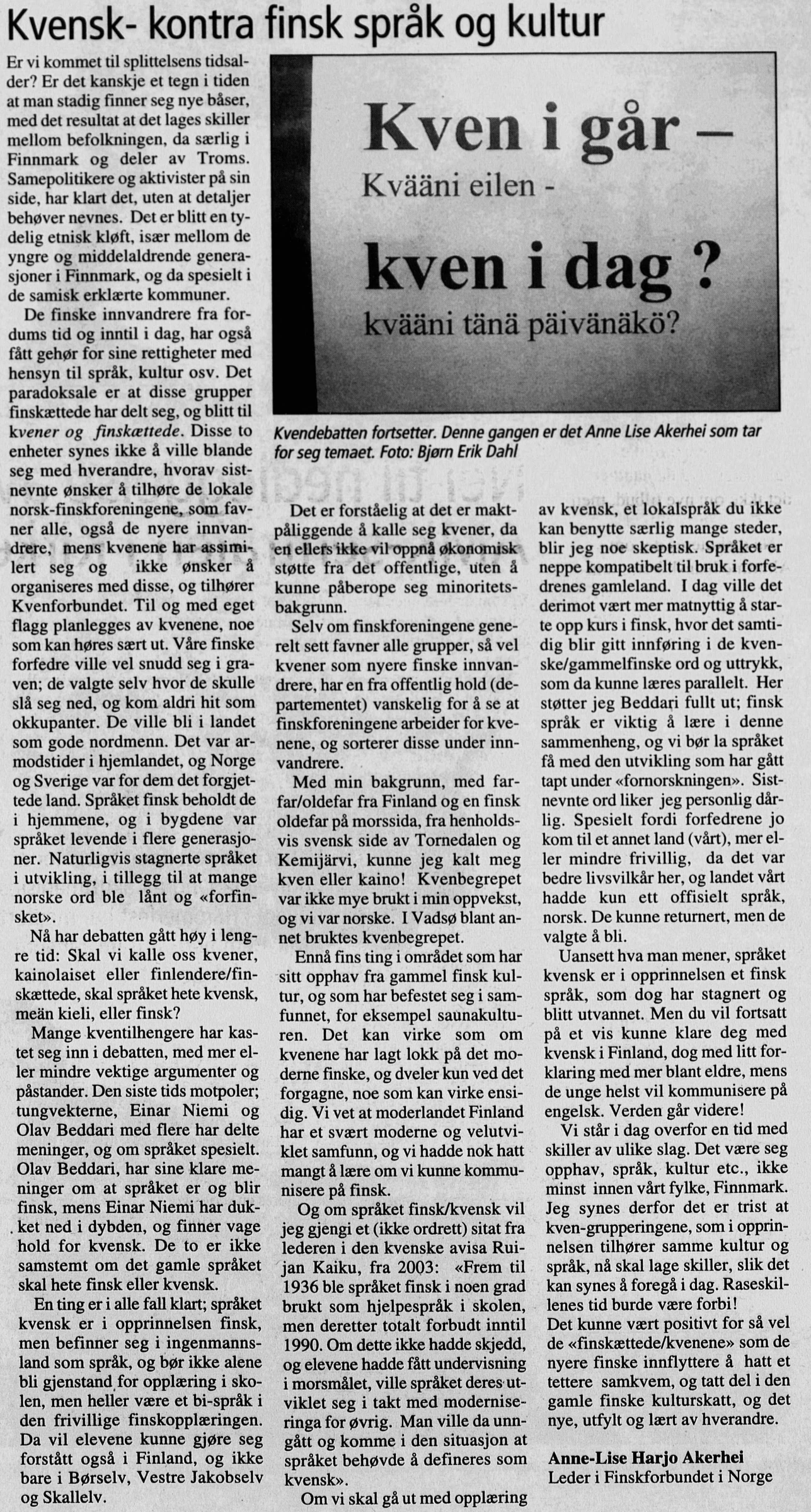
Anne-Lise writes about Finnish language and cultural identity

English summary

Writing as leader of Finskforbundet i Norge, Anne-Lise Harjo Akerhei argues for stronger links between people of Finnish ancestry, Kven communities and newer Finnish immigrants. She recalls her own Finnish family roots and says her childhood community regarded itself as Norwegian. She favors teaching modern Finnish alongside older local words and expressions, emphasizing communication with Finland. Her letter challenges aspects of contemporary Kven identity, public funding and language policy, and expresses concern that separate labels create divisions. These are her views in a public debate, rather than a neutral account of the history or status of the languages.

English translation

Kven versus Finnish language and culture

Have we entered an age of division? Is it perhaps a sign of the times that people continually find new categories for themselves, with the result that divisions are created among the population, particularly in Finnmark and parts of Troms? Sámi politicians and activists, for their part, have managed this, without my needing to go into details. A clear ethnic divide has emerged, especially among the younger and middle-aged generations in Finnmark, and particularly in the municipalities declared Sámi.

Finnish immigrants, from earlier times right up to today, have also gained recognition for their rights concerning language, culture and so on. The paradox is that these groups of Finnish descent have divided into Kvens and people of Finnish ancestry. These two groups do not seem to want to mix. The latter wish to belong to the local Norwegian-Finnish associations, which embrace everyone, including newer immigrants, whereas the Kvens have assimilated and do not wish to organize together with them, but belong to the Kven Association. The Kvens are even planning their own flag, which may sound peculiar. Our Finnish ancestors would surely turn in their graves: they chose for themselves where to settle and never came here as occupiers. They wanted to remain in this country as good Norwegians. There was poverty in their homeland, and Norway and Sweden were the promised land to them. They kept Finnish in their homes, and in the villages the language lived on for several generations. Naturally, its development stagnated, while many Norwegian words were borrowed and “Finnicized.”

The debate has now been heated for a long time: should we call ourselves Kvens, kainolaiset, Finns or people of Finnish descent? Should the language be called Kven, meän kieli, or Finnish?

Many supporters of Kven identity have joined the debate with arguments and assertions of varying importance. Recent opposing voices, the heavyweights Einar Niemi and Olav Beddari among others, hold differing views, particularly about language. Olav Beddari is clear that the language is and remains Finnish, whereas Einar Niemi has delved into the subject and finds tenuous grounds for Kven. The two do not agree on whether the old language should be called Finnish or Kven.

One thing, at least, is clear: Kven is Finnish in origin, but as a language it is in no-man’s-land. It should not be taught on its own in school, but rather as a supplementary language within voluntary Finnish teaching. Pupils would then be able to make themselves understood in Finland too, and not only in Børselv, Vestre Jakobselv and Skallelv.

It is understandable that people feel it essential to call themselves Kvens, since otherwise they will not obtain public financial support without being able to claim a minority background.

Although the Finnish associations generally embrace all groups, both Kvens and newer Finnish immigrants, the authorities—the ministry—find it difficult to see that these associations work for Kvens, and classify them under immigrants.

With my own background, with a paternal grandfather/great-grandfather from Finland and a Finnish great-grandfather on my mother’s side, from the Swedish side of the Torne Valley and Kemijärvi respectively, I could have called myself Kven or kaino! The term Kven was not much used when I was growing up, and we were Norwegian. In Vadsø, among other places, the Kven term was used.

There are still things in this area that originate in old Finnish culture and have become established in society, such as sauna culture. It can seem as though the Kvens have put a lid on modern Finnish life and dwell only on the past, which may appear one-sided. We know that the mother country, Finland, has a very modern and highly developed society, and we would surely have much to learn if we could communicate in Finnish.

On the subject of Finnish/Kven, I would like to reproduce a quotation—not word for word—from an editorial in the Kven newspaper Ruijan Kaiku in 2003: “Until 1936, Finnish was used to some extent as an auxiliary language in schools, but after that it was completely forbidden until 1990. If this had not happened, and the pupils had been taught in their mother tongue, their language would have developed in step with modernization in other areas. One would then have avoided the situation in which the language needed to be defined as Kven.”

If we are to offer instruction in Kven, a local language that cannot be used in very many places, I am somewhat skeptical. The language is hardly compatible with usage in our ancestors’ old homeland. Today it would be more useful to start courses in Finnish that also introduce Kven/old Finnish words and expressions, so that they could be learned side by side. Here I fully support Beddari: Finnish is important to learn in this context, and we should allow the language to catch up with the development it missed during “Norwegianization.” Personally, I dislike that last word. Especially because our ancestors came to another country—ours—more or less voluntarily, because living conditions were better here, and our country had only one official language, Norwegian. They could have returned, but they chose to stay.

Whatever one thinks, Kven is originally a Finnish language, though it has stagnated and become diluted. Still, one can manage to some extent with Kven in Finland, with a little explanation and so forth among older people, while the young prefer to communicate in English. The world moves on!

Today we face a time of divisions of various kinds, whether in origin, language, culture and so on, not least in our own county of Finnmark. I therefore find it sad that Kven groupings, which originally belong to the same culture and language, should now create divisions, as seems to be happening today. The age of racial divisions ought to be over!

It could be positive for both those of “Finnish descent/the Kvens” and newer Finnish immigrants to have closer contact, sharing both the old Finnish cultural heritage and the new, complementing and learning from one another.

Anne-Lise Harjo Akerhei
Chair of Finskforbundet i Norge, the Finnish Federation in Norway

Illustration text, in Norwegian and Finnish: “Kven yesterday—Kven today?”

Photograph caption: The Kven debate continues. This time Anne Lise Akerhei addresses the subject. Photo: Bjørn Erik Dahl.

Fiskeribladet · May 10, 2007 · p. 3

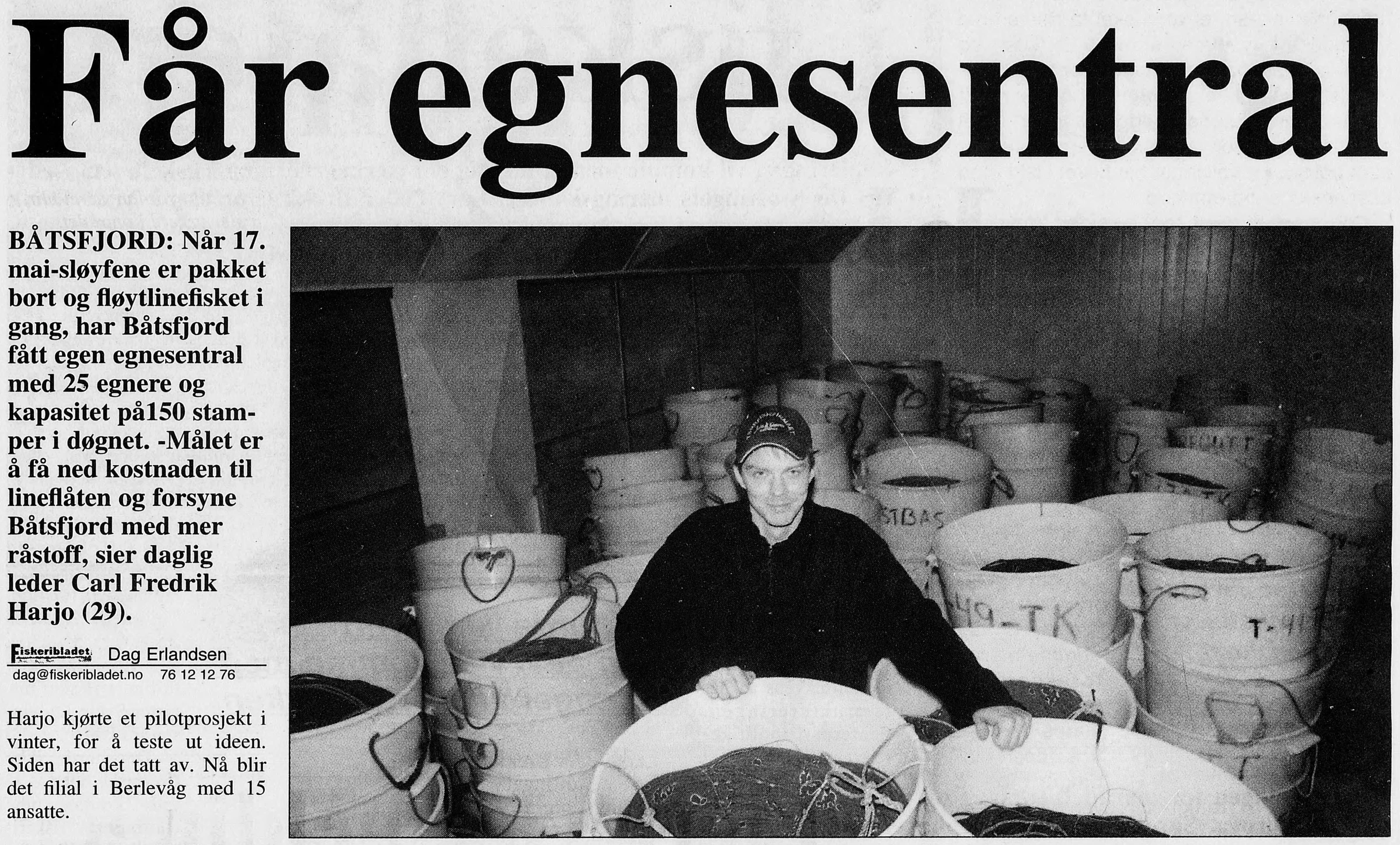
Carl prepares to open the baiting centre in Båtsfjord

Carl Fredrik is Margrethe’s son and Karl Fredrik and Gunvor’s grandson.

English summary

Båtsfjord was preparing for the full opening of Egnesentralen on 18 May. Carl Fredrik Harjo, 29, described a service intended to reduce costs for longline fishing boats and bring more fish ashore locally. The report described 25 baiters and capacity for 150 tubs of baited line a day. A winter pilot had already drawn additional fish landings to Båtsfjord, and a branch in Berlevåg was being developed. Carl had previously worked as a fisherman and trawler mate; he had gone ashore to manage the business.

English translation

Getting a baiting centre

BÅTSFJORD: By the time the May 17 ribbons have been put away and the float-line fishery is under way, Båtsfjord will have its own baiting centre, with twenty-five baiters and capacity for 150 tubs of line a day. “The aim is to bring down costs for the longline fleet and supply Båtsfjord with more fish,” says managing director Carl Fredrik Harjo, 29.

By Dag Erlandsen, Fiskeribladet
Printed contact: dag@fiskeribladet.no · 76 12 12 76

Harjo ran a pilot project over the winter to test the idea. Since then it has taken off. There will now be a branch in Berlevåg with fifteen employees.

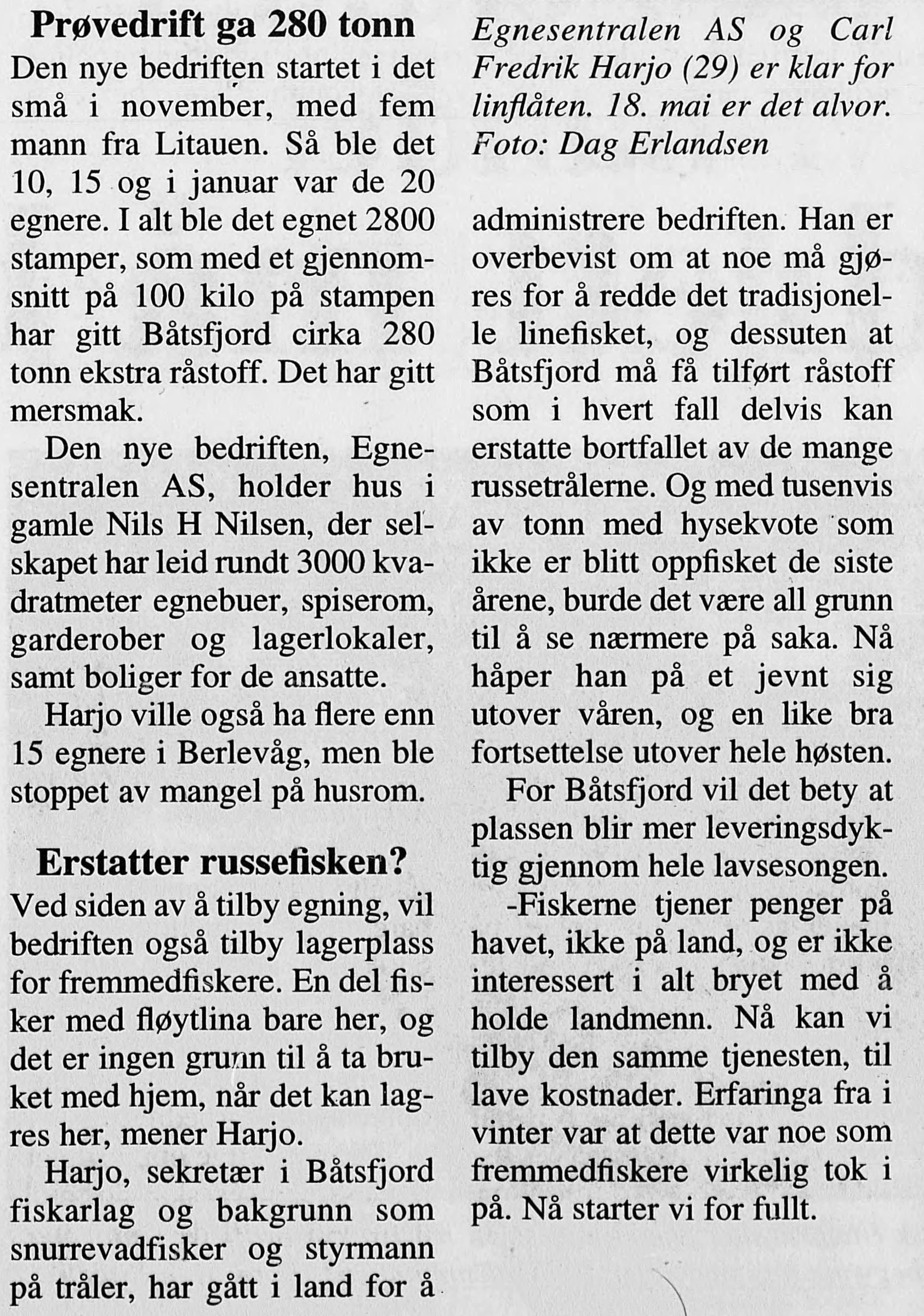
Trial operation brought in 280 tonnes

The new business began on a small scale in November, with five men from Lithuania. Then there were ten, then fifteen, and in January they had twenty baiters. In all, 2,800 tubs of line were baited, which, with an average catch of one hundred kilos per tub, has brought Båtsfjord about 280 additional tonnes of fish. That has whetted their appetite for more.

The new company, Egnesentralen AS, is housed in the old Nils H. Nilsen premises, where it has rented about 3,000 square metres of baiting sheds, dining rooms, changing rooms and storage space, as well as accommodation for the employees.

Harjo also wanted more than fifteen baiters in Berlevåg but was held back by a shortage of housing.

Replacing the Russian fish?

Besides baiting lines, the company will offer storage for visiting fishermen. Some only fish with float lines here, and Harjo sees no reason for them to take their gear home when it can be stored here.

Harjo, secretary of the Båtsfjord fishermen’s association, has a background as a Danish-seine fisherman and trawler mate. He has come ashore to manage the company. He is convinced something must be done to save traditional longline fishing, and that Båtsfjord needs fish supplies that can at least partly make up for the loss of the many Russian trawlers. With thousands of tonnes of haddock quota left uncaught in recent years, there should be every reason to look more closely at the matter. He now hopes for a steady flow of work through the spring and an equally good continuation throughout the autumn.

For Båtsfjord, that would mean being better able to supply fish throughout the low season.

“Fishermen make money at sea, not on land, and they are not interested in all the trouble of employing shore workers. Now we can offer the same service at low cost. Our experience last winter was that this was something visiting fishermen really took to. Now we are starting up in earnest.”

Photograph caption: Egnesentralen AS and Carl Fredrik Harjo, 29, are ready for the longline fleet. May 18 is when it begins in earnest. Photo: Dag Erlandsen.

Carl prepares to open the baiting centre in Båtsfjord · 1/2Enlarge clipping ⤢
Clipping 1 / 2
Carl prepares to open the baiting centre in Båtsfjord · 2/2Enlarge clipping ⤢
Clipping 2 / 2

Finnmarken · June 1, 2007 · p. 12

The baiting centre finds its feet

Carl Fredrik is Margrethe’s son and Karl Fredrik and Gunvor’s grandson.

English summary

The new baiting centre in Båtsfjord was off to a good start. Carl had recruited workers from Lithuania after seeing that fishing boats often struggled to find people to bait their lines. The feature follows the work inside the sheds, including Kristina Sakaloskaite and experienced baiter Unni Ebeltoft, who trained new workers. Carl described plans for storage and other services for the fishing fleet, alongside the baiting operation. The photographs show Carl by the boat Nysol and the women working at the centre.

English translation

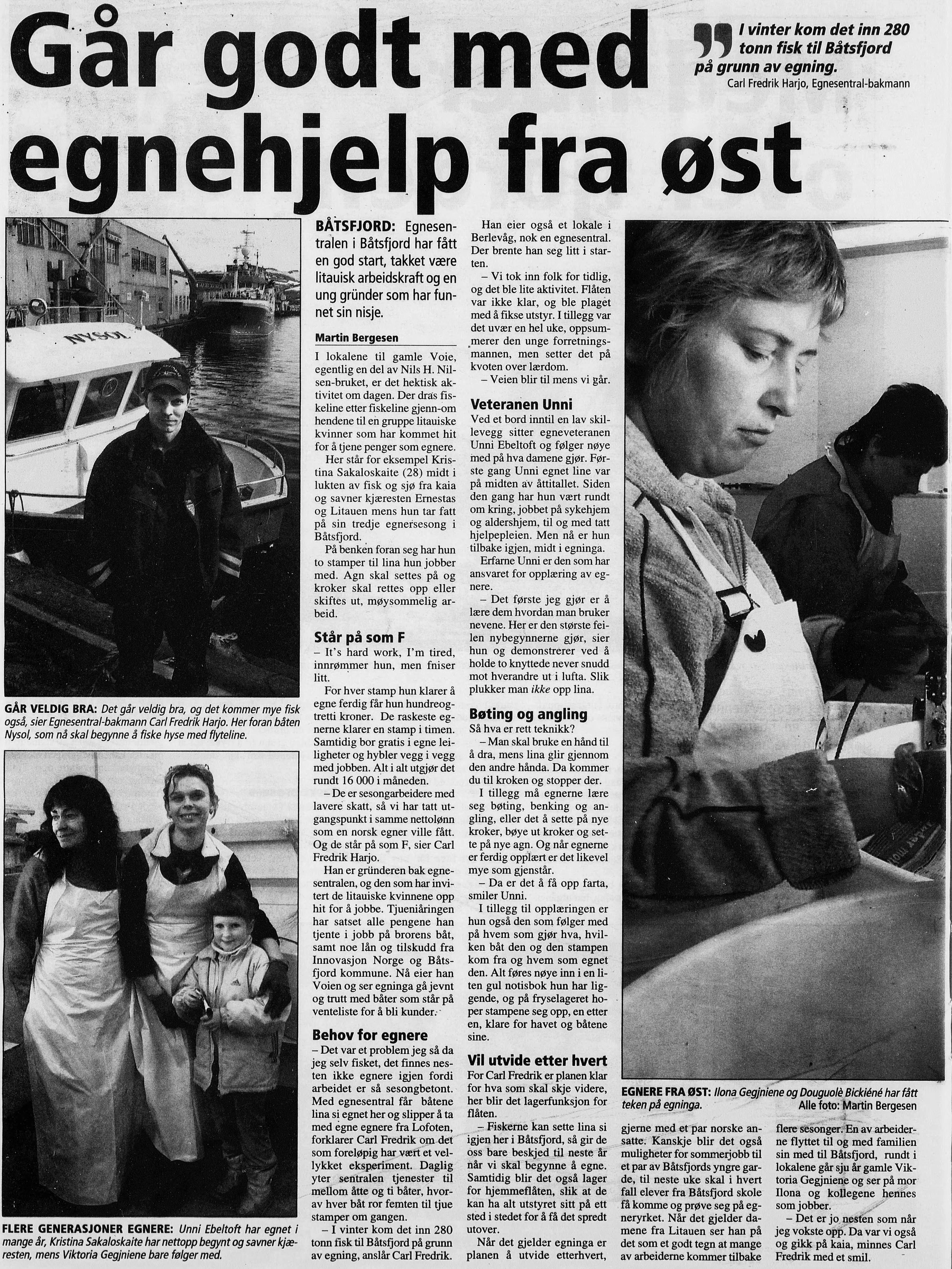
Doing well with baiting help from the east

Pull quote: “This winter, 280 tonnes of fish came into Båtsfjord because of the baiting.” — Carl Fredrik Harjo, the man behind Egnesentralen

BÅTSFJORD: The baiting centre in Båtsfjord has got off to a good start, thanks to Lithuanian workers and a young entrepreneur who has found his niche.

By Martin Bergesen

There is hectic activity these days in the old Voie premises, actually part of the Nils H. Nilsen fish-processing plant. Fishing line after fishing line passes through the hands of a group of Lithuanian women who have come here to earn money as baiters.

One of them is Kristina Sakaloskaite, 28. Amid the smell of fish and the sea at the quay, she misses her boyfriend Ernestas and Lithuania as she begins her third baiting season in Båtsfjord.

On the bench in front of her are two tubs for the line she is working on. Bait has to be put on, and hooks straightened or replaced: painstaking work.

Working like mad

“It’s hard work, I’m tired,” she admits in English, but gives a little giggle.

For every tub she finishes baiting, she earns 130 kroner. The fastest baiters manage a tub an hour. They also live free in their own apartments and bedsits right next door to work. Altogether it amounts to around 16,000 kroner a month.

“They are seasonal workers with lower taxes, so we have worked on the basis of the same take-home pay that a Norwegian baiter would receive. And they work like mad,” says Carl Fredrik Harjo.

He is the founder of the baiting centre and the one who invited the Lithuanian women to come north to work. The twenty-nine-year-old invested all the money he earned working on his brother’s boat, along with loans and grants from Innovation Norway and Båtsfjord municipality. He now owns Voien and sees the baiting progressing steadily, with boats on a waiting list to become customers.

A need for baiters

“It was a problem I saw when I was fishing myself. There are hardly any baiters left because the work is so seasonal. With a baiting centre, the boats can have their lines baited here and do not need to bring baiters from Lofoten,” Carl Fredrik explains of what has so far been a successful experiment. The centre serves between eight and ten boats a day, each taking fifteen to twenty tubs at a time.

“This winter, 280 tonnes of fish came into Båtsfjord because of the baiting,” Carl Fredrik estimates.

He also owns premises in Berlevåg, another baiting centre. He got his fingers slightly burned there at the start.

“We brought people in too early, and there was little activity. The fleet was not ready and was tied up getting equipment fixed. There was also bad weather for a whole week,” the young businessman sums up, putting it down as a learning experience.

“We find our way as we go.”

The veteran, Unni

At a table beside a low partition sits baiting veteran Unni Ebeltoft, keeping a close eye on what the women are doing. Unni first baited lines in the mid-1980s. Since then she has been here and there, worked in nursing homes and homes for the elderly, and even trained as a nursing assistant. But now she is back, right in the middle of baiting.

Experienced Unni is responsible for training the baiters.

“The first thing I do is teach them how to use their hands. This is where beginners make their biggest mistake,” she says, demonstrating by holding two clenched fists facing each other in the air. That is not how to pick up the line.

Repairing lines and replacing hooks

So what is the right technique?

“You use one hand to pull, while the line runs through the other. Then you reach the hook and stop there.”

The baiters also have to learn repairs, straightening and replacing hooks: fitting new hooks, straightening bent ones and putting on new bait. Even when they have finished their training, much remains to be done.

“Then it is a matter of getting the speed up,” Unni smiles.

Besides training, she also keeps track of who is doing what, which boat each tub came from and who baited it. Everything is carefully entered in a little yellow notebook she keeps nearby. In the freezer store, tubs pile up one after another, ready for the sea and their boats.

Plans to expand gradually

Carl Fredrik has clear plans for what comes next: storage facilities for the fleet.

“Fishermen can leave their lines in Båtsfjord and just let us know next year when we should start baiting. There will also be storage for the local fleet, so they can keep all their equipment in one place instead of having it scattered around.”

As for baiting, the plan is to expand over time, preferably with a couple of Norwegian employees. There may also be summer-job opportunities for some of Båtsfjord’s young people. Next week, at least, pupils from Båtsfjord school will come and try the trade.

As for the women from Lithuania, he sees it as a good sign that many of the workers come back for several seasons. One has even moved her family to Båtsfjord. Seven-year-old Viktoria Gegnjiene walks around the premises watching her mother Ilona and her colleagues work.

“It is almost like when I was growing up. We used to spend time down on the quay too,” Carl Fredrik recalls with a smile.

Photograph caption: GOING VERY WELL: “It is going very well, and a lot of fish is coming in too,” says Carl Fredrik Harjo, the man behind Egnesentralen. Here he is in front of Nysol, which is about to begin fishing for haddock with float lines.

Photograph caption: SEVERAL GENERATIONS OF BAITERS: Unni Ebeltoft has baited for many years, Kristina Sakaloskaite has just started and misses her boyfriend, while Viktoria Gegnjiene simply watches.

Photograph caption: BAITERS FROM THE EAST: Ilona Gegnjiene and Doguole Bickiene have got the hang of baiting.
All photographs: Martin Bergesen.

Finnmarken · February 7, 2008 · p. 21

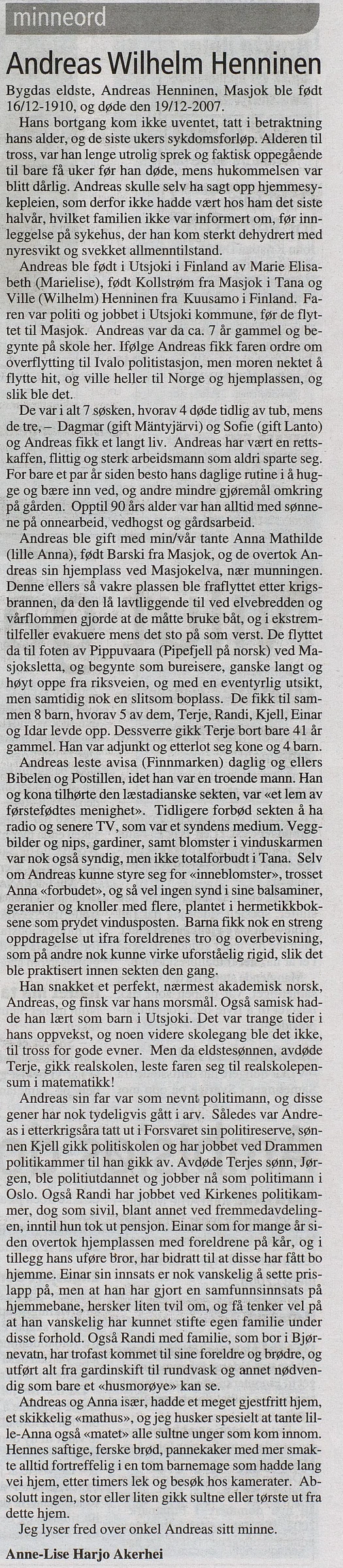
Anne-Lise remembers her uncle Andreas Wilhelm Henninen

English summary

Anne-Lise Harjo Akerhei remembers her uncle Andreas Henninen, born in Utsjoki on 16 December 1910 and deceased on 19 December 2007. His parents were Marie Elisabeth Kollstrøm of Masjok and policeman Ville (Wilhelm) Henninen of Kuusamo. He moved to Masjok at about seven. Andreas married Anna Mathilde Barski; after the wartime destruction they left their flood-prone riverside home and established a new smallholding below Pippuvaara. Five of their eight children grew up: Terje, Randi, Kjell, Einar and Idar. Anne-Lise recalls his strength, faith, languages and appetite for learning, including studying mathematics alongside his son’s schoolwork. Kjell became a policeman in Drammen, while Einar and Randi helped care for their parents. Her warmest memories are of the couple’s hospitality: Anna’s bread and pancakes fed visiting children, and everyone was welcomed.

English translation

In memoriam
Andreas Wilhelm Henninen

The village’s oldest resident, Andreas Henninen of Masjok, was born on December 16, 1910, and died on December 19, 2007.

His passing was not unexpected, considering his age and the course of his illness in recent weeks. Despite his age, he had long been remarkably fit and was still up and about until just a few weeks before he died, although his memory had deteriorated. Andreas was said to have canceled the home nursing service himself, so they had not visited him for the last six months. The family was not informed of this until he was admitted to hospital, severely dehydrated, with kidney failure and in a weakened general condition.

Andreas was born in Utsjoki, Finland, to Marie Elisabeth, known as Marielise, née Kollstrøm, from Masjok in Tana, and Ville (Wilhelm) Henninen from Kuusamo, Finland. His father was a policeman working in Utsjoki municipality before they moved to Masjok. Andreas was then about seven years old and began school here. According to Andreas, his father had been ordered to transfer to Ivalo police station, but his mother refused to move there. She wanted to go to Norway and her home place instead, and that is what happened.

There were seven siblings in all. Four died young of tuberculosis, while the other three—Dagmar, married name Mäntyjärvi; Sofie, married name Lanto; and Andreas—lived long lives. Andreas was an upright, hardworking and strong man who never spared himself. Only a couple of years ago his daily routine still consisted of chopping and carrying in firewood and doing other small jobs around the farm. Until the age of ninety, he always joined his sons in work on the surrounding land, woodcutting and farm work.

Andreas married my—our—aunt Anna Mathilde, “little Anna,” née Barski, from Masjok, and they took over Andreas’s family home by the Masjok River, near its mouth. They left this otherwise beautiful place after the wartime burning. It lay low on the riverbank, and the spring floods meant they had to use a boat and, in extreme cases, evacuate while the flooding was at its worst. They then moved to the foot of Pippuvaara, Pipefjell in Norwegian, by Masjoksletta, and began clearing a new smallholding. It was quite far from, and high above, the main road, with a marvelous view, but it must also have been a demanding place to live. They had eight children in all, of whom five—Terje, Randi, Kjell, Einar and Idar—grew up. Sadly, Terje died at only forty-one. He was a teacher and left a wife and four children.

Andreas read the newspaper, Finnmarken, every day, as well as the Bible and the book of sermons, for he was a man of faith. He and his wife belonged to the Laestadian sect, to the “congregation of the Firstborn.” In earlier times the sect forbade radios, and later television, as a medium of sin. Pictures on the walls, ornaments, curtains and flowers on the windowsill were probably also considered sinful, though not completely forbidden in Tana. Although Andreas could do without “indoor flowers,” Anna defied the “ban” and surely saw no sin in the balsams, geraniums, tubers and other plants growing in the tins that adorned her windowsill. The children probably had a strict upbringing based on their parents’ faith and convictions, which others might have found incomprehensibly rigid, as practiced within the sect at that time.

Andreas spoke perfect, almost academic Norwegian, and Finnish was his mother tongue. He had also learned Sámi as a child in Utsjoki. Times were hard during his childhood and, despite his abilities, he had no opportunity for further schooling. But when his eldest son, the late Terje, attended secondary school, his father studied the secondary-school mathematics syllabus himself!

As mentioned, Andreas’s father was a policeman, and those genes have evidently been passed down. In the postwar years Andreas was selected for the Armed Forces’ police reserve. His son Kjell attended police college and worked at Drammen police headquarters until he retired. The late Terje’s son Jørgen trained as a police officer and now works as one in Oslo. Randi also worked at Kirkenes police headquarters, though as a civilian, including in the immigration section, until she retired.

Many years ago Einar took over the family home, with an arrangement to provide for his parents and also his disabled brother. His contribution enabled them to continue living at home. It is difficult to put a price on Einar’s efforts, but there is little doubt that he has performed a service to society on the home front. Few probably think about how difficult it must have been for him to establish a family of his own under these circumstances. Randi and her family, who live in Bjørnevatn, have also faithfully visited her parents and brothers, doing everything from changing curtains to spring-cleaning and the other necessary tasks that only a “housewife’s eye” can see.

Andreas, and Anna especially, kept a wonderfully hospitable home—a real “house of food.” I particularly remember how Aunt little-Anna also “fed” every hungry child who dropped in. Her moist, fresh bread, pancakes and other food always tasted wonderful to a child with an empty stomach and a long way home after hours of playing and visiting friends. Absolutely no one, young or old, left this home hungry or thirsty.

May peace rest over the memory of Uncle Andreas.

Anne-Lise Harjo Akerhei

Finnmarken · July 24, 2009 · p. 4

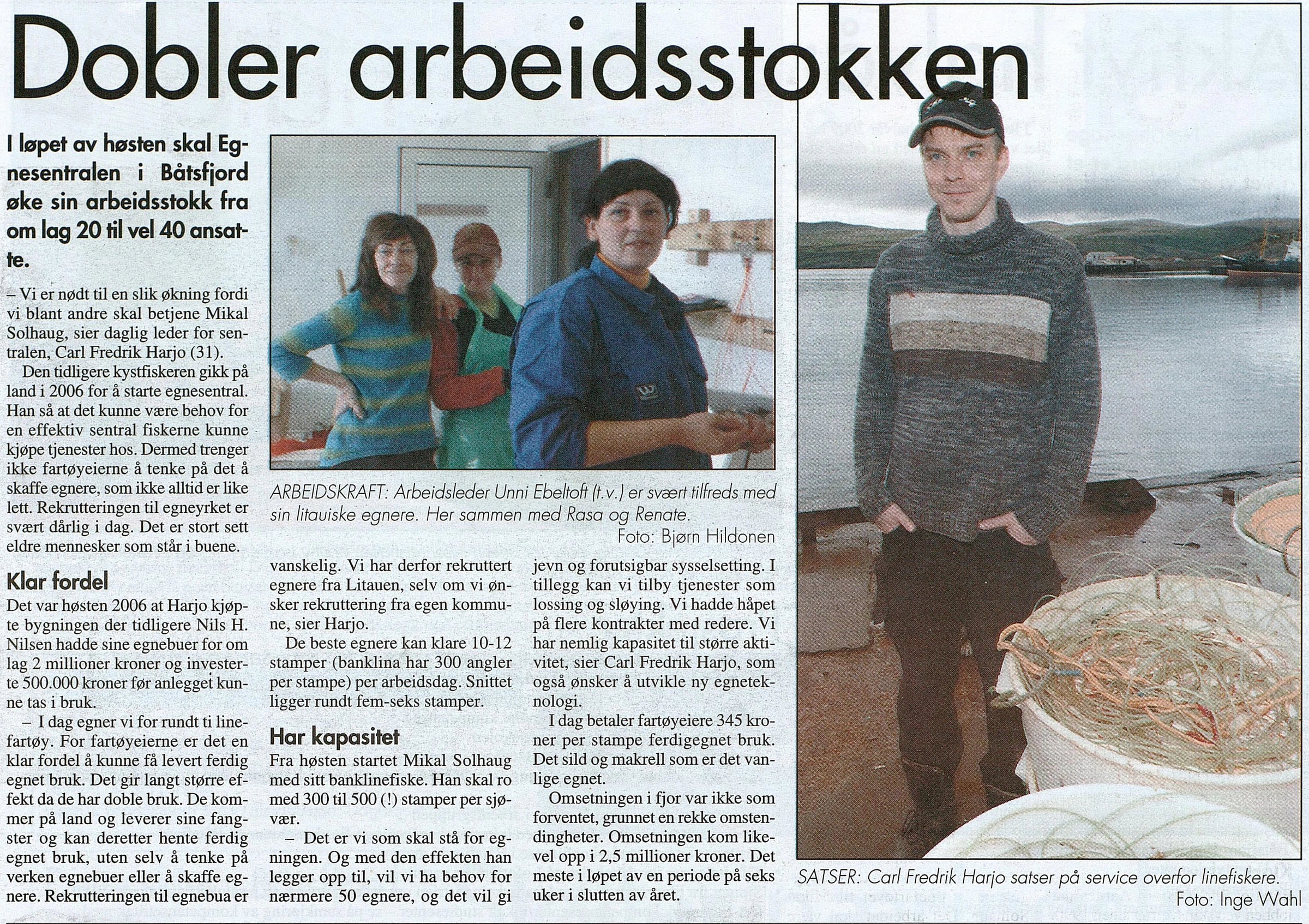
Plans to double the workforce

Carl Fredrik is Margrethe’s son and Karl Fredrik and Gunvor’s grandson.

English summary

Carl Fredrik Harjo, 31, said Egnesentralen planned to grow from about 20 employees to more than 40 during the autumn, partly to serve the vessel Mikal Solhaug. He explained that boats could collect baited lines, land their catch, and take fresh lines aboard without maintaining their own baiting sheds. The article recalls his purchase of the former Nils H. Nilsen baiting facilities in 2006. It also describes the difficulty of recruiting workers and his hopes of expanding services and improving the baiting technology.

English translation

Doubling the workforce

During the autumn, Egnesentralen in Båtsfjord plans to increase its workforce from about twenty to more than forty employees.

“We need that increase partly because we will be serving Mikal Solhaug,” says the centre’s managing director, Carl Fredrik Harjo, 31.

The former coastal fisherman came ashore in 2006 to start a baiting centre. He saw that there might be a need for an efficient centre from which fishermen could buy services. Vessel owners would then no longer have to worry about finding baiters, which is not always easy. Recruitment to the trade is very poor today. It is mostly older people working in the sheds.

A clear advantage

In autumn 2006, Harjo bought the building where Nils H. Nilsen previously had its baiting sheds, for about two million kroner, and invested another 500,000 kroner before the facility could be put into use.

“Today we bait for about ten longline vessels. Being able to receive ready-baited gear is a clear advantage for the vessel owners. It makes them much more efficient because they have two sets of gear. They come ashore and deliver their catches, then collect baited gear without having to think about maintaining baiting sheds or finding baiters. Recruiting people for the sheds is difficult. We have therefore recruited baiters from Lithuania, although we would like to recruit from our own municipality,” Harjo says.

The best baiters can manage ten to twelve tubs—bottom longline gear has three hundred hooks per tub—in a working day. The average is about five or six tubs.

Capacity available

Mikal Solhaug is starting bottom longlining in the autumn. The vessel will fish with three hundred to five hundred (!) tubs per trip.

“We will do the baiting. At the level of activity he is planning, we will need close to fifty baiters, which will provide steady, predictable employment. We can also offer services such as unloading and gutting. We had hoped for more contracts with vessel owners, because we have capacity for more activity,” says Carl Fredrik Harjo, who also wants to develop new baiting technology.

Today vessel owners pay 345 kroner per tub of ready-baited gear. Herring and mackerel are the usual bait.

Last year’s turnover was below expectations for a number of reasons. Nevertheless, it reached 2.5 million kroner, most of it during a six-week period at the end of the year.

Photograph caption: WORKFORCE: Supervisor Unni Ebeltoft, left, is very pleased with her Lithuanian baiters. Here she is with Rasa and Renate. Photo: Bjørn Hildonen.

Photograph caption: INVESTING: Carl Fredrik Harjo is investing in services for longline fishermen. Photo: Inge Wahl.

FiskeribladetFiskaren · November 30, 2009 · p. 4, 5

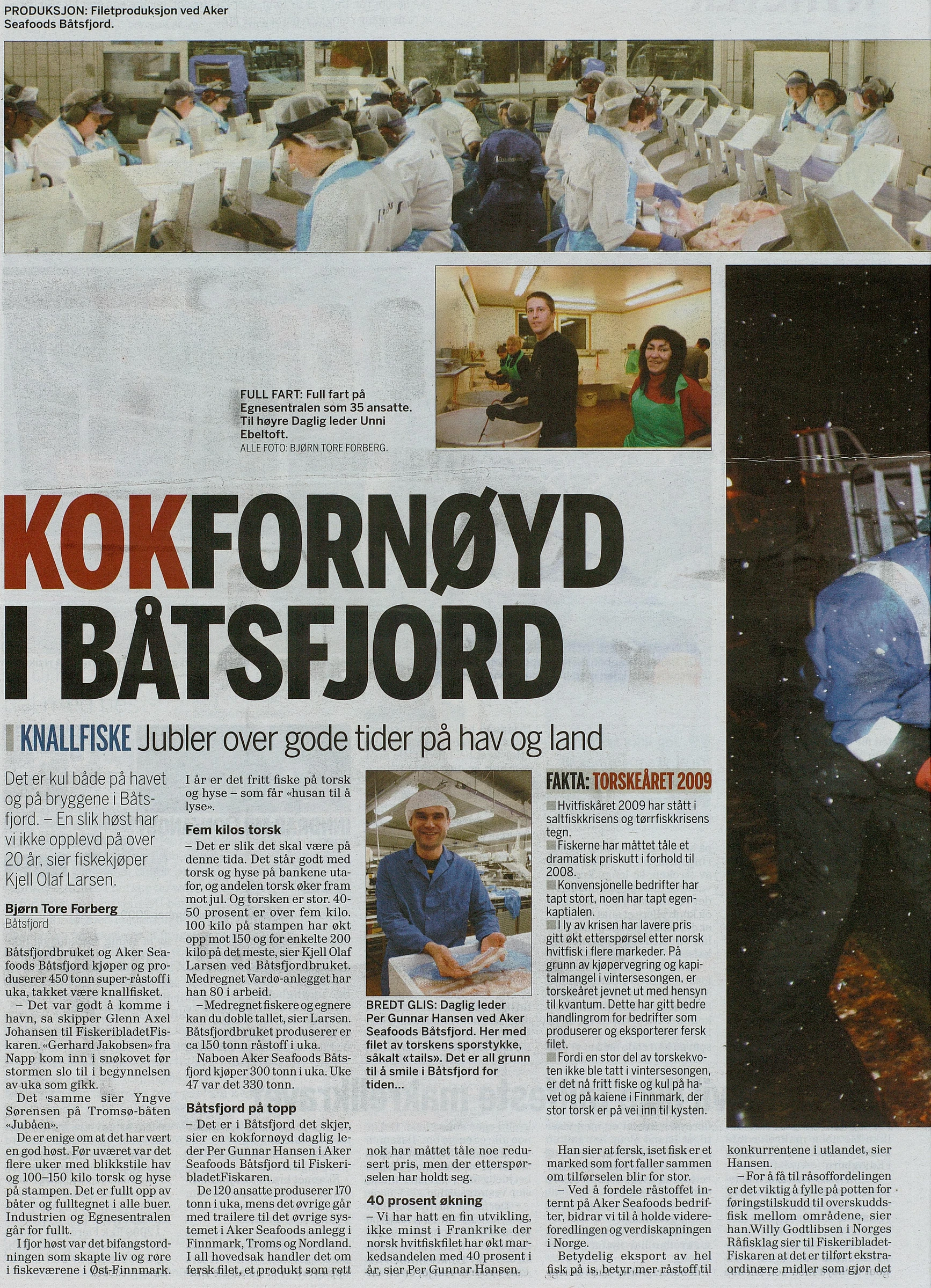
A busy autumn on Båtsfjord’s waterfront

Carl Fredrik is Margrethe’s son and Karl Fredrik and Gunvor’s grandson.

English summary

This two-page waterfront feature describes an unusually busy autumn for Båtsfjord’s fishermen, fish processors, and baiting centre. Carl-Fredrik Harjo said all 35 baiting stations were staffed and that Egnesentralen had additional capacity. Work for Mikal Solhaug alone occupied 15–20 baiters. Despite lower fish prices than the previous year, he described renewed optimism as visiting longliners brought work to the harbour. The feature includes photographs of the baiting operation, fish processing, and crews working aboard their boats.

English translation

Delighted in Båtsfjord

EXCELLENT FISHING: Celebrating good times at sea and on land

Things are booming both at sea and on Båtsfjord’s quays. “We have not experienced an autumn like this for more than twenty years,” says fish buyer Kjell Olaf Larsen.

By Bjørn Tore Forberg, Båtsfjord

Båtsfjordbruket and Aker Seafoods Båtsfjord are buying and processing 450 tonnes of top-quality fish a week, thanks to the excellent fishing.

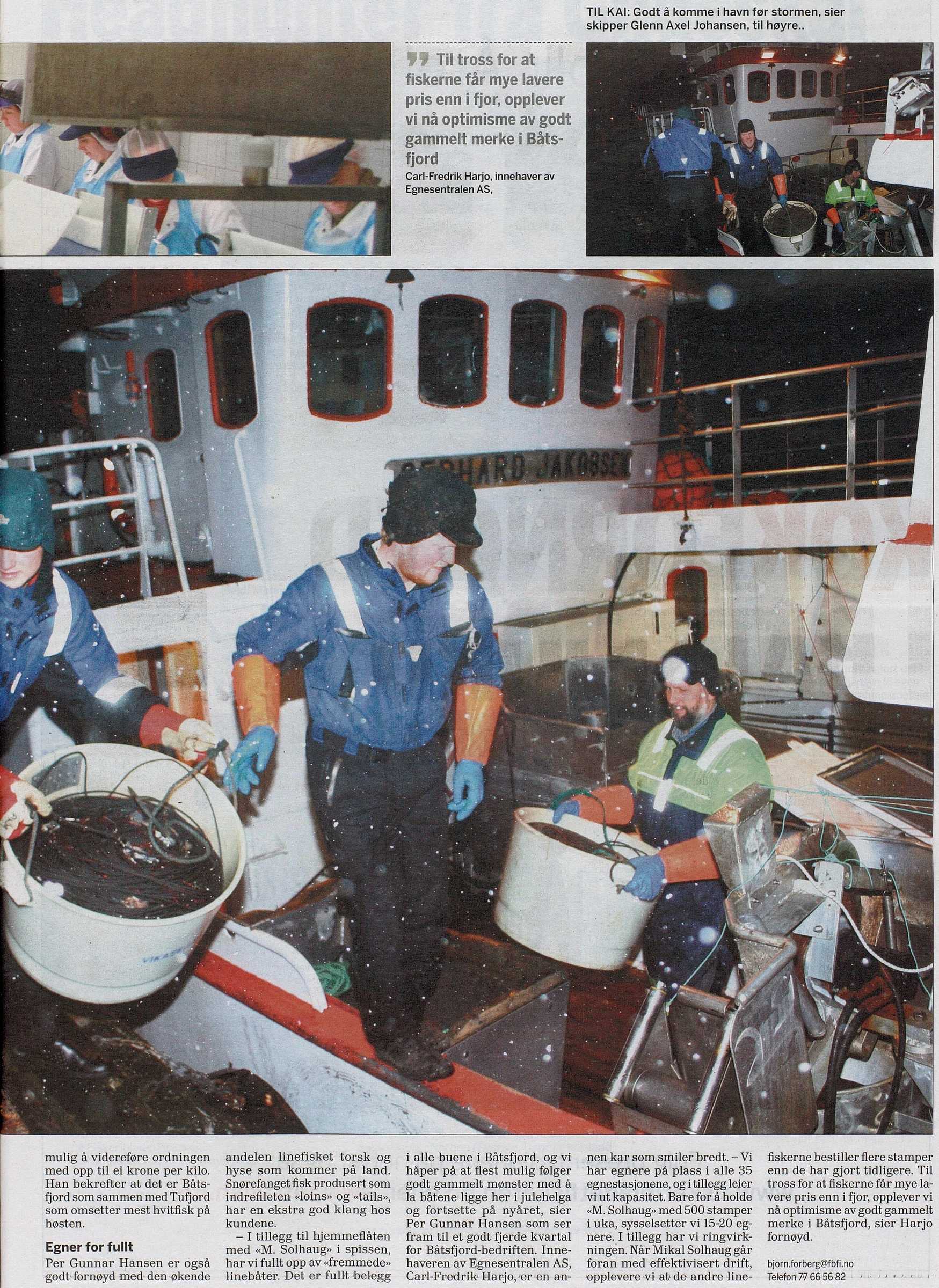
“It was good to get into port,” skipper Glenn Axel Johansen told FiskeribladetFiskaren. Gernhard Jakobsen, from Napp, came in through the driving snow before the storm struck early in the past week.

Yngve Sørensen aboard the Tromsø vessel Jubåen says the same.

They agree that it has been a good autumn. Before the bad weather there were several weeks of glass-calm seas, yielding one hundred to 150 kilos of cod and haddock per tub of line. There are plenty of boats and full baiting crews in every shed. The processing industry and Egnesentralen are operating at full capacity.

Last autumn it was the Danish-seine fleet that brought life and activity to the fishing communities of eastern Finnmark. This year it is unrestricted cod and haddock fishing that is “lighting up the houses.”

Five-kilo cod

“This is how it should be at this time of year. There is plenty of cod and haddock on the banks offshore, and the proportion of cod is increasing toward Christmas. And the cod are big. Forty to fifty percent weigh more than five kilos. One hundred kilos per tub has risen toward 150, and for some as much as two hundred kilos,” says Kjell Olaf Larsen at Båtsfjordbruket. Including the Vardø plant, he has eighty people at work.

“If you include fishermen and baiters, you can double that number,” Larsen says. Båtsfjordbruket processes about 150 tonnes of fish a week.

Its neighbor, Aker Seafoods Båtsfjord, buys three hundred tonnes a week. In week 47, it was 330 tonnes.

Båtsfjord on top

“Båtsfjord is where it is happening,” a delighted Per Gunnar Hansen, managing director of Aker Seafoods Båtsfjord, tells FiskeribladetFiskaren.

The 120 employees process 170 tonnes a week, while the remainder goes by truck to the rest of Aker Seafoods’ network of plants in Finnmark, Troms and Nordland. It is mainly fresh fillet, a product that has had to accept somewhat lower prices, although demand has held up.

Forty percent increase

“We have had good growth, not least in France, where Norwegian whitefish fillet has increased its market share by forty percent this year,” says Per Gunnar Hansen.

He says the market for fresh fish on ice can collapse if the supply becomes too great.

“By distributing the fish internally among Aker Seafoods companies, we help retain further processing and value creation in Norway.

“Substantial exports of whole fish on ice mean raw material for our competitors abroad,” Hansen says.

To gain the benefits of a year-round operation, it is important to replenish the fund for subsidies to transport surplus fish between regions, he says. Willy Godtlibsen of Norges Råfisklag tells FiskeribladetFiskaren that additional extraordinary funding has been provided, allowing the scheme to continue at up to one krone per kilo. He confirms that Båtsfjord, together with Nufjord, has handled the most whitefish this autumn.

Baiting at full capacity

Per Gunnar Hansen is also very pleased with the growing proportion of longline-caught cod and haddock coming ashore. Line-caught fish processed into the prized fillet cuts known as “loins” and “tails” has an especially good reputation among customers.

“In addition to the local fleet, led by M. Solhaug, we have plenty of visiting longliners. Every shed in Båtsfjord is fully occupied, and we hope that as many as possible will follow the good old pattern of leaving their boats here over Christmas and continuing with the winter fishery,” says Per Gunnar Hansen, who is looking forward to a good fourth quarter for the Båtsfjord company.

Carl-Fredrik Harjo, owner of Egnesentralen AS, is another man with a broad smile. “We have baiters at all thirty-five baiting stations, and we are also renting additional capacity. Just keeping M. Solhaug supplied with five hundred tubs a week employs fifteen to twenty baiters. There are knock-on effects too. When Mikal Solhaug leads the way with efficient operations, we find that the other longline fishermen order more tubs than they used to. Although fishermen are getting much lower prices than last year, we are now seeing good old-fashioned optimism in Båtsfjord,” Harjo says happily.

Pull quote: “Although fishermen are getting much lower prices than last year, we are now seeing good old-fashioned optimism in Båtsfjord.” — Carl-Fredrik Harjo, owner of Egnesentralen AS

FACTS: The cod year, 2009

• The whitefish year of 2009 has been marked by the crises in salted fish and stockfish.
• Fishermen have had to endure a dramatic price cut compared with 2008.
• Traditional fish-processing businesses have suffered major losses; some have lost their equity.
• Amid the crisis, lower prices have increased demand for Norwegian whitefish in several markets. Because of buyers refusing fish and a lack of capital during the winter season, cod landings have become more evenly distributed through the year. This has given greater room to maneuver to businesses producing and exporting fresh fillet.
• Because part of the cod quota was not caught in the winter season, unrestricted fishing is now bringing intense activity at sea and on Finnmark’s quays, with large cod moving in toward the coast.

Photograph caption: PRODUCTION: Fillet production at Aker Seafoods Båtsfjord.

Photograph caption: FULL SPEED: Egnesentralen, with thirty-five employees, is working at full speed. On the right is manager Unni Ebeltoft.

Photograph caption: A BROAD GRIN: Managing director Per Gunnar Hansen at Aker Seafoods Båtsfjord, holding a fillet from the cod’s tail section, known as a “tail.” There is every reason to smile in Båtsfjord these days.

Photograph caption: AT THE QUAY: “Good to get into port before the storm,” says skipper Glenn Axel Johansen, on the right.

All photographs: Bjørn Tore Forberg.
Printed contact: bjorn.forberg@fbfi.no · Telephone 77 66 56 82

A busy autumn on Båtsfjord’s waterfront · 1/2Enlarge clipping ⤢

Clipping 1 / 2
A busy autumn on Båtsfjord’s waterfront · 2/2Enlarge clipping ⤢

Clipping 2 / 2

FiskeribladetFiskaren · December 3, 2010 · p. 5

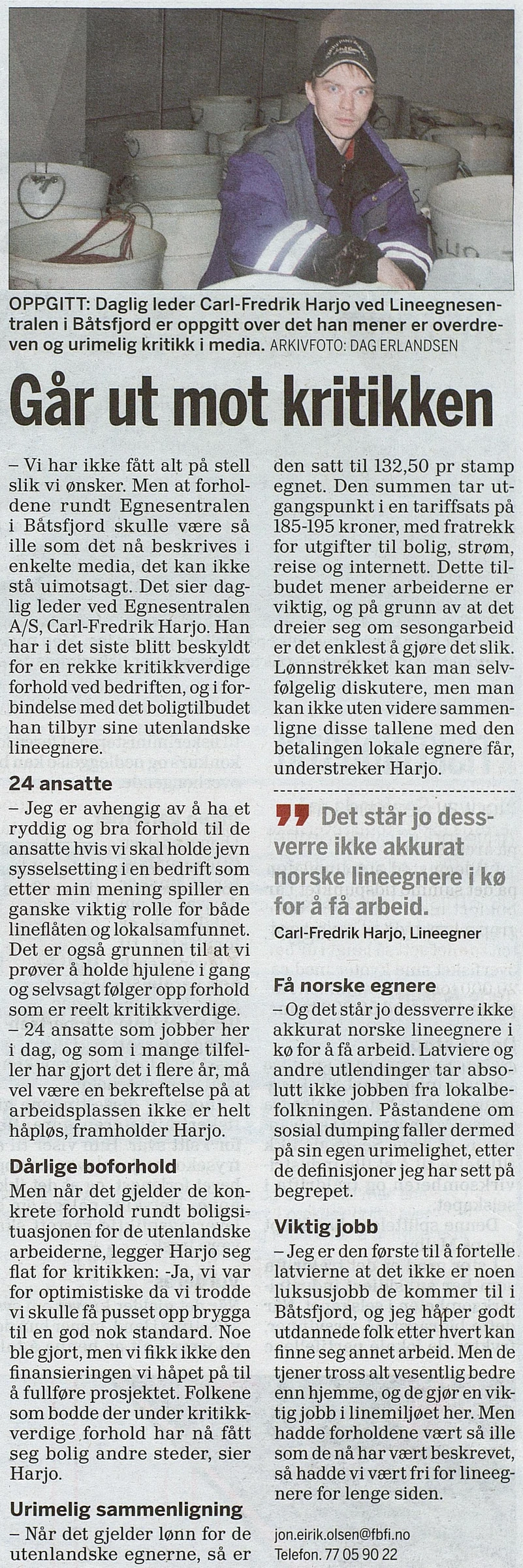
Carl responds to criticism of the baiting centre

Carl Fredrik is Margrethe’s son and Karl Fredrik and Gunvor’s grandson.

English summary

Carl-Fredrik Harjo responded to newspaper criticism of conditions at the baiting centre and the accommodation offered to overseas workers. He acknowledged that the housing renovation had not reached the intended standard and said the workers affected had been rehoused elsewhere. He described a business employing 24 people and argued that comparisons of pay needed to take account of accommodation, electricity, travel, and other arrangements. The article presents his response to that criticism.

English translation

Speaking out against the criticism

“We have not got everything in order the way we want. But the claim that conditions at Egnesentralen in Båtsfjord are as bad as some media are now describing cannot go unanswered.” So says Carl-Fredrik Harjo, managing director of Egnesentralen A/S. He has recently been accused of a number of unacceptable conditions at the company and in the accommodation he offers his foreign line baiters.

Twenty-four employees

“I depend on having a proper, good relationship with the employees if we are to maintain steady employment in a business that, in my view, plays quite an important role for both the longline fleet and the local community. That is also why we try to keep things running and, of course, address conditions that genuinely deserve criticism.

“The twenty-four employees working here today, many of whom have done so for several years, must be some confirmation that this is not an entirely hopeless place to work,” Harjo maintains.

Poor accommodation

But on the specific issue of housing for the foreign workers, Harjo accepts the criticism without reservation: “Yes, we were too optimistic when we thought we could renovate the wharf building to a sufficiently good standard. Some work was done, but we did not get the financing we had hoped for to complete the project. The people who were living there in unacceptable conditions have now been provided with accommodation elsewhere,” Harjo says.

An unreasonable comparison

“As for the foreign baiters’ pay, it is set at 132.50 kroner per tub baited. That amount is based on a collectively agreed rate of 185–195 kroner, with deductions for housing, electricity, travel and internet expenses. This package is important to the workers, and because it is seasonal work, this is the simplest way of doing it. Of course, the deductions can be discussed, but one cannot simply compare these figures with what local baiters are paid,” Harjo emphasizes.

Pull quote: “Unfortunately, Norwegian line baiters are hardly lining up to get work.” — Carl-Fredrik Harjo, line baiter

Few Norwegian baiters

“Unfortunately, Norwegian line baiters are hardly lining up to get work. Latvians and other foreign workers are certainly not taking jobs away from the local population. The allegations of social dumping therefore do not stand up, based on the definitions of the term I have seen.”

An important job

“I am the first to tell the Latvians that they are not coming to Båtsfjord for a luxury job, and I hope that well-educated people will eventually find other work. But they do, after all, earn considerably more than at home, and they do an important job in the longline industry here. If conditions had been as bad as they have now been described, we would have been without line baiters long ago.”

Photograph caption: EXASPERATED: Managing director Carl-Fredrik Harjo at the line-baiting centre in Båtsfjord is exasperated by what he considers exaggerated and unreasonable criticism in the media. Archive photo: Dag Erlandsen.

Printed contact: jon.eirik.olsen@fbfi.no · Telephone 77 05 90 22

Finnmarken · April 28, 2011 · p. 23

Anne-Lise shares a photograph and memories of her father’s family

English summary

Anne-Lise Harjo shares a family photograph she dates to 1904–05, probably taken in Vadsø before the move to Masjok. It shows her grandparents Ludvig and Anna with some of their children; her father Fredrik had not yet been born. She recalls the family’s losses to tuberculosis, Ludvig’s death in 1908, and Anna’s later marriage to Petter Barski of Østre Seida, with whom she had a daughter. Signe and Kristian were the longest-lived of the children pictured. Anna is remembered for her kindness and warmth.

English translation

Photo memory

Do you have an interesting photograph from our recent or distant history that you would like to share with Finnmarken’s readers? Send it to Finnmarken, P.O. Box 616, 9811 Vadsø. Write down everything you know about where and when the picture was taken and who is in it. Remember to include a return address.

A family sorely tried

This photograph is actually more than a hundred years old. Its contributor, Anne-Lise Harjo, who now lives in Vadsø, tells us that it was taken as early as 1904–05.

She also tells us that it shows members of her own father’s family. Her father, Fredrik, who lived in Masjok, had not been born when the photograph was taken. Among those pictured is his brother Kristian, seated at the front. On the left sits her grandfather Ludvig Harjo, with her grandmother Anna Katrine. At the back, on the left, we see Isak Harjo and Andreas Harjo, while the girl on the right is Signe Margrethe Harjo. She married a man from Salangen in Troms and eventually had four children.

But life was not as easy for the others. Andreas and Isak both died of tuberculosis. They were only twenty-seven and twenty-eight years old.

The eldest brother, Bernhardt, who is not in the photograph, also died young, at only twenty-one, of the same disease. Andreas was married and left a wife and a daughter. Bernhardt and Isak were unmarried and died without children.

Anne-Lise Harjo believes the photograph must have been taken in Vadsø. She bases this on the fact that the family lived in Vadsø before moving to Masjok in Tana.

We have mentioned that many of the children in the family died very young. So did their father Ludvik, who died as early as 1908. At that time, the youngest son was only two years old. His wife eventually remarried, to Petter Barski from Østre Seida. They had a daughter together.

Of the people in the photograph, Signe and Kristian lived the longest. Anne-Lise’s father also died young, at only forty-seven, while his wife Anna was sixty-two when she died. She is remembered as an incredibly kind, warm and good woman.

Translation note: The newspaper’s photograph identifications and ages are retained as printed. Its final paragraph mixes generations: Anna Katrine was Ludvig’s wife; Fredrik’s wife was Gunvor. The family’s updated identifications remain in the biographies.

Fiskeribladet · April 15, 2025 · p. 14

Carl looks ahead in the king-crab trade

Carl Fredrik is Margrethe’s son and Karl Fredrik and Gunvor’s grandson.

English summary

Carl Fredrik Harjo, managing director and owner of Arktis Fisch in Båtsfjord, discussed lower turnover in 2024 and the outlook for the company. He attributed the decline chiefly to limited raw-material supply and identified uncertainty over American tariffs as a concern for king-crab exports. The article also describes maintenance work, plans for live-fish sales to Europe, and the development of transport tanks for live fish and crab. A portrait identifies Carl beside the feature’s large photograph of a king crab. The interview was conducted before the American 15-percent tariff announcement mentioned in the newspaper’s introductory note.

English translation

Lower turnover for crab buyer

“The greatest uncertainty is tariffs on exports to the USA,” says Arktis Fisch’s managing director and owner, Carl Fredrik Harjo, discussing the financial outlook.

ECONOMY
Siri Nilsen Ahmer, Bergen

Fiskeribladet notes that this interview with Harjo took place before the American tariff rate of fifteen percent became known.

From 2023 to 2024, crab buyer Arktis Fisch’s operating result fell from about 2.9 million kroner to a loss of 76,000 kroner.

Last year, the Båtsfjord company had turnover of about 36.6 million kroner, down from 47.78 million the year before. According to managing director Carl Fredrik Harjo, the change was mainly due to a shortage of raw material.

“Although the king-crab quotas were lower, we did not cut back. We still have development projects that will be completed this year. But things are not looking too bad,” Harjo tells Fiskeribladet.

Things are quiet at Arktis Fisch at present.

They are carrying out maintenance work that has halted production.

But in May, when the closed season for king crab is over, they will be operating again.

They will receive shellfish and live fish.

Dark clouds on the horizon

Harjo believes 2025 has the potential to be better for them. The total male king-crab quota for 2024 was 966 tonnes, but this year it has increased to 1,510 tonnes.

“I think 2025 will be as good as 2023, partly because of the increased quotas. But of course there are some dark clouds on the horizon,” Harjo says.

Asked what those dark clouds are, Harjo answers: “Tariffs.”

“That particularly concerns the USA, where customers do not know whether they will have to pay twenty-five percent more on imports.”

Harjo explains that he previously regarded the USA as a safe and more developed market, but that this has changed.

“Trading with the USA has become unpredictable,” Harjo says.

King crab from Arktis Fisch mainly goes to the USA and the EU.

The USA is by far the largest export market for king crab, both live and frozen, according to Synne Guldbrandsen, head of marketing at Norges Råfisklag.

“There has been particularly strong growth in the export price of frozen king crab so far this year. As the Norwegian Seafood Council says, this is because ‘Norway is the only supplier of king crab to the USA, since Alaska has already sold its entire catch and Russia remains under sanctions,’” Guldbrandsen writes in an email to Fiskeribladet.

Shellfish and fish

Almost everything Arktis Fisch sells is exported.

The development projects Harjo is working on involve selling live fish to European markets. For now they handle cod, haddock and wolffish.

“In 2024 we invested in various equipment for the live-fish side of the business, so a lot of money went into that. We are still working on the development side, but it will hopefully generate substantial income.”

So far this year, the average price for Grade A male crab weighing more than 3.2 kilos in the quota-regulated area is 627 kroner per kilo, according to Guldbrandsen at Råfisklaget.

In February, Arctis Fisch paid 620 kroner per kilo for king crab. Harjo does not venture to predict what king-crab prices will be in the future.

“How do you view the prospects ahead?”

“We are a small receiving facility; we do not gain much from large quotas. We are not going to be the buyer taking hundreds of tonnes. We are focusing on being closer to the market and our customers,” Harjo replies.

In 2024 the company employed the equivalent of six full-time workers.

Selling transport tanks

For the past nine years they have also worked on developing transport tanks for live fish and crab to be carried by road.

What is new this year is that they will have the tanks manufactured and sell them to others.

According to Harjo, the tanks are easy to work with, light in weight and sturdy, and will keep fish and crab alive for four days.

“We are our own pilot customer. We have used them for many years and know they work. With these tanks, we can deliver live, wild-caught fish directly to restaurants,” Harjo says.

Pull quote: “I think 2025 will be as good as 2023.” — Carl Fredrik Harjo

FACTS: King-crab regulations

• A total quota of 1,510 tonnes has been set for male crabs.
• A total quota of sixty tonnes has been set for female crabs.
• Fifteen percent of the total male-crab quota is reserved for damaged crab.
• The closed season continues from March 1 to April 30.
• The permitted two-percent bycatch for fishing with bottom-set nets or bottom longlines continues in 2025.
• The turnover requirement of 200,000 kroner for a full king-crab quota continues in 2025.

Photograph caption: Arktis Fisch will begin receiving king crab again in May. Photo: Siri Nilsen Ahmer.

Portrait caption: Carl Fredrik Harjo, managing director and owner of Arktis Fisch in Båtsfjord, established in 2006. Photo: Private/archive.

Printed contact: siri.nilsen.ahmer@fiskeribladet.no · Telephone 926 66 097